September 6, 2010

NIMBY – hear the middle-class roar

They came with their hairy dogs, determined looks on their faces and helmeted children scootering ahead of the adults holding picket signs. The people of the Beach and Birchcliffe had come to protect the Quarry.

A former dump, at one point, the Quarry is roughly 50 undeveloped acres southeast of the Main subway station. Environmentalists sing the praises of the wildlife. However, the area was zoned in the 1960s for highrise development, and the developers are exercising their legal rights. So, the community was out to defend it.

I happened on the protest by chance, with a friend. We had to stop. The banners said “Save our neighbourhood” and “1960s planning is bad planning.”

The proposed 7 twenty-story buildings would provide 1,455 units of housing, at a density 7 times what the surrounding area is now with its detached, single-family homes.

“Affordable housing!” I whooped. No one took up the call.

It’s hard to know what to think about these kind of events.

People were rising to the defense of the community, but against whom? The developer. Yes, probably. The newcomers (interlopers) – new renters or condo buyers.  Perhaps some of them.

It was easy to see what we were against, but what were we fighting for? About every person here probably has a different reason, my wiser friend explained.

It reminded me of other protests I’ve seen. The outrage against the possible arrival of big box store in South Riverdale pitched local residents against each other, often split along ethnic and income lines. The Salvation Army and Seaton House faced fierce community meetings when they moved to house homeless men in other neighbourhoods, even if only temporarily such as on Pape Avenue. (The Sally Ann, bless its soul, has a webpage on the topic of NIMBY-ism.)

These debates too often deteriorate into a debate about who is moving in, or they erupt, under a more politically correct guise, such as “Social services should not be concentrated here. We have our fair share already.”

Another recent example close to home was the call from near-by residents to have Felstead park’s playground equipment upgraded – something already on the schedule, but not soon enough for their liking. They too used the blind that as a mixed income neighbourhood, they had been ignored to the benefit of richer neighbourhoods near-by. However, as a gentrifying neighbourhood, the press was on.

Or more recently, neighbours to the south of here, feeling protective of their “own,” confronted members of a church congregation for bringing their faith to the streets, unfortunately by a fire hydrant where a gay couple live. This well-meaning crowd ended up as a “Was my face red…” front-page story in the Toronto Star.

Within the past year, another of my neighbours closed down his family restaurant when he heard an apartment building next door to him was being built to provide supportive housing to people with mental health problems. More plain in his prejudices, he refused to stay near “crazy” people.

Examples from other parts of the city include the conversion of the “Entertainment District” to a residential area and almost any neighbourhood where condos have been built close to a slaughterhouse or other industrial area. If the City of Toronto mapped out where building orders occur, they are in concentrated in the areas with higher and mixed-incomes – the gentrified and the gentrifying areas of the city.

What under lies all these is fear. People don’t want to lose what they have. When people (re-)act from a fearful place, any larger vision gets lost.

But the reality that the neighbourhoods with the highest complaints are not the places with the most problems, but rather places with the most privilege. These are the neighbourhoods where the “sharp elbows of the middle class” claim the resources seen to be due to them.

Flawed as the Priority Neighbourhood Areas were, what they did do effectively was to re-focus resources away from the noisiest, squeakiest parts of the city, to areas that hadn’t had any attention for a very long time. This leveling of the playing field probably led to some of the strongest critiques of the mayor, David Miller, that he had let things slide in the areas where, frankly, people are more likely to vote.

Instead, the Strong Neighbourhood strategy has evened some things out. The new Community Partnership Strategy is also building an evidence base so that neighbourhood comparisons can be done more accurately.

These strategies show we are a more generous city than these other NIMBY stories tell about us. When given a chance, we can dream of a common good.

But, until we Torontonians see our backyard as the entire city, inequality will continue to split neighbourhoods, into “good” and “bad’ places to live, into places where we fight each other.

Continue reading

August 25, 2010

Community Partnership Strategy: Community Space

This is a long-delayed follow-up to some earlier posts on the City of Toronto’s Community Partnership Strategy which is currently under development and will measure community resources in neighbourhoods across the city.

Bonnie Green writes in the recent issue of the Agora Foundation’s The Philanthropist about the tale of two non-profit organizations in search of program space in their local communities. The article, Creating Social Space in the New Urban Landscape, captures the challenge many non-profit organizations and neighbourhoods face: a lack of community space.

Good neighbourhoods need more than services; they need the space to deliver these community programs and places where community can gather. Much of the challenge of delivering service in Toronto’s “inner suburbs” has been one of carving program space out of basements and strip malls in order to bring community services to local residents. These community spaces are the places where literacy and health programs are found, where sports leagues and seniors’ groups run, where we can access the services we need or where we organize and work with others, from and for our communities.

Good neighbourhoods also need places where neighbours can meet each other, spaces like front porches, school yards and parks, corner stores, coffee shops, places of worship, recreation centres, school yards, dog runs, and even sidewalks. These are the spaces where we can go, outside of our homes and work, where we can meet each other on neutral territory.

Academics describe both these kinds of community gathering spots as third places, and maintain that they are vital to the social fabric of a neighbourhood.

The website Cooltown Studios describes such places this way:

If you aren’t motivated to leave home or your workplace, chances are you don’t live around too many successful third places.

So, it makes great sense that the City of Toronto’s Community Partnership Strategy (CSP) proposes to use these third places as an indicator of the strength of the community support system within a city neighbourhood, combining it with two other structural components: the presence of community organizations, and funding.

The CSP’s definition of community space will measure “space for residents, informal groups, community-based organizations; meetings, programs, administration; multi-purpose [and] dedicated space.”

Two types of  measurable spaces have been identified: community meeting space, which allows informal and grassroots interactions, and community program space, which is more likely to be booked and permitted for service delivery.

Similar to the work of the Strong Neighbourhoods Taskforce, the measure could also include the percentage of the population with one kilometre of meeting space, such as in libraries, recreation centres, and community-based organizations.

However, the CSP is more than an inventory of local resources. In consultation with community, city staff are exploring the “when is enough, enough” question to answer what benchmarks would work: how much space is needed in a neighbourhood and what functions does it need to fill? How do the needs of various neighbours differ? What’s the baseline requirement for any neighbourhood?

Not enough research — or policy-wrangling — has been done to determine these answers yet, so the early stages of the CSP are more likely to provide an effective way of comparing Toronto neighbourhoods to each other. Now, thanks to the CSP, that conversation will have a good evidence base.

August 15, 2010

It’s always something: Life and death on a city block


The man across the street from me died recently. He is the twelfth death that I can remember on the block during the time I have lived here.

The Dalai Lama once said to remember that whenever you enter a room with others, there is always pain somewhere in the room. This is my remembrance of pain on the street, my own included. It’s perhaps a macabre exercise but one that underscores the thickness of our neighbourhoods.

When I lead Jane’s Walks in the neighbourhood, we fly through the neighbourhood. This tour will pause much more frequently and cover little more than a city block.

The only people I know who have gotten mugged in my neighbourhood both got mugged at the underpass to the railway tracks at the top of the street. And the restaurant at the other end is nicknamed the Kick & Stab.  This is some of what has happened in the spaces between these two places:

  • A corner brick house was built by a man during WWI. The woman who lived in it promised payment when her husband returned. Lost is the reason why, but the builder was never paid. His daughter bullied the new little girl who moved in after that – bullying passed on generationally, and spatially.
  • Further south is the family that raised a crowd of children, one they lost when he was eleven. Four neighbourhood boys had found an open sewer grate and crawled down for an adventure. What they found was a pocket of deadly gas. Only the two quickest boys were able to climb out. The others succumbed. His father bankrupted himself, suing the City for neglect.
  • Walking again south, we come to the house where five-year-old Jeffrey died with his grandparents after his young parents were found incompetent. However, his grandmother, barely better equipped, became overwhelmed. The testimony at the trial which I remember is how one of the neighbourhood mums, a woman I knew by sight from the local school ground, visited one day and found Jeffrey’s grandmother giving him a bath in the basement. The grandmother told our neighbour she didn’t know if she could manage. Within months, the weight of a toddler, 21 pound Jeffrey died of neglect and septic shock. A new, happy family lives behind those walls now, a little girl, who knows of him, in the bedroom where Jeffrey had been locked. It overlooks our backyards.
  • Turning right, here is where Louie ran a store for years, robbed just as frequently. His face was always relieved when he saw you were a customer. He’s gone now, and the owners of the store around the block have bought a big dog. Their faces are perpetually nervous too.
  • Here an old man found in his basement apartment, not having the strength to walk out on his own, relying on his neighbours to fetch groceries. The police found him when there was a fire in the building.
  • Here the brother and sister, grown, the patterns set when they were young. He was suspended, then expelled, from the local grade school. She lured into trading her young sexuality for favours.
  • Here the man who didn’t see his family for fifteen years until he was able to save enough for them to emigrate,  his toddler turned to a teenager.
  • And here the mother who went mad. And recovered. Sort of.
  • Here the man who has depression who won’t tell anyone. His wife miscarried, too.
  • Here the man so alienated from his family that he didn’t attend the funeral of his disabled son.
  • Here the brother who became a drug addict and then committed suicide. His father beat his mother.
  • Here the house that was filled with young people, lost to the world. They burned the house down setting off fire crackers in the waste can. One of them, panicked, rushed to the second floor porch, certain she was trapped, waiting for the fire trucks. Her friends, rushing out to the front sidewalk, chanted, “Jump, jump, jump.” Two households were burned out, neither covered by insurance.
  • Here the man who doesn’t talk to others. He’s in the hospital a lot.
  • Here the elderly mother whose dutiful daughter stayed close until she met a man who took her money. When the mother objected, they found a long-term home for her.
  • Here the woman who moved here with a draft dodger and had a beautiful child. But he lives on the streets now.
  • Here the daughter with special needs so carefully tended because her friendliness makes her vulnerable.
  • Here the daughter who died of cancer in her early 20’s.
  • Here the man who nursed his lover through the final stages of AIDS. Now, a couple who lost a child unborn.
  • Here the man who beat his wife until she left. His grown sons visit sometimes.
  • Here the woman and two children who emigrated here, to follow her husband, then to find they had no status. Her husband beat her too. She left him, and met a woman, a white Canadian who stepped in where her husband left off, we didn’t like her. The mother was almost deported, but neighbours put up the surety, testified on her behalf. The Canadian woman moved her away from this neighbourhood. The last we heard, she was homeless and mad. We don’t know what happened to the children. Now there, a women whose time is occupied with her suicidal sister.
  • Here the husband who was so cheap he wouldn’t let his wife have a visitor over for tea because electricity and tea bags cost money.
  • Here a four-year-old child lived, her Mum her only support, a woman who too became addicted. The neighbours each took turns watching over the child, feeding her, until her grandmother arrived months later and set things straight. I saw her grown and well.
  • Here, two bad landlords.
  • Here the smoker who died of lung cancer, saying, “I feel so stupid. I’m scared.”
  • Here the man who never told his family he is gay. But they never visit.
  • Here the partner who strayed, had a child with another woman, then left.
  • Here another straying man, whose lover left him. His wife wouldn’t take him back. And, then, a woman with a hundred friends who was self-conscious she was alone in life, single.
  • Here a father who swears his son is slow because of an undetected gas leak.
  • Here the couple who, when they moved, left pictures drawn on the wall of the wife having sex with their labrador dog.
  • Here the father who lost his legs and then his life to diabetes. An adult son also died. His wife had bottles delivered regularly to her home until she was put in housing. She’s better now. Then, a tenant who never worked after a construction accident.
  • Here the two half-brothers who lived and aged together for more than 3 decades, the older one passed away first, his brother’s name on his lips, his brother’s arms around him.
  • Here, another alcoholic and a tenant, in the basement, who couldn’t live peaceably with her partner.
  • Here the family that faced with dread that the daughter had inherited the mother’s disease, the men stood stalwart by these wives, only grouching about parking or snow removal.
  • Here the family who bought a home, a dream they could just afford, but it burned down early one morning, grandmother escaping with grandchildren, because the little boy who lived in the basement apartment found some matches. They didn’t have insurance either.
  • Here the mother who shepherded her two sons to school everyday, past her ex-mother-in-law, who would speak to none of them.
  • Here the woman, schizophrenic, who has managed through medication and personal strength and neighbourliness, to raise her child well.

There’s more, there’s always more, but that’s enough. As my neighbour June would sum up such events, “It’s always something on [our street].”

Continue reading

August 10, 2010

Sidewalk exchanges

When the small piano on my front porch begins to tinkle, I know a neighbourhood toddler has ventured up from the sidewalk, tired parent in tow. I keep it there just for that. In the winter, we meet out there when we are shovelling. Or we see each other early in the morning when we are running out with our smelly green bins. Clusters of us appear along the street as we return from our workday, visiting those already on their porch.

This, like any neighbourhood, is a neighbourhood where our sidewalks are important.

Our sidewalks also serve a trading function. Old bookshelves, dishes and lamps are regularly laid out well before garbage day in the neighbourhood for perusal and collection by others.  I recently met a new neighbour and realized I had her discarded lamp in my living room. (In my first house, most of the furniture “free-cycled.” My partner and I even learned the garbage collection schedule of several of the upscale areas around us—sadly, something I would be less likely to do now with the urban spread of bed bugs.)

These outdoor activities have grown out of the density of our neighbourhood where we live cheek by porch, exchanges which occur by design, by happenstance, by tradition and by local culture. They have made our neighbourhood a better place to be.

Flag of Portland, Oregon. Designed by Douglas ...

Flag of Portland, Oregon. Image via Wikipedia

Word now from Portland, Oregon, where a few neighbourhoods have formalized the opportunities for these daily communal interactions, including setting up a local outdoor tea cart and building neighbourhood “sharing posts.” Mike Lanza at Playborhood.com posted  on the this development after he took a trip to the west coast.  When Communities take over their own streets includes pictures of these great communal creations. Read it to enjoy!

Using the same creative approach, Neighbourhoods blogger Kevin Harris was one of the initiators of  a new, fun Facebook group called 50 ways to meet your neighbours (“Give a nod on the bud, Gus”). The group sprang out of a meeting Harris attended and some recent research he described that showed that Brits are shy about meeting one another.

Sounds familiar. Sidewalks are a low-risk way for us all to get to enjoy a little musical (or other form of) interchange.

July 31, 2010

Cradle and all: Comprehensive supports for lone parent families and other poor people

Investing in Families seems like basic common sense, but it took academics like Gina Browne and her colleagues at McMaster University to build a solid case for supporting lone parents on social assistance.

When The Bough Breaks, their longitudinal 2001 study of single parents, showed that families move off social assistance more quickly when they are guided through the service maze than if they are left on their own.

Seven hundred and sixty-five families in the Hamilton and Halton region were randomly assigned to a different levels of support services:

  1. Home visits with a public health nurse to do health promotion,
  2. Employment (re-)training,
  3. Recreational & skills development programs for children, with parental involvement, or child care as appropriate
  4. Comprehensive services (all the above three), or
  5. No additional supports.

Families who had never accessed these services were now connected.

The families which did the best were the ones who received the whole suite of services (#4). The families who did the next best were the ones where the children had received the additional supports and programs (#3).

The ones who did the worse, the control group which mimics the current social assistance system, were the ones who were left on their own to negotiate their own move to independence (#5). It’s a learning which underscores recommendation is the current call for a review of social assistance in the province.

Ontario Works should be turned upside down. Today it is a program that provides financial assistance with some employment supports. The new program should be primarily focused on human capacity development, with financial assistance as just one of the tools available to assist low income Ontarians. – The Social Assistance Review Advisory Council (SARAC)

The City of Toronto took notice of these learnings, too. Its program, Investing in Families, was piloted in 2007 in the Jane Finch area has now been expanded to each of the city’s remaining Priority Neighbourhood Areas. Led by Toronto Employment and Social Services, the program brings together the services and resources from three other City divisions; Public Health, Children’s Services and Parks, Forestry and Recreation have each made commitments.

While burdensome for service-providers, working across silos, the model works for at least two good reasons.

First off, Browne noticed that their children were receiving direct program supports, parents were less likely to drop out of the study and more likely, in the end, to do better. Simply, parents with were motivated by active support for their children’s well-being.

Second is a lesson about the weight of poverty. In his book, The Persistence of Poverty, author Charles Karelis describes the “rational” reaction of a person stung by a bee. Salve would be found and applied. The metaphor describes how the middle class work to solve a problem when they meet one.

However, Karelis explained, poverty is more like being stung by a swarm of bees. Coming at you from all sides, this same “rational” person, with the same salve, would not even bother to make the attempt. Faced with more hurt than salve, the reasonable choice is to choose not to act. Why spend the energy on something that won’t stop the hurt? (Cf. The buzz about bee stings and the poor – thestar.com). The only solution is to ensure that all the bee stings are medicated.

So the anti-poverty programs that have been the most effective are the ones that wrap-around a vulnerable person, that give them a chance to catch their breath, and to take steps out of poverty.

And, win-win, Browne et. al. showed this saves the system money, too.

Continue reading

Tags: ,
July 14, 2010

Racialized poverty & academic performance: A tentative exploration of the latent effects of social capital on educational achievement

The power of a strong research report is the way it changes our civil discourse. In Toronto, Poverty by Postal Code, the Strong Neighbourhoods Taskforce Report, MISWAA, and University of Toronto/St. Christopher House research reports on neighbourhood change have all played a robust part in recent public policy discussions. Such reports re-frame the way we think about our city and each other.

So, when the TDSB’s Inner City Advisory Committee (ICAC) asked the board’s research staff to do a comparative analysis tracking students’ academic achievement patterns against the Neighbourhood Change CURA’s “Three Cities” report, it seemed like a good idea. The Three Cities report had splashed over the front pages of our daily newspapers and underscored the growing inequality and geographic separations within our city. ICAC expected the results would provide further insight into schools in low-income neighbourhoods.

On first analysis, however, the results were disappointing.

Several measures of educational achievement were tested, including:

  • EQAO Grade 3 Math scores
  • EQAO Grade 6 Math scores
  • Grade 9 science results
  • Grade 9-10 Academic program
  • Ontario Secondary School Literacy Test (OSSLT)
  • Access to Ontario post-secondary institute

Yet, the correlation between the “Three Cities” and students’ academic performance was weak — likely for two reasons: first, the Neighbourhood Change/Three Cities analysis used average incomes in its comparisons of neighbourhoods, a known, weaker predictor of academic performance; and, secondly, almost half of the TDSB’s highest-need schools are actually located outside the areas identified as the “third city” or lowest-income areas.

Nevertheless, the school board’s researcher charged with the task, Dr. Rob Brown, persevered in his analysis.

The “three cities,” described by Dr. Hulchanski et. al., break down into further categories. For instance, high income areas are comprised of Elite neighbourhoods which were rich and have remained rich and Gentrifying neighbourhoods which have become high-income in recent decades.

Poor areas of the city break out into four main areas:

  • Youngest suburbs (Lower density, homeowners, larger families, white-collar jobs, high visible minority population, higher Chinese population)
  • Older suburbs (Lower density, more seniors, lower education levels, higher White population)
  • Renters (Immigrant reception areas, highest density, apartment towers, high levels of education, low incomes, more South Asian)
  • Lowest incomes (Highrise rental and social housing, low incomes, lower education, manual labour jobs, higher Black population, more single parents)

So, when Brown looked to see whether academic achievement tracked with these categories, the patterns were more interesting. What he found gives new insight into some of the debates at the school board around race and poverty.

Predictably, the highest performing students were almost consistently the students who lived in the Elite neighbourhoods. However, in two instances they were beaten, in Grade 3 Math and Grade 9 Science — both times by students, in the “third city,” from the Youngest Suburbs. In fact, in all but two of the measures, students in the Youngest Suburbs also out-performed the Gentrifying group of students in “city one”: Taking academic program in Grade 9-10, and the OSSLT.

University admissions tracked a similar path. 53% of Elite students confirmed attendance at an Ontario university, followed by 49% of students in the Youngest Suburbs. These two groups were also the most likely to have applied to post-secondary education. Students in every other neighbourhood type lagged behind in the 33% – 36% range, except for high school students in the Lowest-income neighbourhoods, where only 25% confirmed university attendance (and where 57% did not apply to any level of higher education).

In comparison, students from the other parts of the “third city,” Older Suburbs and Renters, were often within a few percentage points of each other and approaching, or occasionally surpassing, the performance of middle-income students in “city two.” The lowest academic performers were the Lowest Income, except in the case of Grade 3 math, where they beat the Gentrifying neighbourhoods.

So, the analysis shows that while income, or the lack there-of, can be an important predictor of students’ academic performance, it is not a determinant. While Brown himself doesn’t speculate, the interesting part of this work is to imagine what protective factors might be helping some low-income students to compete.

A perfunctory analysis might note that the distinguishing factors between the different “cities” are the racial and ethnic compositions of them. Buttressing the weight of this is the first release of the TDSB’s Student Census which made headlines when it was published because of the analysis which how students of various ethno-cultural backgrounds were performing in school. But that initial report stopped there at these correlations, ipso facto, not looking to control other factors, such as poverty, lone parent status, low education levels and other risk factors found in each of these neighbourhoods.

I would argue a deeper, more nuanced picture emerges from Brown’s ICAC study, one which outlines the structuralist nature of educational achievement. Because the neighbourhood categories were more homogenous, it was possible to examine some of the complex interplays of income and race and, more importantly, the social capital students were able to access.

Within the context of the City of Toronto, these factors play out along a racial dimension, in other places, they may play out along other lines of identity, of accent or class or another form of “othering.” We need to think though the root cause of the barriers. For instance, racism, rather than race, per se, may be a barrier, but so is limited access to social and economic capital or access to strong, supportive social networks. Race, ethnicity and culture are the shorthand for a much more complex picture, which encapsulates access to resources and opportunities, individual and systemic racism, community expectations and a wide range of other social determinants.

So, for instance, students in the Youngest Suburbs were part of a cultural heritage that holds scholarship in esteem, where white-collar jobs were more common, and where family structures were wider. In contrast, students in the Lowest Income neighbourhoods were more likely to live in low-quality (rental, crowded) housing, with poorer job prospects, fewer family supports, and fewer role models who had attended higher education. Students in the Youngest Suburbs and the Renters have also more likely been exposed to a second language, which can improve learning.

These apparent racial divisions are the evidence of deeper divides within the city. They represent the unequal division and distribution of resources among us. These racial divides allow the easy concentration of resources within family, kinship, and friendship networks, encasing the economic and social capital that families and neighbourhoods bring to bear on its own young. The result is that those with the fewest resources are least likely to apply to university, whereas those who still have a strong sense of aspiration, positive supports, and role models are more likely to have better outcomes.

This peer effect is underscored by the work of David Harding at the University of Michigan. He found that “disadvantaged neighborhoods exhibit greater heterogeneity in college goals and that adolescents in more heterogeneous neighborhoods are more likely to change educational goals over time and are less likely to act in concert.” Essentially, more kids in richer neighbourhoods attend university because they are expected to do so.

What Brown’s research underscores is that poverty is about more than income. It’s about the inoculative supports which many lack.

Continue reading

June 30, 2010

The poor job that schools do…

Tonight, I met Penny Milton, head of the Canadian Education Association, and I described how a comment she had made at a recent meeting I attended had startled me – and crystalized why I am still an education advocate.

I asked if I could quote her:

The gap between kids coming out of the school system is wider than when they come in.

“It’s a huge condemnation,” I said.

“Oh, I was saying that back in 1987,” she said.

And, we agreed, why we have to keep working on these issues.

The role of the school system must be to give every child an equal opportunity and an equitable start.

Continue reading

June 12, 2010

Cynthia’s Walks

On Cynthia’s passing: It was peaceful. She was surrounded by family. And it was too soon. “Damn, damn, damn.” Her memorial has been set for September 11th, 1 p.m. at St. John Norway.

She had a long stride, so she moved fast. It’s the way I remember Cynthia, arms swinging, backpack on one shoulder.

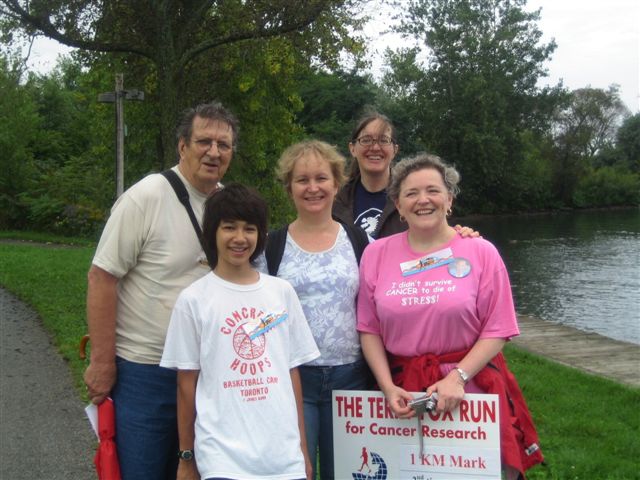
Neighbours at the 2009 Terry Fox Walk

Cynthia’s wearing her Breast Cancer T-shirt on the Terry Fox Walk. We were walking for another dear neighbour.

We walked a lot, me less eagerly, hoping instead to sit on her couch, she striding ahead, explaining that she couldn’t walk slowly. There were the shopping trips, brisk evening walks with other neighbours, and longer fundraising walks. Always walking.

When Cynthia heard about the first Jane’s Walk, she said, “We should lead one in our neighbourhood.” She had already talked to the head of a local community agency. I was working, at the time, at United Way Toronto on issues around building strong communities. But, as a researcher, stepping out in front was not my first inclination, so I demurred, offering only to speak at one of the stops. That first walk became Ashbridges to Little India. The next year, Cynthia and I led a group of forty through a torrential rain, stopping at the Mahar Restaurant for chai and samosas that Cynthia had arranged through the local BIA.

Cynthia Brouse, award-winning magazine writer, editor and my friend and neighbour for nearly fifteen years, I was proudest of a Toronto Life piece for which she hadn’t won an award: Indian Summer, the story of living in our east-end neighbourhood. (She was kind enough to omit the story of our first meeting, when, toddlers in tow, I had brushed her off and, instead, she included a quixotic story about my son and I dancing with a sparkler. And about how “dense, multiplex networks” function.)

Last year, our Greenwood Coxwell walk gained some profile, being written up by a Globe columnist, but Cynthia wasn’t well enough to lead the walk again with me. Her breast cancer had returned. Another neighbour, a historian, stepped in graciously to help, and Cynthia came to listen this time, her mother pushing her wheelchair.

However this year, within days of the annual walk, Cynthia said good-bye to her home and, for the last time, has been admitted to hospital.

Still, we talked about this thing we had joined together, this celebration of neighbourhoods, and the convergent theme of neighbourliness. I told her how this year the walk had grown again. Crazily, I had decided to do two walks, a reprise of our earlier ones and a new one I had thought up. And, crazily, two new walks had sprung up in the neighbourhood, led by others!  (The media coverage also grew with a Spacing radio podcasts of my walk and of Jane Farrow’s east end tour and also a CBC interview on Fresh Air about Jane’s Walks across the province which profiled our neighbourhood.) Our conversations had taken a life of themselves.

These ideas of local community, social networks, neighbouring, how we manage, or how we come to rely on each other, these themes were what Cynthia and I considered, continuously, until the end.

Earlier this spring, when things looked pretty gloomy, I joked with Cynthia, “I’ve had enough of sick and dying neighbours.”

Looking at me steadily, she said, “You will be happy again.”

Now, I remember that, and I imagine her offering me a cupcake to enjoy — because we can always walk it off.
Continue reading

June 11, 2010

Choosing between the good, the bad and the poor schools

Many years ago, when my daughter was ready to begin school, we looked to the neighbourhood school. We attended a fun fair. I chatted with the school principal. I talked to other parents in the area. And if there had been provincial EQAO testing scores on the then-budding internet, we would have looked those up. It’s a good thing we didn’t.

The school, it turned out, was a great school, and we hit it during its heyday, when the principals valued social equity, the teachers were committed, and parents were welcomed inside.

Yet, if we had only judged this school on its provincial EQAO scores, we may never have gone.

No, it’s not that it was a bad school, but it was a poor school — a school with a large number of students from low-income families. And everyone from the C. D. Howe Institute to the Ontario Institute in Education has shown that poor kids don’t do well in standardized tests such as the EQAO.

The reality is that the richest schools have the best academic outcomes, and lock-step down the income ladder, except through feats of teaching heroics, test scores and other markers of academic success drop.

Excellence in test-taking predicts….excellence in test-taking. It has much weaker correlations with overall course grades, graduation, or later success in life. This is why tests like the SAT (Standardized Aptitude Tests) are slagged even by university admission officers as a lousy way to find academic excellence, yet it is one of the only one consistent measures available.

But, still, when new parents move into the neighbourhood, they want to know (as I did), “Is it a good school?”

It’s a fair question.

Every year, the provincial tests administered to Ontario students by the EQAO attract a ton of media coverage. We all want to know how our school do.

With the installation of provincial EQAO tests, a wealth of other websites have emerged, happy to advise the worried parents of wee ones.

The EQAO scores at my family’s local public school have improved over the past decade, so much so, that when the Premier (the “Education Premier”) visited last year, the first comment he made publicly was how well test scores had improved at the school.

And yes, teachers have tried harder, new programs have been introduced, and scores have risen. What McGuinty didn’t say, but was just as important, was that the average income in the neighbourhood has also been steadily rising. And so predictably, our scores have risen.

Parents who are hunting for the best school might as well ignore the scores. A lot more than what can be captured in a provincial test goes into an effective schools.

In my more mischievous moments, when people ask me what makes a good school, I want to advise them to ask how students were suspended (data that is hard to find again) or, in high school, how many students committed suicide in the past year (never published, of course).

Instead, go see how many parents show up to help for the pizza lunch, see how many school clubs are run, and see how the principal welcomes parents. Think about the value of knowing other families in the local community.

Most of us are happy with our schools. It’s why such a high proportion of Canadians still send their children to publicly-funded schools.

And this is not to say that there are not bad schools in the system, places where principals suspend inordinate numbers of their students or impose bans on parents entering playgrounds when faced with their sharp criticism, places where the physical plant has deteriorated to embarrassing levels.

But the value of a neighbourhood school is best known by those closest to it. As  the OISE Survey of Public Attitudes towards Education in Ontario continues to find, those who are closest to the school system are the happiest with it.

The research bodes well for any worried parent.

Continue reading

June 7, 2010

Alone we go fast, together we go far

Political parties are a bit of an oxymoron. They are not actually that fun.

The newest version of political incubators are camps: NetChangeChangecamp, Govcamp, Agendacamp. Camps, these big messy open meetings emerged from other sectors, like Torcamp and Democamp works with developers, designers, investors and other interested folk. Even the legendary TEDs qualify as part of these innovative models, I think.

Described as “un-conferences,” here, networking and creativity trumps long debates and secondary motions which mires so much political action.

The idea behind Changecamp’s is to “re-imagine government and citizenship in the age of participation” and last fall it drew over 200 people to the Metro Toronto Reference Library.

Changecamp is spreading across the city now.

On Saturday, June 19th,[June 14th Update: Sometime soon] it will be landing at the Centennial College Centre for Creative Communication in the old east end of Toronto.

Michael Cayley, founder of the east-end Riverdale Rapids ning, and Mark Kuznicki, a member of the Centre for Social Innovation are two of the key leads who cooked up this community-level version.

The camp will be a great chance to meet neighbours and to talk about ideas.

And, as Al Gore reminded us, alone we go fast, together we go far. So, let’s have a chat.

For more info and to register: Go to the Riverdale Rapids events page.