Posts tagged ‘Community’

June 5, 2009

Crime and social cohesion in Toronto neighbourhoods

Neighbourhood social cohesion has gotten some recent media attention in Toronto.

Presenting recently at 2009 Canadian Association of Geographers, Ryerson professor Sarah Thompson caught the attention of the National Post.

Co-author with Professor Rosemary Gartner, they have been able to map out “The spatial distribution of homicide in Toronto’s neighborhoods, 1988 – 2003” and to do some preliminary analysis on the difference between high homicide and low homicide neighbourhoods.

“Measures of neighborhood-level socio-economic disadvantage and the proportion of residents who were young males were the most consistent correlates of neighbourhood-level homicide counts,” according to their research.

At this point, more analysis is needed, however speculation on other reasons for the differences includes the level of community services available locally and the social cohesion in the neighbourhood.  It’s an exciting start.

United Ways Toronto and Peel are also bringing some attention to the issue of social cohesion. They’ve invited Garland Yates, a Senior Associate at the Annie E. Casey Foundation, to speak at their Annual General Meetings. He has been working with the United Way Toronto’s resident engagement project, Action for Neighbourhood Change, for the past three years.

CBC Metro Morning’s Andy Barrie interviewed him this week while he was in town. (The man does not mind getting up early when he travels, three mornings in a row.)

When pushed by Barry to move past the platitudes of “facilitating” and “enabling” and to explain what could be done to strengthen social networks, Yates rose to the challenge, explaining the messy and unorganized ways that social networks function and social cohesion builds:

“First of all…social networks are pretty organic…I remember when growing up my mother and others would do things for each other, like each other’s hair.

“I don’t think it is necessarily about creating [social networks], and we have to be careful, as well, not to overprofessionalize them.

“Where there are natural tendencies of people to relate and interact with each other…that relate to welfare and improvement of the neighbourhood, we ought to just encourage them.

“A kind of simplistic way of putting it is, is that if we have resources we should invest those resources in activities that get people to interact and not necessarily in a program structure.”

CBC Metro Morning, June 3, 2009

Upon reflection, the implications of both these presentations call for further exploration of the role of community agencies in the strengthening of neighbourhoods. Community service agencies formalize the supports that used to have to be provided by social networks, yet, in our complex, densely-populated communities, neither can replace the other.

And speaking of the The National Post, it’s doing some great Toronto-focused profiles of the city:

  • A series since the beginning of May, Peter Kuitenbrouwer’s Walk Across Toronto has focused on the wide range of neighbourhoods outside the downtown (and predictable, as he terms it) city core.
  • A weekly series called Toronto, A to Z, profiling interesting corners of the city. They are up to the letter M now.
  • 95 (and counting) separate profiles entitled My Toronto by “famous” sons and daughters of the city.

read more »

May 19, 2009

An electronic front porch

Web 2.0 is re-shaping the way individuals communicate to those living near them, and, concurrently, social media needs to re-form to meet the demands of local communities.

I found an interesting article with a long name, Networking Serendipitous Social Encounters in Urban Neighbourhoods, written by Marcus Foth and published in Australia, which makes the above argument very well.

I had been considering it since another Twitter friend, Michael Cayley (@memeticbrand), challenged me last year to consider how social media supports the way we interact in our neighbourhoods. As Social Capital Value Added blogger and the founder of Riverdale Rapids ning, Cayley’s question is an honest one.

Here’s what I learned from Foth’s analysis:

  • If so designed, Web 2.0 tools can compliment community development work, allowing on-line communities of choice to merge into communities of place. Social media supplement and enhance local channels for communication. (U of T professor Barry Wellman had written extensively on this dynamic, as well.)
  • In times before electronic communications, we relied on neighbours and came to know them. “The fact that people residing in the immediate surroundings were known also established a feeling of security, community identity and a sense of belonging – a feeling that clashes with the experience of living in today’s high density, compact urban environments.” (Foth, 2009) We find community in other places now.
  • The construction of physical “town squares” and other public spaces has becomes less important in these technologically connected times. Electronic communications now facilitate personal interactions and, often, ways of meeting physically. Community connections are strengthened in different ways now.
  • Caution is required as traditional power dynamics can get played out through social media. These electronic “front porches” also have a hierarchy. Those with more social capital gather more social capital.
  • People won’t be attracted to place-focused web 2.0 tools simply because of proximity. Websites like Neighborhood Fruit or Wikimapia or the ubiquitous Craig’s List all offer some more concrete reward for interaction, whether it’s a fresh peach, esoteric knowledge, or a new job.

Foth identifies a social media project he is working on in three Australian cities to develop “urban tribes” which offer enough diversity for on-line subscribers to find others to be self-sustaining, .

In the end, it was a compelling article to find. The magic of the Web2.0 internet is that it offers serendipitous encounters, like those afforded by sitting on a front porch. (In fact, as our neighbourhoods become more homogeneous, the chances that our communities of interest and our local communities will overlap only rises. Our interconnections will only be stronger.)

Only a few days ago, I was talking to a neighbour, by phone, about how the two of us were both sick and therefore house-bound. The only interactions we had had for a few days were through things that plugged into walls. It seemed sort of sad at the time.

Now I can see we were riding the crest of the future.

May 16, 2009

The annual summer learning deficit looms for low income students

Soft summer days will soon be upon us, schools will let out, and poor kids will be left to fall further behind academically.

In a recent summer, my own son was able to collect a number of free T-shirts when he attended consecutive weeks of science, computer and basketball camps. He was provided with a rich range of experiences, excursions and learning opportunities.

In contrast, this week, I put together a funding application for one of my agency’s summer camps. The budget broke down so that each child would allocated bus fare for one return trip/week with an additional $8 per child for admission or other costs, $5/day/child for food (because food security is a real issue), and $2/day/child for supplies for arts & crafts, games and recreation. We’re hoping to be given the $10,000 maximum grant. Otherwise these amounts will have to be cut.

However, these are differences of opportunity between poor kids and their more privileged counterparts that are apparent even in schools within the public education system.

The real inequity emerges from the learning shortfall or “summer slide” that occurs when school is out in July and August. The students from more privileged backgrounds continue to gain academic ground through the summer, boosting their verbal, organizational and other learning skills. At best, students from low income families tread water. More often they backslide.

Learning disparities accumulate each summer so that by high school, the summer learning gap strongly predicts whether a student will take an academic course load, finish high school or attend post-secondary education.

Perhaps most startlingly, the implications from the research are that if schools are able to help low-income students catch-up when they are in session, then supporting these learning opportunities through the summer break may be more important even than the early learning initiatives, which first gave kids their leg up, but which are not as long-lasting.

This issue of the summer achievement learning gap has some respectable backers:

In February, the Toronto District School Board received a staff report on year-round schooling. Unfortunately, the report was limited by an examination of whether the current 185 days of instruction should be spread throughout the calendar year, rather than looking at whether additional instructional days might have an impact.

While not making a formal recommendation, the door is still open. The Board report left the possibility of moving to a different calendar if a school community requested the scheduling change.

The summer learning gap is not an issue that can be easily addressed at the board-level. Funding and teaching contracts are provincial matters.

However, within Ontario,Toronto probably has the most compelling reason and capacity to act on the issue. The TDSB’s leadership on inner city and urban issues offers the opportunity for the board to lead on this issue, in the best interests of low income students.

read more »

May 10, 2009

In a mixed neighbourhood: Theory, please meet Reality

In one of my last posts, A white resident’s dilemma, I suggested that mixed neighbourhoods were good solutions to the tidal wave of gentrification in many cities. In riposte, Kevin Harris, the U.K. blogger for Neighbourhoods, quoted some residents with whom he has worked and who weren’t convinced by the real world validity of the ‘mixed neighbourhoods’ concept:

‘You had neighbours who you wouldn’t mix with if you were dying. It was theory-led, they had this theory that everyone had to mix together and it wasn’t going to work.’

This resident’s comment, a good reality test, is a challenge to the gnarly problem of how we live together, in community.  Personality differences, alone, can challenge the possibility of this theoretical neighbourhood. (I remember one of my own neighbours once explaining to me about a woman at his church, “People say she is hard to get along with, but I know what to do and I’ll tell you what you do. You’ve got to ask her about her dog. We get along just fine.”)

Yes, indeed, living in community is difficult. At a minimum, this resident’s comments speak to the need for common civility. Still, I can present my own similar example of theory clashing with reality.

Last fall, one of my other neighbours remarked to me how well we all got along on the street. “I think,” he said, “it’s because we are all so much alike, at the same stage of life.” It threw me back. Here I was, presenting later that week at the Ontario Non Profit Housing Association conference on the topic of strong neighbourhoods, and he was describing a good neighbourhood as one that was not inclusive.

So obviously my theory, seemingly naive and well-principled, needed more work. It prompted me to turn to some of the academics who have looked at this issue.

My instincts about the stages of gentrification and its homogenizing effects are borne out by studies such as Alan Walks and Richard Maaranen, who looked at gentrification in Toronto, Vancouver and Montreal between 1961 and 2001. Within Toronto, they found that more than a third of neighbourhoods were gentrifying, mainly around the downtown core.

So I wasn’t imagining it, but how about this idealistic answer I had proposed?

U of T’s Centre for Urban and Community Studies/Cities Centre also held a symposium last year which did an international comparison of the patterns of gentrification in the western world. They made the important point there that “mixed neighbourhoods can be defined in many ways, through class, race, ethnicity, language, lifestyle, generation, household type.”

I felt like I was getting closer.

What Kevin Harris’ resident was complaining about, and my neighbour was commenting on, was the reality that co-location does not work. In fact, it often aggravates.

It is common sense that many residents do better when located close to others at a similar life stage. If we want to swap cigarettes or baby-sitting or garden tools, it’s easier usually with someone in the same life stage or age grouping. Noise complaints are often an example of clashing lifestyles/stages: someone’s up too late partying, or someone is up too early mowing. Zoning laws mediate these very things.

If, the differences we are talking about, however, are based in class and/or race, then even more so, a structural answer is needed, a need to create and strengthen the social and institutional bridges between us. These are the places where community can be created (and much of what this blog is about).

In all of these examples of division, the answer lies in strengthening the social fabric of the neighbourhood in explicit, yay planned, ways.

Community walkability is important. Our children need to go to the same schools. Housing forms should be similar. Economic opportunities must be shared. The issue also underscores the important functions of civility and shared identities.

Mixed neighbourhoods have to be about more than living alongside each other, but are really about living with each other. Still this seems too idealistic because frictions arise, if our communities are zero-sum games, where if one wins, the other loses.

Neighbourhoods are situated in a larger context, so mixed neighbourhoods about more than civility and good zoning; they have to address and mitigate social and economic injustices.

Otherwise, Kevin Harris’ residents is right: they won’t work.

May 6, 2009

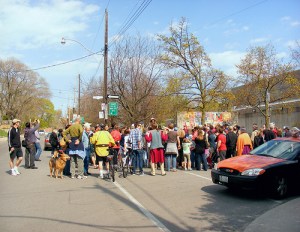
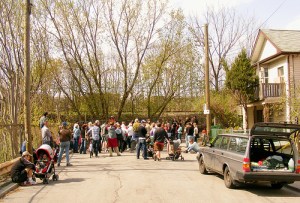
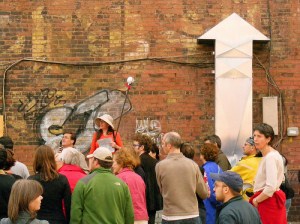
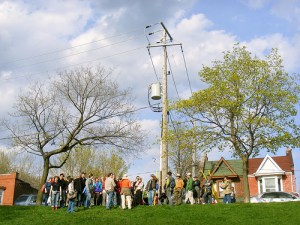
Greenwood-Coxwell Jane’s Walk

Sunday, May 3, 2009.
Photographs by Jeff Stewart (many thanks!)

To see the profile of this walk in the Globe & Mail by the Architourist, see here.

Leading a Jane's Walk, 2009

Leading a Jane

Discussing importance of community hubs and social institutions

Roden School: Discussing importance of community hubs and social institutions

Discussing community resiliency and social networks

Top of Craven Road: Discussing community resiliency and social networks

Discussing Robert Putnam's <i>Bowling Alone</i>

Gerrard Street Theatre: Discussing Robert Putnam

Discussing the buffering function of neighbourhoods

Greenwood Park: Discussing the buffering function of neighbourhoods

More photos, see reflex6002
Another Blogger’s perspective on the walk: ripple.ca
Demographic profile: Greenwood Coxwell

read more »

May 5, 2009

A white resident’s dilemma: gentrification or segregation?

A Twitter friend, @JessieNYC, a smart and progressive woman who lives in New York City, worried recently about the selection of her new home. She had two choices: to live on the Upper East Side, a high income and mainly white neighbourhood, or to move to another apartment in East Harlem. Her choice was essentially to remain, isolated, in a white enclave or to become a gentrifier.

Gentrification is an issue about which I think a lot, but have hesitated to write about specifically because this is so personally about my neighbourhood. However another Twitter user I follow recently posted a link to Life, Inc., a searing analysis of gentrification and racial politics in Brooklyn, New York. So I have decided to take the plunge; these are things that have to be debated.

For the past fifteen years, my neighbourhood has been changing.

Renters have been displaced as homes are converted to single family dwellings. Front-yard vegetable gardens are being replaced by granite rock and Japanese maples. Median income is rising. The occupational classes of my neighbours have been changing. Where I used to live next to taxi drivers, railway conductors, sales clerks, hotel maids and medical secretaries, I now live among a range of fashion, acting, film and visual artists and writers, and professionals such as social workers, librarians, teachers, and museum curators.

And the neighbourhood is now less racially diverse. Where my (mixed-race) children could see their Chinese heritage reflected around them, where they learned to greet older adults as Po-po or Gong-gong, many of these families have moved away, almost always to be replaced by a young, white couple and a large dog, pleased to be able to afford to enter the housing market on their two incomes. One of the kindergarten teachers at the school where my kids, now in high school, attended, was surprised to realize this year that every child in her morning class is white. When my children were young, she had less than a handful of student who were white.

When I whined about these demographic shifts, a Facebook friend called me out. “Tough living where others want to live, isn’t it?” he said.

Even Jane Jacobs defended gentrification, saying this “unslumming” showed the desirability of a neighbourhood and improved the neighbourhood.

Others have admonished: Change happens!

So I have struggled to articulate my discomfort with these changes.

They are threefold:

  1. The economic drivers of the change
  2. The racial impacts of gentrification
  3. The homogenization of the neighbourhood

1. The neighbourhood change is as a result of economic forces. CUNY Professor Neil Smith provides some insight into the dynamics of these shifts (See the blog Racialicious for more). The forces underlying these moves and improvements to the the neighbourhood are economic – nay, capitalistic, rather than a reflection of social forces or personal decisions.

Smith elaborates, denying “our goal is some rigidly conceived `even development’. This would make little sense. Rather, the goal is to create socially determined patterns of differentiation and equalisation which are driven not by the logic of capital but genuine social choice.

People will maximize their return, so if that means selling out while prices are high, so they will move.  At the neighbourhood level, this plays out as high residential mobility, as prices continue to rise, and people’s price point is reached. (I remember when the first house on our street sold for over $250,000. My older neighbour crowed to me, “Diane, we’re quarter-millionaires!”). When my neighbours move away, they are having their rental housing sold from under them, or, as owners, are cashing in and moving further away, often outside the city.

These individual actions have a cumulative impact.

2. These neighbourhood changes play out racially, as well. In a city as diverse as Toronto, what plays out economically plays out racially. And because income and race are correlated here, upwardly mobile neighbourhoods are becoming whiter. Professor David Hulchanski’s work is bearing this out (see my previous post on racial divisions tracking income polarization).

The racial composition of my neighbourhood has shifted, and whites are becoming the dominant racial group here, the very opposite dynamic of what is happening demographically in the city.

3. Perhaps the most telling symptom of gentrification, is that this demographic shift is unidirectional.

Gentrification happens, in stages. And, as working class has shifted to artistic class, the upper class (and higher housing prices) cannot be far behind. The downtown city core of Toronto has become a destination.

Some of neighbours are just fine with that. Often, these same some, upon their arrival here, find the rough granularity of the neighbourhood disturbing. Often, they moved here thinking they have purchased a good bargain, just at the edge of one of the high-income neighbourhoods around us, and they mistake this neighbourhood for that one. It’s not long before they are disappointed and organizing a petition.

Or, sometimes, they thought the “colour” would be nice. And, yet, their singular arrival usually displaces an East Asian family. (Stats Can data shows one in five ethnic-Chinese people left the neighbourhood between 2001 and 2006.)The only in-migration to the neighbourhood, besides whites, are some South Asians and Urdu-speakers because the mosque and commercial district is in walking distance (Their numbers doubled, so that now they comprise 5% of the local population).

The answer to these three problems, the economic, the racial, the homogenization, is to purposefully plan for mixed neighbourhoods. Left to wider economic forces, the poor (and, by corollary, people of colour), are continually displaced.

So what to do, after all this awfulizing? Mixed neighbourhoods!

Sometimes, as discussions of mixed income neighbourhoods erupt, wealthier neighbourhoods often object to the idea of affordable housing being built in the neighbourhood. However, the response from one wise woman was, where do you want the woman who cares for your child at the daycare or serves you coffee in the morning to live? Is she a part of our community, or not?

Gentrification happens because of income inequality, an issue which is continuing to grow.  While these are issues, created at an entirely different levels, they are played out locally, within and between our neighbourhoods.

So my reply to my Twitter friend’s dilemma was, whether she stayed within the white enclave where she lives, or moves to a more diverse neighbourhood, I knew she would work to build an inclusive place. It’s the only fair thing to be done.

More:

Income polarization tracking racial divisions

“Are there limits to gentrification? Evidence from Vancouver”

Mixed picture on mixed income: Moving in on poor neighbourhoods


April 30, 2009

Proximity makes the heart grow fonder

How do friendships form? gives some insight into why mixed neighbourhoods are important. The study, from Marmaros and Sacerdote, researchers from Google and Dartmouth College, tracked the 4.2 million e-mail exchanges between university students for more than a year to identify the social networks they established.

As Dartmouth students are assigned randomly to student residences, the researchers were able to track how factors like geographic proximity, family background, racial identity and shared student activities affected the formation of friendships between students.

The literature explains we are most likely to become close friends with people with whom we have frequent contact.  Fostering friendship with a random stranger further away requires an additional investment of time with no guarantee of a positive pay-off of a close friendship. Marmoros and Sacerdote wanted to test the theory that we are more likely to become close friends with someone with whom we have “lots of local, low cost social interactions.”

In essence, when we see a neighbour regularly, we get a short-term and a long-term benefit: in the immediate interaction, we are provided with the opportunity to exchange information and then, over the course of time, trust is built through reciprocity. Both these benefits can emerge at a fairly low cost to ourselves without a large investment of time or other resources. Random interactions expose us to the possibility of bigger pay-offs.

Marmaros and Sacerdote found such a “neighbourly effect” among the students whom they mapped. Students were more likely to form friendships with those who lived close to them or who shared an activity or class. The effect was lessened if students did not share the same racial or family background, however, the effect was still positive.

A caution from the study:

  • The positive effects on social interaction were only found at fairly close distances, such as among those living on the same floor in a school dorm.

Otherwise shared activities were required to demonstrate significant cross-cultural friendship formation. Even while seen as a broad societal benefit, the authors explained, an individual may be less likely to form a cr0ss-cultural friendship if it is seen as more “costly” in terms of time or additional risk factors. Happily, proximity to each other seems to help overcome the racial barrier.

Two additional noteworthy upsides:

  • Close friendships continued even when students moved further distances from each other. The opportunity to form friendships across a variety of identities, provided by living close to each other, provides a lasting effect. Once friendships are formed, most students found it worth continuing to invest in them.
  • Citing other research and expanding on their own, the authors describe the positive equity effects on the attitudes of white students who live with a Black roommate. While the white students were not more likely to have a larger circle of Black friends (as a result of having one Black friend), they are “more likely to support affirmative action in admissions and societal income redistribution.”
April 19, 2009

The riches that social networks provide

One of my neighbours complained to me recently how the neighbourhood had changed. With the reconstruction of Regent Park, a wave of newcomers had been (dis)placed into the TCHC housing behind his house (also social housing).

“They have no respect for the neighbourhood,” he said, “and they’re causing all kinds of trouble.”

Now on the face of it, Don’s complaint could be seen as a predictable reaction to the arrival of newcomers, however I sympathized with him. This wasn’t a case of NIMBY-ism, because his complaint was really more about bad planning than about “bad” people.

In a hard-hitting article published in The Atlantic last summer, Hanna Rosin explored what happened to residents of large urban housing projects who had been moved to housing in “better neighbourhoods.”

Rosin followed residents of the projects and spoke to academics who were examining the impact of these displacements. She described some foreboding findings:

  • Social problems which had been concentrated in high poverty areas were dispersed into the neighbourhoods where residents found new housing and were more difficult to police. In effect, the bad spread further.
  • Social networks were decimated. Moved to new neighbourhoods, residents lost any long-standing or supportive relations upon which they might have come to rely and were slow to build new ones. In short, the good was lost.

Without supports, either formal or informal, to ease the transition, outcomes were bound to be poor.

Strong social networks build when we live near someone for years, or send our children to the same local school, or meet on a summer stroll past a front porch. Social networks are even more important in a low-income neighbourhood because we share resources among us.

For instance, my neighbour Marlene announced no one needed to buy a bundt pan because she had bought one recently. And, I know, that if I need a ladder, Ming and Doug both have one, or if they need a jigsaw, they can borrow mine. If I lived in another, less well-networked neighbourhood, we each would have faced the choice of buying our own or doing without.

Our new, displaced neighbours were settled here in a strange neighbourhood without these resources, and no provision was made to fill the gap.

I should borrow that bundt pan to make a welcome cake and introduce them to the neighbourhood.

April 11, 2009

Crime: Targeting the few "bad apples"

The police division in which Riverdale and the Beach lies has the second highest Break & Enter rate in the City. Only the downtown core/entertainment area outranked Division 55 during this period (January  – October 2008). (See Toronto Police Service data and the Toronto Star crime maps for the source of this analysis. Another interesting website, allowing individuals to pool their collective knowledge is the Spotcrime website.)

So these high stats make one of the stories buried in the 2005 annual police report all the more interesting.

The Division’s Major Crime Unit developed a program to track serial offenders, out on bail for Break and Enter and other major crimes.

Through the program, police met with offenders and their sureties as they were released from jail and then tracked their bail conditions, making regular follow-up visits weekly.

A regular, rotating list of the Top 15 offenders was maintained. Police found, by tracking these few people, they were able to drop the break-in rate by 38%.

The pattern is reminiscent of the one described by Malcolm Gladwell when he wrote in the New Yorker about Million Dollar Murray, a homeless man who in the final years of his life absorbed a large portion of health, social and police services. Gladwell makes the compelling argument that the most effective use resources is not when they are spread across a population, but when they concentrated on the most needy.

It’s a focused tactic that runs counter-intuitively to our Canadian sense of fairness and universalism; however it’s one now seen in the Province of Ontario’s  poverty reduction strategies, the City of Toronto‘s and United Way‘s Strong Neighbourhood Strategies, and TDSB’s Model Schools for Inner Cities. Each of these strategies brings additional resources to those identified as most in need.

At worst, this tactic prioritizes the vulnerable. As best, it just may work.

April 6, 2009

Ontario School Information Finder

In a bid to improve access to information and individual school accountability, the provincial Ministry of Education made a big misstep. This week, it introduced the Ontario School Information Finder which allows parents (and others so inclined) to comparison shop between shoes, er, schools.

Parents can find schools by name, or even more easily, by typing in their postal codes into the search engine. Then adding additional schools to their shopping cart, school bags, they can select three, hit the “Compare the Schools I selected” button and see how each school compares to the others in two domains: student achievement (as measured by provincial testing) and student demographics (including percentage of students from low income families, recent immigrant families, families with a university level-education and students receiving special education).

“What’s the objection to parents knowing this information?”, a reporter asked me today.

No objection. Parents already have access to this information. It is publicly available through the Fraser Institute and C.D. Howe, probably the most famously, but also through individual school profiles published by school boards, real estate agents, Toronto Life, and even a school board trustee.

However, the problem is the way the Ministry has packaged the data on student achievement and student demographics, as if it were a meaningful measure of a school. Learning the number of immigrants at a school, or the number of low-income kids, only tells you about the “input.” It doesn’t tell you how good the students are and it doesn’t tell you how good the school is, how much learning goes on there. However, it’s very likely that the Ministry website will be used to shop between schools.

When parents choose a school for their child, provincial test scores are probably one of the least reliable measures of a good school (and was part of the reason so many parents resisted the introduction of the EQAO). To be bald, provincial test scores correlate highly (although not absolutely) with student demographics, as the TDSB’s recent work on its Learning Opportunity Index attests. So, if parents choose a school by its test scores, they will likely be choosing a school where wealthier students attend rather than a school where great learning is happening.

Well, maybe peers are important. Higher income kids are three times more likely to go to university then kids in the bottom 10% of income (TDSB report). Isn’t that a good influence? It may be, but there are other considerations.

Social mix strengthens an important civic function of public education. We learn to get along with each other there. Students who attend more homogeneous schools learn alot less about others who are different from them – and, frankly, this is already a problem that occurs in many of Toronto’s schools, as Professor David Hulchanski’s work on the sorting of neighbourhoods by income has shown. A tool like this will accelerate this segregation. (And it is segregation; parents I spoke to in a focus group last year in one upper income neighbourhood worried that their kids only see people of colour at the local corner store and that their kids will not understand diversity in any real or granular sense when they move out of their enclave.)

Given the choice, parents acts for the benefit of their own child, as they should; so if “good” schools are defined, uncritically, as the ones with higher test scores, poor kids will be left further behind. Poor kids will be left further behind because they have fewer options, whether it’s bus fare to travel to “better” schools or parents who know how to hunt through the system. Left unfettered, two streams will emerge: elite schools and “bad” schools.

In a bid to give parents greater free choice, to ensure their own family’s gain, the Ministry has created a tool that gives free rein to individual license without considering our common good. What we will see is greater inequality, and it sounds all too familiar in these economic times.

The common good, the idea that a social mix strengthens us all, is even part of the calculation.

People for Education has been quick off the mark on this one, posting an open letter to the Premier, because the Ministry website undercuts the very foundation of a strong public education system. Parents and educators are signing up in droves to endorse the letter.

So, what should parents want to know when selecting a school?

  1. Is the principal an excellent educational leader?
  2. How well do teachers connect to the community? to each other? to the students?
  3. How happy are other parents with the school?
  4. Is the school a small enough size that people know each other and big enough to allow some diversity?
  5. How welcoming is the school culture?
  6. What additional supports are available to students?
  7. What sort of improvement do students make when they attend the school, i.e. what is the value-added?

School visits will give you that information.So what if you wanted to build a web tool which might work?

Rate My teacher is a website that lets students get at some of these issues, even if it is focused at individual teachers. Perhaps a more useful website would have been one that let parents connect with each other, to share their experience and learn from each other.

Suggestions like this are often met by fear (and anyone who has ever read the anonymous comments left on a newspaper website has some reason for this fear). However a moderated forum or a wiki format would achieve the same school-level accountability and transparency that the Ministry was trying to achieve and have provided more meaningful information for parents looking to learn more about their local schools.

Perhaps counter-intuitively, when Ontarians are polled about the performance of schools in OISE’s biannual survey, the happiest people in the system are usually those closest to the the school system, that is parents. And parents are most likely to be happy about their own school and although they may worried about other schools. A Wiki page for each school would allow parents to build a shared vision of the strength of their local school. A Web 2.0 approach would have been a much better model. We may get there.