Posts tagged ‘Neighborhoods’

October 17, 2009

Toronto's emotional map running hot & cold

Kevin Stolarick, Richard Florida’s “stats guy” at the Martin Prosperity Institute has been up to a bit of mischievous mapping in his spare time.

Using data from a UC Berkeley psychologist who publishes the Big Five Personality Test , Stolarick has mapped out the major emotional of characteristics of Toronto residents by neighbourhood (probably Forward Sortation Areas – the first three digits of a postal code).

The Toronto Star published the maps today: Toronto the Good – and bad and sad and mellow and … .

It’s a relief to see some maps that break the traditional “U” and “O” deprivation patterns. West-enders are extroverted, east-enders are neurotic. Suburban areas tend to be more agreeable, while those along the subway lines are less so. Most of the city is the conscientious type. Those closer to the lake tend to be more open to new experiences.

Now, because the survey is web-based, Stolarick says the sample is probably skewed towards the young (and tech-savvy), but it certainly is a bit of fun!

October 17, 2009

Neighbourhood De-fence

The De-fence Project is coming to Riverdale.

One of my favourite direct action groups is the Toronto Space Committee’s De-fence Project. With an obvious sense of fun, the group encourages homeowners to take down the front yard chain-link fences which were popular in many downtown neighbourhoods.

The fences were considered an improvement when they began their spread in the 1970s over the higher wooden fences of earlier times. The open links allowed air flow while maintaining security. Yet, as the De-fence crew says, our front gardens end up looking like jail yards.

I remember the delight my family felt when a former neighbour with a large, ill-mannered dog moved away. Our delight was compounded because the new neighbour was glad to have us take down the fence between us, and to simply allow the day lilies define our border.

The Globe and Mail’s Architourist’ Dave LeBlanc wrote a recent article the movement to neighbours sharing their yards rather than fencing them. His focus was on the suburbs.

Join the De-fence volunteers Sunday October 18th, and bring pliers and work gloves, if you’ve got them.

11am: 180 Riverdale Avenue
Noon: 173 Riverdale Avenue
1:30: 157 Withrow Avenue
2:30: 124 Wolfrey Avenue.

GOOGLE MAP: http://tinyurl.com/ylyr6b5

For further info, contact: defence@publicspace.ca

October 1, 2009

David Crombie on neighbourhoods and belonging

Quick notes from David Crombie, the former mayor of Toronto, speaking at the WoodGreen Community Services’ annual general meeting tonight:

Someone wise once said there are three questions everyone has to answer:

    1. Who am I?
    2. Where do I belong?
    3. How do I behave?

Neighbourhoods are where we do that.

Crombie also took a moment to reflect that he is the same age as the agency itself, 73 years old. Evoking the issues the agency faced at its start, Crombie reminded the crowd of  its founder Ray McCleary’s rallying call in the 1930s, “We need to reduce the power of poverty.”

Ever so. The work goes on.

August 25, 2009

Life in a town of 900

A few days ago, I travelled through the town of Skagway, Alaska on my way for a day of horseback riding and canoeing in the Yukon. Our bus driver, Mark, settled in the sea-side, shipping town fourteen years ago and proudly showed us around before we got on the highway. He explained, in very concrete terms, the sociology of life in a very small community.

A wintertime population of about 900, none of them there all at once, he explained, absorbs to up to 10,000 people every summer day when the cruise ships arrive.  The town’s summer population is swelled also buy the in-migration of commercial operators, happy to sell amethyst, gold and jade to the summer crowds. Others come looking for seasonal work. The summer time resident population swells to 2 – 3,000.  Many of them are housed in trailers at the edge of town – which Mark said residents called their “ghetto”, probably, I thought because of the poor quality of the housing, distant from any services.

Because of the small size of the town, Mark explained the importance of a strong sense of community in a hostile and changing environment. “It means,” he said,”that we don’t all necessarily like each, but we have to look out for each other.” For example,  fundraising benefits are regularly held for those facing medical or other life crises to help defray the unexpected and exorbitant costs.

Mark also amazed us when he explained why the border guards were so friendly. The social networks in a small town are dense, he explained, because everyone does a lot of different things. They have to if they want things to go.

“I’ll be back here at the border in a few hours to work. I keep their mechanical systems running. But that’s just what I get paid for,” he said, launching into another spiel. “I also do a weekly show on the local radio station and I am on the volunteer fire department.

“Because there’s is work to be done and if we don’t do it, who’s going to?”

July 16, 2009

One neighbourhood, many politics

It could have been an awkward conversation — me: a manager; my neighbour: a striking city worker; and another neighbour, who makes her living in the service industry, depending on tips.

The topic of the city workers’ strike, now ending its third week, had just popped into our front porch chitchat.

I froze, tried to shoo the topic away.

But instead, what started as a snipe about “greedy unions” turned into a wide-ranging discussion about the integrity in collective bargaining and the hard and very human realities of living through a strike. The exchange became a chance to soften hard lines which missed the complexity of our situations.

By the end, we were laughing, teasing, empathizing.

We were able to have this conversation because we had all know each other for over a dozen years. We trusted each other to have this hard conversation.

The Toronto Star profiled a similar encounter between neighbours. It is, though, a conversation that may be less and less likely in Toronto neighbourhoods, which are increasingly divided along income lines. (Why do we build homogenized houses of similar value in separated neighbourhoods?)

What happens in neighbourhoods which have less diversity, whether those differences are along political, class, or racial lines? Political science presents a useful concept to answer this: supermajorities (more than a majority, often 2/3).

In supermajorities, diverse opinions are not heard, and political positions harden. What was a conservative or a progressive belief becomes, in an unchallenged field, an ultra-conservative or a radical one.

Conversations like the one on my front porch tonight reminded me of one more reason why mixed neighbourhoods are important.

read more »

June 28, 2009

A neighbourhood by any other name

No one in my neighbourhood agrees where we live. We laugh about our multiple names, but if attachment to a place begins with what we call it, we don’t know where we live.

The situation is aggravated by the bisection of the community into two different political ridings a few elections back. Confusingly, parents call a school trustee for whom they cannot vote, yet from whom they require help.

Even, a recent incarnation of a residents’ association debated the topic of a neighbourhood name at a few of its meetings, considering an on-line poll after no consensus was found. The website is still entitled ?? Residents’ Association.

When the Toronto Star tried to map out Toronto neighbhourhoods, they ended up leaving our 16 square blocks blank – nameless – hanging there between Riverdale and the Beach. Debate renewed on the Star’s website over it, many suggesting their version.

So, as a neighbour and I called this year’s Jane’s Walk, we are Greenwood-Coxwell: A neighbourhood of many names.

The naming of neighbourhoods is important, if you look at the energy that goes into it.

Spacing Montreal recently profiled a few Montreal quartiers struggling with their boundaries and their names.

Residents in a few of the Toronto Priority Neighbourhood Areas have also demanded changes to the original, City-imposed names. Crescent Town is looking at a version of Taylor-Massey Creek, and Jane-Finch is variously called Black Creek, University Heights or Elia. Residents in Eglinton East-Kennedy Park, Westminster-Branson have also reportedly rejected the City-imposed appellations.

As part of its newly introduced Historic Neighbourhood Strategy, the city of Barrie, Ontario is trying to involve local residents in just such an exercise. When residents identify with and are attached to their neighbourhood, engagement grows.

Identification with the geographic area in which you live is one of the key markers of belonging. Community developers often work with local residents to help them define, and if necessary, name their neighbourhood.

So how did we become a neighbourhood of many names? Through the complex evolution and structures that make up any neighbourhood.

Historically, we are:

  • Ashbridge Estates, as sometimes suggested by residents who live close to the original Ashbridge home.  Harkening to this semi-regal historical connection, but similar to an attempt to carve out a separate identity, as documented in some New York city neighbourhoods.
  • Ashdale Village, a now-defunct effort by some local residents who, through the efforts of a few residents, tried to re-create a cohesive identity. Yet, strangely, they focused on only a small section of the neighbourhood and faded away when one key member moved away. Such grassroots efforts are not always doomed to failure. AshdaleVillage.com has re-emerged with a new suffix.  The Pocket, just to the west of here has successfully established their heretofore unnamed identity, through the creation of a residents’ newsletter and regular events.
  • Leslieville, as sometimes used by those closer to Queen Street, or by real estate agents intent on capturing us with the re-branded neighbourhood to the southwest. (Jane Farrow, at the Centre for City Ecology, taught me that locals also call it colloquially Lesbieville because of the settlement of gays and lesbians into the neighbourhood. See the Star’s map of the week.)

Economically, we are:

  • the Gerrard India Bazaar as the local BIA’s version of our neighbourhood. Gerrard Street is the commercial centre of the community, but tensions arose with this name because it excludes others South Asian communities who live in and visit the neighbourhood. The (re-)branding of a neighbourhood is almost common, now. One neighbourhood in Seattle was tarted up by local businesses with a new name, banners hung, without most its residents even knowing about it.

Socially, we are:

  • Little India. This is probably the most popular among local residents. It is the name I was taught when I moved here, the commercial strip well-established, and what I often say, by habit, although it’s also a name which carries unfortunate colonial overtones.

Geographically:

The neighbourhood is proximate to a few others, so we are sometimes attached to:

  • Riverdale (for those who orient west)

and Administratively, we are:

  • the Greenwood-Coxwell Corridor (Greenwell? Although some in the neighbourhood prefer the perverted spoonerism Coxwood). During the development of the City of Toronto’s new 140 neighbourhoods, planners grouped demographically similar census tracts into larger “neighbourhoods.” Our name was chosen for two of the main streets which as boundaries to the community, and we were lumped with folks on the other side of the tracks – a long walk.

Now, mainly, when people ask where I live, I’ve learned to just give the nearest major intersection.

read more »

June 5, 2009

Crime and social cohesion in Toronto neighbourhoods

Neighbourhood social cohesion has gotten some recent media attention in Toronto.

Presenting recently at 2009 Canadian Association of Geographers, Ryerson professor Sarah Thompson caught the attention of the National Post.

Co-author with Professor Rosemary Gartner, they have been able to map out “The spatial distribution of homicide in Toronto’s neighborhoods, 1988 – 2003” and to do some preliminary analysis on the difference between high homicide and low homicide neighbourhoods.

“Measures of neighborhood-level socio-economic disadvantage and the proportion of residents who were young males were the most consistent correlates of neighbourhood-level homicide counts,” according to their research.

At this point, more analysis is needed, however speculation on other reasons for the differences includes the level of community services available locally and the social cohesion in the neighbourhood.  It’s an exciting start.

United Ways Toronto and Peel are also bringing some attention to the issue of social cohesion. They’ve invited Garland Yates, a Senior Associate at the Annie E. Casey Foundation, to speak at their Annual General Meetings. He has been working with the United Way Toronto’s resident engagement project, Action for Neighbourhood Change, for the past three years.

CBC Metro Morning’s Andy Barrie interviewed him this week while he was in town. (The man does not mind getting up early when he travels, three mornings in a row.)

When pushed by Barry to move past the platitudes of “facilitating” and “enabling” and to explain what could be done to strengthen social networks, Yates rose to the challenge, explaining the messy and unorganized ways that social networks function and social cohesion builds:

“First of all…social networks are pretty organic…I remember when growing up my mother and others would do things for each other, like each other’s hair.

“I don’t think it is necessarily about creating [social networks], and we have to be careful, as well, not to overprofessionalize them.

“Where there are natural tendencies of people to relate and interact with each other…that relate to welfare and improvement of the neighbourhood, we ought to just encourage them.

“A kind of simplistic way of putting it is, is that if we have resources we should invest those resources in activities that get people to interact and not necessarily in a program structure.”

CBC Metro Morning, June 3, 2009

Upon reflection, the implications of both these presentations call for further exploration of the role of community agencies in the strengthening of neighbourhoods. Community service agencies formalize the supports that used to have to be provided by social networks, yet, in our complex, densely-populated communities, neither can replace the other.

And speaking of the The National Post, it’s doing some great Toronto-focused profiles of the city:

  • A series since the beginning of May, Peter Kuitenbrouwer’s Walk Across Toronto has focused on the wide range of neighbourhoods outside the downtown (and predictable, as he terms it) city core.
  • A weekly series called Toronto, A to Z, profiling interesting corners of the city. They are up to the letter M now.
  • 95 (and counting) separate profiles entitled My Toronto by “famous” sons and daughters of the city.

read more »

May 31, 2009

Key factors associated with youth delinquency

A Statistics Canada analysis this spring looked at factors associated with delinquent activity among immigrant youth in Canada. Ostensibly, the report was comparing newcomer and Canadian-born youth, but what it found was more about the importance of family and friends.

The report on property-related and violent activities relied on self-reports from the 2006 International Youth Survey.

Youth were asked if they had participated in a series of risky behaviours in the previous 12 months:

  • Property delinquency was measured as youth who had damaged something on purpose (including bus shelter, window or seat), stolen a bicycle or vehicle, stolen from a store, burglary and arson
  • Violent delinquency was measured whether a youth had snatched a purse or bag, carried a weapon, threatened someone with harm, participated in a fight intentionally.

Here’s what the report found:

Rates of both property and violent delinquency vary by generational status within Canada. Native-born youth reported the highest rates of property-related delinquency, while youth who had immigrated to Canada after the age of 5 reported the lowest rates. However, factors other than generational status were found to account for differences across generational groups in rates of property-related and violent delinquency.

Having delinquent peers has the strongest effect on all youth in terms of explaining rates of self-reported delinquency. The odds of reporting property delinquency were more than three and a half times higher for youth who had delinquent peers than for those who did not. Youth who reported having peers involved in delinquent activities were almost three times more likely, as those without, to report violent delinquency.

Relationships with family also play an important role. Youth who reported a good relationship with their mother were less likely to report violent delinquency.

Youth who spent the majority of their time with friends were also more likely to report property  and/or violent delinquency. Youth who were isolated from family or friends reported higher levels of property delinquency.

If youth reporting being a victim, they also were more likely to be involved in delinquent behaviour. Those who had experienced a theft were more likely to report property-related delinquency. They were also more likely, along with those who reported having been hit violently, to report violent delinquent acts.

Finally, schools play a role as well. Youth who aspired to university were less likely to report either type of property or violent activities while youth who skipped school were more likely to do so. Youth who felt that their school was ‘unsafe’ were also more likely to report having committed acts of violent delinquency.

In sum, protective factors for youth included aspirations for university and spending time with family and/or close relationship with mothers. (Recent immigrants were most likely to enjoy these conditions, and therefore were least likely to be involved in delinquent behaviours. Stereotypes, be damned!)

read more »

May 10, 2009

In a mixed neighbourhood: Theory, please meet Reality

In one of my last posts, A white resident’s dilemma, I suggested that mixed neighbourhoods were good solutions to the tidal wave of gentrification in many cities. In riposte, Kevin Harris, the U.K. blogger for Neighbourhoods, quoted some residents with whom he has worked and who weren’t convinced by the real world validity of the ‘mixed neighbourhoods’ concept:

‘You had neighbours who you wouldn’t mix with if you were dying. It was theory-led, they had this theory that everyone had to mix together and it wasn’t going to work.’

This resident’s comment, a good reality test, is a challenge to the gnarly problem of how we live together, in community.  Personality differences, alone, can challenge the possibility of this theoretical neighbourhood. (I remember one of my own neighbours once explaining to me about a woman at his church, “People say she is hard to get along with, but I know what to do and I’ll tell you what you do. You’ve got to ask her about her dog. We get along just fine.”)

Yes, indeed, living in community is difficult. At a minimum, this resident’s comments speak to the need for common civility. Still, I can present my own similar example of theory clashing with reality.

Last fall, one of my other neighbours remarked to me how well we all got along on the street. “I think,” he said, “it’s because we are all so much alike, at the same stage of life.” It threw me back. Here I was, presenting later that week at the Ontario Non Profit Housing Association conference on the topic of strong neighbourhoods, and he was describing a good neighbourhood as one that was not inclusive.

So obviously my theory, seemingly naive and well-principled, needed more work. It prompted me to turn to some of the academics who have looked at this issue.

My instincts about the stages of gentrification and its homogenizing effects are borne out by studies such as Alan Walks and Richard Maaranen, who looked at gentrification in Toronto, Vancouver and Montreal between 1961 and 2001. Within Toronto, they found that more than a third of neighbourhoods were gentrifying, mainly around the downtown core.

So I wasn’t imagining it, but how about this idealistic answer I had proposed?

U of T’s Centre for Urban and Community Studies/Cities Centre also held a symposium last year which did an international comparison of the patterns of gentrification in the western world. They made the important point there that “mixed neighbourhoods can be defined in many ways, through class, race, ethnicity, language, lifestyle, generation, household type.”

I felt like I was getting closer.

What Kevin Harris’ resident was complaining about, and my neighbour was commenting on, was the reality that co-location does not work. In fact, it often aggravates.

It is common sense that many residents do better when located close to others at a similar life stage. If we want to swap cigarettes or baby-sitting or garden tools, it’s easier usually with someone in the same life stage or age grouping. Noise complaints are often an example of clashing lifestyles/stages: someone’s up too late partying, or someone is up too early mowing. Zoning laws mediate these very things.

If, the differences we are talking about, however, are based in class and/or race, then even more so, a structural answer is needed, a need to create and strengthen the social and institutional bridges between us. These are the places where community can be created (and much of what this blog is about).

In all of these examples of division, the answer lies in strengthening the social fabric of the neighbourhood in explicit, yay planned, ways.

Community walkability is important. Our children need to go to the same schools. Housing forms should be similar. Economic opportunities must be shared. The issue also underscores the important functions of civility and shared identities.

Mixed neighbourhoods have to be about more than living alongside each other, but are really about living with each other. Still this seems too idealistic because frictions arise, if our communities are zero-sum games, where if one wins, the other loses.

Neighbourhoods are situated in a larger context, so mixed neighbourhoods about more than civility and good zoning; they have to address and mitigate social and economic injustices.

Otherwise, Kevin Harris’ residents is right: they won’t work.

May 6, 2009

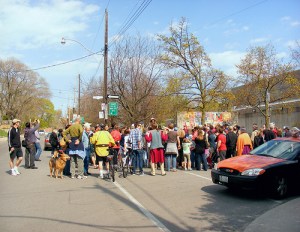
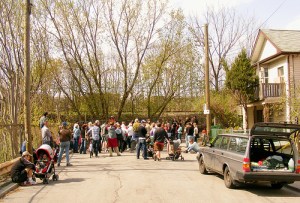
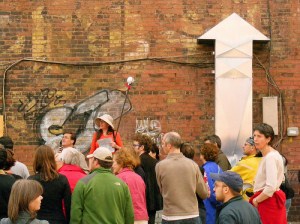
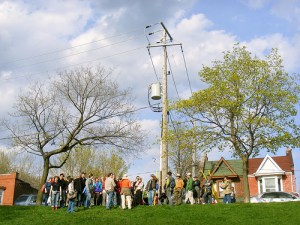
Greenwood-Coxwell Jane’s Walk

Sunday, May 3, 2009.
Photographs by Jeff Stewart (many thanks!)

To see the profile of this walk in the Globe & Mail by the Architourist, see here.

Leading a Jane's Walk, 2009

Leading a Jane

Discussing importance of community hubs and social institutions

Roden School: Discussing importance of community hubs and social institutions

Discussing community resiliency and social networks

Top of Craven Road: Discussing community resiliency and social networks

Discussing Robert Putnam's <i>Bowling Alone</i>

Gerrard Street Theatre: Discussing Robert Putnam

Discussing the buffering function of neighbourhoods

Greenwood Park: Discussing the buffering function of neighbourhoods

More photos, see reflex6002
Another Blogger’s perspective on the walk: ripple.ca
Demographic profile: Greenwood Coxwell

read more »