May 10, 2009

In a mixed neighbourhood: Theory, please meet Reality

In one of my last posts, A white resident’s dilemma, I suggested that mixed neighbourhoods were good solutions to the tidal wave of gentrification in many cities. In riposte, Kevin Harris, the U.K. blogger for Neighbourhoods, quoted some residents with whom he has worked and who weren’t convinced by the real world validity of the ‘mixed neighbourhoods’ concept:

‘You had neighbours who you wouldn’t mix with if you were dying. It was theory-led, they had this theory that everyone had to mix together and it wasn’t going to work.’

This resident’s comment, a good reality test, is a challenge to the gnarly problem of how we live together, in community.  Personality differences, alone, can challenge the possibility of this theoretical neighbourhood. (I remember one of my own neighbours once explaining to me about a woman at his church, “People say she is hard to get along with, but I know what to do and I’ll tell you what you do. You’ve got to ask her about her dog. We get along just fine.”)

Yes, indeed, living in community is difficult. At a minimum, this resident’s comments speak to the need for common civility. Still, I can present my own similar example of theory clashing with reality.

Last fall, one of my other neighbours remarked to me how well we all got along on the street. “I think,” he said, “it’s because we are all so much alike, at the same stage of life.” It threw me back. Here I was, presenting later that week at the Ontario Non Profit Housing Association conference on the topic of strong neighbourhoods, and he was describing a good neighbourhood as one that was not inclusive.

So obviously my theory, seemingly naive and well-principled, needed more work. It prompted me to turn to some of the academics who have looked at this issue.

My instincts about the stages of gentrification and its homogenizing effects are borne out by studies such as Alan Walks and Richard Maaranen, who looked at gentrification in Toronto, Vancouver and Montreal between 1961 and 2001. Within Toronto, they found that more than a third of neighbourhoods were gentrifying, mainly around the downtown core.

So I wasn’t imagining it, but how about this idealistic answer I had proposed?

U of T’s Centre for Urban and Community Studies/Cities Centre also held a symposium last year which did an international comparison of the patterns of gentrification in the western world. They made the important point there that “mixed neighbourhoods can be defined in many ways, through class, race, ethnicity, language, lifestyle, generation, household type.”

I felt like I was getting closer.

What Kevin Harris’ resident was complaining about, and my neighbour was commenting on, was the reality that co-location does not work. In fact, it often aggravates.

It is common sense that many residents do better when located close to others at a similar life stage. If we want to swap cigarettes or baby-sitting or garden tools, it’s easier usually with someone in the same life stage or age grouping. Noise complaints are often an example of clashing lifestyles/stages: someone’s up too late partying, or someone is up too early mowing. Zoning laws mediate these very things.

If, the differences we are talking about, however, are based in class and/or race, then even more so, a structural answer is needed, a need to create and strengthen the social and institutional bridges between us. These are the places where community can be created (and much of what this blog is about).

In all of these examples of division, the answer lies in strengthening the social fabric of the neighbourhood in explicit, yay planned, ways.

Community walkability is important. Our children need to go to the same schools. Housing forms should be similar. Economic opportunities must be shared. The issue also underscores the important functions of civility and shared identities.

Mixed neighbourhoods have to be about more than living alongside each other, but are really about living with each other. Still this seems too idealistic because frictions arise, if our communities are zero-sum games, where if one wins, the other loses.

Neighbourhoods are situated in a larger context, so mixed neighbourhoods about more than civility and good zoning; they have to address and mitigate social and economic injustices.

Otherwise, Kevin Harris’ residents is right: they won’t work.

May 6, 2009

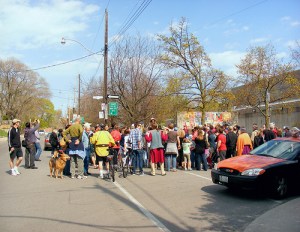
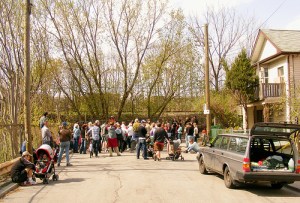
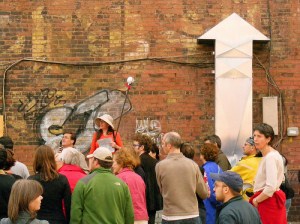
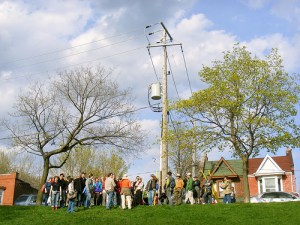
Greenwood-Coxwell Jane’s Walk

Sunday, May 3, 2009.
Photographs by Jeff Stewart (many thanks!)

To see the profile of this walk in the Globe & Mail by the Architourist, see here.

Leading a Jane's Walk, 2009

Leading a Jane

Discussing importance of community hubs and social institutions

Roden School: Discussing importance of community hubs and social institutions

Discussing community resiliency and social networks

Top of Craven Road: Discussing community resiliency and social networks

Discussing Robert Putnam's <i>Bowling Alone</i>

Gerrard Street Theatre: Discussing Robert Putnam

Discussing the buffering function of neighbourhoods

Greenwood Park: Discussing the buffering function of neighbourhoods

More photos, see reflex6002
Another Blogger’s perspective on the walk: ripple.ca
Demographic profile: Greenwood Coxwell

Continue reading

May 5, 2009

A white resident’s dilemma: gentrification or segregation?

A Twitter friend, @JessieNYC, a smart and progressive woman who lives in New York City, worried recently about the selection of her new home. She had two choices: to live on the Upper East Side, a high income and mainly white neighbourhood, or to move to another apartment in East Harlem. Her choice was essentially to remain, isolated, in a white enclave or to become a gentrifier.

Gentrification is an issue about which I think a lot, but have hesitated to write about specifically because this is so personally about my neighbourhood. However another Twitter user I follow recently posted a link to Life, Inc., a searing analysis of gentrification and racial politics in Brooklyn, New York. So I have decided to take the plunge; these are things that have to be debated.

For the past fifteen years, my neighbourhood has been changing.

Renters have been displaced as homes are converted to single family dwellings. Front-yard vegetable gardens are being replaced by granite rock and Japanese maples. Median income is rising. The occupational classes of my neighbours have been changing. Where I used to live next to taxi drivers, railway conductors, sales clerks, hotel maids and medical secretaries, I now live among a range of fashion, acting, film and visual artists and writers, and professionals such as social workers, librarians, teachers, and museum curators.

And the neighbourhood is now less racially diverse. Where my (mixed-race) children could see their Chinese heritage reflected around them, where they learned to greet older adults as Po-po or Gong-gong, many of these families have moved away, almost always to be replaced by a young, white couple and a large dog, pleased to be able to afford to enter the housing market on their two incomes. One of the kindergarten teachers at the school where my kids, now in high school, attended, was surprised to realize this year that every child in her morning class is white. When my children were young, she had less than a handful of student who were white.

When I whined about these demographic shifts, a Facebook friend called me out. “Tough living where others want to live, isn’t it?” he said.

Even Jane Jacobs defended gentrification, saying this “unslumming” showed the desirability of a neighbourhood and improved the neighbourhood.

Others have admonished: Change happens!

So I have struggled to articulate my discomfort with these changes.

They are threefold:

  1. The economic drivers of the change
  2. The racial impacts of gentrification
  3. The homogenization of the neighbourhood

1. The neighbourhood change is as a result of economic forces. CUNY Professor Neil Smith provides some insight into the dynamics of these shifts (See the blog Racialicious for more). The forces underlying these moves and improvements to the the neighbourhood are economic – nay, capitalistic, rather than a reflection of social forces or personal decisions.

Smith elaborates, denying “our goal is some rigidly conceived `even development’. This would make little sense. Rather, the goal is to create socially determined patterns of differentiation and equalisation which are driven not by the logic of capital but genuine social choice.

People will maximize their return, so if that means selling out while prices are high, so they will move.  At the neighbourhood level, this plays out as high residential mobility, as prices continue to rise, and people’s price point is reached. (I remember when the first house on our street sold for over $250,000. My older neighbour crowed to me, “Diane, we’re quarter-millionaires!”). When my neighbours move away, they are having their rental housing sold from under them, or, as owners, are cashing in and moving further away, often outside the city.

These individual actions have a cumulative impact.

2. These neighbourhood changes play out racially, as well. In a city as diverse as Toronto, what plays out economically plays out racially. And because income and race are correlated here, upwardly mobile neighbourhoods are becoming whiter. Professor David Hulchanski’s work is bearing this out (see my previous post on racial divisions tracking income polarization).

The racial composition of my neighbourhood has shifted, and whites are becoming the dominant racial group here, the very opposite dynamic of what is happening demographically in the city.

3. Perhaps the most telling symptom of gentrification, is that this demographic shift is unidirectional.

Gentrification happens, in stages. And, as working class has shifted to artistic class, the upper class (and higher housing prices) cannot be far behind. The downtown city core of Toronto has become a destination.

Some of neighbours are just fine with that. Often, these same some, upon their arrival here, find the rough granularity of the neighbourhood disturbing. Often, they moved here thinking they have purchased a good bargain, just at the edge of one of the high-income neighbourhoods around us, and they mistake this neighbourhood for that one. It’s not long before they are disappointed and organizing a petition.

Or, sometimes, they thought the “colour” would be nice. And, yet, their singular arrival usually displaces an East Asian family. (Stats Can data shows one in five ethnic-Chinese people left the neighbourhood between 2001 and 2006.)The only in-migration to the neighbourhood, besides whites, are some South Asians and Urdu-speakers because the mosque and commercial district is in walking distance (Their numbers doubled, so that now they comprise 5% of the local population).

The answer to these three problems, the economic, the racial, the homogenization, is to purposefully plan for mixed neighbourhoods. Left to wider economic forces, the poor (and, by corollary, people of colour), are continually displaced.

So what to do, after all this awfulizing? Mixed neighbourhoods!

Sometimes, as discussions of mixed income neighbourhoods erupt, wealthier neighbourhoods often object to the idea of affordable housing being built in the neighbourhood. However, the response from one wise woman was, where do you want the woman who cares for your child at the daycare or serves you coffee in the morning to live? Is she a part of our community, or not?

Gentrification happens because of income inequality, an issue which is continuing to grow.  While these are issues, created at an entirely different levels, they are played out locally, within and between our neighbourhoods.

So my reply to my Twitter friend’s dilemma was, whether she stayed within the white enclave where she lives, or moves to a more diverse neighbourhood, I knew she would work to build an inclusive place. It’s the only fair thing to be done.

More:

Income polarization tracking racial divisions

“Are there limits to gentrification? Evidence from Vancouver”

Mixed picture on mixed income: Moving in on poor neighbourhoods


May 3, 2009

Urban neighbourhoods: The long view

Urban neighbourhoods characterized by poverty, rapid residential turnover, and dilapidated housing suffer disproportionately high rates of infant mortality, crime, mental illness, LBW, TB, physical abuse, and other factors detrimental to children’s well-being (Shaw & Mackay, 1942).

May 2, 2009

Top Ten Rules of Street Parking, learned by experience

(For link to Toronto parking regulations, see bottom of this post.)

Absolutely, while the wisdom of keeping a car downtown is questionable, on-street parking is one area of social interaction which can be smoothed by congenial neighbours or can be a continual source of aggravation by ones who are not. Street parking is a reflection of how we live together.

  1. If you circle the block looking for a parking spot, one will open up in front of your house as soon as you walk up the pathway to your front door.
  2. Parking switchovers (staying up late or rising early to move the car to the opposite side of the street) occur every two weeks on downtown residential streets for the ostensible purpose of clearing the dust and debris off the street; however, throughout course of the entire spring, summer and fall, you will only see a street sweeper twice. Corollary: Parking switchovers will not occur in the winter even though several feet of snow accumulate on both sides of the street and snow plows pass by more frequently.
  3. Switchover days almost always fall on a week-end, when most local residents are sleeping in.
  4. The day you forget to move your car for the switchover will be the same day your neighbour forgets to warn you.
  5. Leaving room between cars in the summer is anti-social, ensuring fewer cars are able to park on the block; leaving room between cars in the winter is essential, to get enough traction to break out of the snowbanks.
  6. In the winter, your neighbours who do not have a car will feel free take a parking space in front of their house to put their snow.
  7. If your neighbours go on vacation, they will have left the car awkwardly parked to take up two spaces. If they haven’t left their keys with anyone, they will be parked so as to block three spaces.
  8. If a new neighbour moves onto your block, they will have at least one more car than your former neighbour did.
  9. Down-towners can be distinguished from Suburban-ites by their swiftness and skill in parallel parking. Corollary: If there is nothing on TV, spending an evening on the front porch can provide good entertainment value.
  10. Cars are an essential signal to your neighbours, providing vital information such as whether you are home.(I’ve had neighbours come check on me because my car hasn’t moved in long time.) Corollary: If you need help (parking your car, getting a jump, or a push), stand by your car and look forlorn. Good people will come to you.
  • For a more interesting foray, see the Map of the Week from the Toronto Star’s FOI request, looking at parking ticket locations in the city.

Continue reading

April 30, 2009

Proximity makes the heart grow fonder

How do friendships form? gives some insight into why mixed neighbourhoods are important. The study, from Marmaros and Sacerdote, researchers from Google and Dartmouth College, tracked the 4.2 million e-mail exchanges between university students for more than a year to identify the social networks they established.

As Dartmouth students are assigned randomly to student residences, the researchers were able to track how factors like geographic proximity, family background, racial identity and shared student activities affected the formation of friendships between students.

The literature explains we are most likely to become close friends with people with whom we have frequent contact.  Fostering friendship with a random stranger further away requires an additional investment of time with no guarantee of a positive pay-off of a close friendship. Marmoros and Sacerdote wanted to test the theory that we are more likely to become close friends with someone with whom we have “lots of local, low cost social interactions.”

In essence, when we see a neighbour regularly, we get a short-term and a long-term benefit: in the immediate interaction, we are provided with the opportunity to exchange information and then, over the course of time, trust is built through reciprocity. Both these benefits can emerge at a fairly low cost to ourselves without a large investment of time or other resources. Random interactions expose us to the possibility of bigger pay-offs.

Marmaros and Sacerdote found such a “neighbourly effect” among the students whom they mapped. Students were more likely to form friendships with those who lived close to them or who shared an activity or class. The effect was lessened if students did not share the same racial or family background, however, the effect was still positive.

A caution from the study:

  • The positive effects on social interaction were only found at fairly close distances, such as among those living on the same floor in a school dorm.

Otherwise shared activities were required to demonstrate significant cross-cultural friendship formation. Even while seen as a broad societal benefit, the authors explained, an individual may be less likely to form a cr0ss-cultural friendship if it is seen as more “costly” in terms of time or additional risk factors. Happily, proximity to each other seems to help overcome the racial barrier.

Two additional noteworthy upsides:

  • Close friendships continued even when students moved further distances from each other. The opportunity to form friendships across a variety of identities, provided by living close to each other, provides a lasting effect. Once friendships are formed, most students found it worth continuing to invest in them.
  • Citing other research and expanding on their own, the authors describe the positive equity effects on the attitudes of white students who live with a Black roommate. While the white students were not more likely to have a larger circle of Black friends (as a result of having one Black friend), they are “more likely to support affirmative action in admissions and societal income redistribution.”
April 28, 2009

Disease and the regenerative power of cities

An appropriate quote, in these pandemic times, from Jane Jacobs’ The Death and Life of Great American Cites:

Vital cities have marvoulous innate abilities for understanding, communicating, contriving and inventing what is required to combat their difficulties. Perhaps the most striking example of this ability is the effect that big cities have had on disease. Cities were once the most helpless and devastated victims of disease, but they became great disease conquerors. All the apparatus of surgery, hygiene, microbiology, chemistry, telecommuications, public health measures, teaching and research hospitals, ambulances and the like, which people not only in cities but also outside them depend upon for the unending war against premature mortality, are fundamentally products of big cities and would be inconceivable without big cities. The surplus wealth, the productivity, the close-grained juxtaposition of talents that permit society to support advances such as these are themselves products of our organization into cities, and especially into big and dense cities.

April 24, 2009

City Planner Robert Moses to Jane Jacobs and her cohorts upon the defeat of lower midtown Manhattan expressway

“There is nobody against this – NOBODY, NOBODY, NOBODY, but a bunch of … a bunch of MOTHERS!”

April 19, 2009

The riches that social networks provide

One of my neighbours complained to me recently how the neighbourhood had changed. With the reconstruction of Regent Park, a wave of newcomers had been (dis)placed into the TCHC housing behind his house (also social housing).

“They have no respect for the neighbourhood,” he said, “and they’re causing all kinds of trouble.”

Now on the face of it, Don’s complaint could be seen as a predictable reaction to the arrival of newcomers, however I sympathized with him. This wasn’t a case of NIMBY-ism, because his complaint was really more about bad planning than about “bad” people.

In a hard-hitting article published in The Atlantic last summer, Hanna Rosin explored what happened to residents of large urban housing projects who had been moved to housing in “better neighbourhoods.”

Rosin followed residents of the projects and spoke to academics who were examining the impact of these displacements. She described some foreboding findings:

  • Social problems which had been concentrated in high poverty areas were dispersed into the neighbourhoods where residents found new housing and were more difficult to police. In effect, the bad spread further.
  • Social networks were decimated. Moved to new neighbourhoods, residents lost any long-standing or supportive relations upon which they might have come to rely and were slow to build new ones. In short, the good was lost.

Without supports, either formal or informal, to ease the transition, outcomes were bound to be poor.

Strong social networks build when we live near someone for years, or send our children to the same local school, or meet on a summer stroll past a front porch. Social networks are even more important in a low-income neighbourhood because we share resources among us.

For instance, my neighbour Marlene announced no one needed to buy a bundt pan because she had bought one recently. And, I know, that if I need a ladder, Ming and Doug both have one, or if they need a jigsaw, they can borrow mine. If I lived in another, less well-networked neighbourhood, we each would have faced the choice of buying our own or doing without.

Our new, displaced neighbours were settled here in a strange neighbourhood without these resources, and no provision was made to fill the gap.

I should borrow that bundt pan to make a welcome cake and introduce them to the neighbourhood.

April 11, 2009

Crime: Targeting the few "bad apples"

The police division in which Riverdale and the Beach lies has the second highest Break & Enter rate in the City. Only the downtown core/entertainment area outranked Division 55 during this period (January  – October 2008). (See Toronto Police Service data and the Toronto Star crime maps for the source of this analysis. Another interesting website, allowing individuals to pool their collective knowledge is the Spotcrime website.)

So these high stats make one of the stories buried in the 2005 annual police report all the more interesting.

The Division’s Major Crime Unit developed a program to track serial offenders, out on bail for Break and Enter and other major crimes.

Through the program, police met with offenders and their sureties as they were released from jail and then tracked their bail conditions, making regular follow-up visits weekly.

A regular, rotating list of the Top 15 offenders was maintained. Police found, by tracking these few people, they were able to drop the break-in rate by 38%.

The pattern is reminiscent of the one described by Malcolm Gladwell when he wrote in the New Yorker about Million Dollar Murray, a homeless man who in the final years of his life absorbed a large portion of health, social and police services. Gladwell makes the compelling argument that the most effective use resources is not when they are spread across a population, but when they concentrated on the most needy.

It’s a focused tactic that runs counter-intuitively to our Canadian sense of fairness and universalism; however it’s one now seen in the Province of Ontario’s  poverty reduction strategies, the City of Toronto‘s and United Way‘s Strong Neighbourhood Strategies, and TDSB’s Model Schools for Inner Cities. Each of these strategies brings additional resources to those identified as most in need.

At worst, this tactic prioritizes the vulnerable. As best, it just may work.