January 14, 2011

Federalizing school fundraising

There’s a secret the Toronto District School Board doesn’t want us to know:

In some schools, chocolate-chip cookies cost a quarter and, in others, they cost a Toonie. So, if I bake 5 dozen cookies for a child in one school, we will raise $15 for the school’s coffers. In the second school, we would raise $120.

What the school board doesn’t want to tell us is just exactly how much money schools are able to raise from their parents and just how little others are able to raise. They don’t want this public because it’s part of the agreement that was made when school council bank accounts were closed and fundraising was brought, properly, under the authority of the school board’s finances; the commitment was that  individual school totals would not be revealed.

But that doesn’t mean the questions should be verboten.

  • How much money is raised by the richest group of schools compared to how much is raised by the poorest? How big is the gap?
  • How many schools have set up private foundations?

The Inner City Advisory Committee, as part of the provincial consultations on fundraising and fees, was able to pry some information out of the school board administration at their December meeting, but it was not provided in writing and was not minuted.

People for Education has been tracking school fundraising for more than a decade. In their 2009 report, they said

Fundraising is a reality in schools across the country, and fundraising activities can be an effective method for engaging parents and school communities, but high levels of fundraising lead to inequities among schools.

So, the Ontario Ministry of Education has heard the call and is conducting consultations on the topic of school fundraising this spring. They should hear some good ideas.

Max Wallace, a self-described rabble rouser, has an idea – federalism: the have-not should receive transfer payments from the haves to ensure a common standard. He has started up a Facebook group, the Coalition against Public School Inequality (CAPSI), to advocate for the idea, and he is making the rounds, talking to administrators, trustees, and journalists. Another parent, Nadia Heyd, has pointed out that the TDSB already has a way to do this. When the TDSB fundraising policy was put together, ten years ago, that idea was enshrined in it:

In its policy documents on fundraising, it also says “To ensure equity, a central equity fund shall be maintained that will hold funds voluntarily donated through a system-wide, curriculum-based fundraising criteria”

But who has heard of it since?

It’s time we talk about this fundamental inequality.

Continue reading

January 10, 2011

Canadian immigrants, housing and social relationships

A few years ago, Dr. Sutama Ghosh presented the results of her freshly minted thesis at a CERIS seminar on the housing of 30 Bangladeshi immigrant families in three Toronto neighbourhoods. She described one highrise tower she visited where children ran through the apartments of their neighbours, giggling, peeking into the fridge, and playing. Doors to the hallway were unlocked so that the children could have free-run. Mothers watched over each other’s children or visited in the laundry rooms. The community had created a “vertical neighbourhood” in the same way that suburban children might scamper through a set of backyards. Ghosh also described other families living in buildings where they were isolated, walled-off and alone. These apartment buildings, where many new immigrants first settle are, as she phrased it, “vertical neighbourhoods” and “spaces of hope and despair.”

Short and tall

Image by Loozrboy via Flica a few years ago kr

It’s a timely topic because later this week, United Way Toronto should be releasing an in-depth study looking at Torontonians who live in high-rise towers across the city, their well-being, their challenges and their communities.

Canadian geography professors, Brian Ray and Valerie Preston have also looked at the social isolation immigrants and found that building form is vital in explaining how connected immigrants are to their communities. Where Ghosh found hope, Ray and Preston found that isolation was more common, de-bunking the myth that immigrants live in inward-focused ethnic enclaves.

Poor social integration, if it is indeed a problem, may be much more a function of housing than the ethnocultural composition of neighbourhoods.

Those who rented or lived in apartment buildings were less likely to know their neighbours than other immigrants or Canadian-born because the places they lived did not necessarily provide the spaces to meet others. The ability to meet through chance encounters offered in “horizontal neighbourhoods,” ones with sidewalks and nearby stores, is often limited in apartment buildings. Neighbours may see each other in mailrooms or elevator rides. Building lobbies commonly lack a place to sit and socialize.

In a nice contrast, the new buildings in Regent Park have been designed to include common bulletin boards, laundromats with nearby play areas, rooftop garden plots and exercise and party rooms, normally a feature of condo buildings.

However, Ray and Preston also found that immigrants who lived in apartment buildings were just as likely as others to:

  • express a sense of belonging, even through the fleeting interactions with their neighbours, and
  • to have a majority of friends from other ethnic groups, a telling rebuttal to the idea that diversity dilutes trust in others.

They concluded that more thoughtful building designs and public policy would improve the social isolation that many immigrants — and apartment–dwellers — experience, making better neighbours.

Ray also be presents later this week at York University CERIS seminar on a related topic. It’s going to be a good week.

My thanks to blogger Kevin Harris, Neighbourhoods, for referring the Ray, Preston article to me.

Continue reading

January 2, 2011

2010 in review: WordPress blog mail and more

This is the new year’s message I got from WordPress and some of my own thoughts on the year in More.

The stats helper monkeys at WordPress.com mulled over how this blog did in 2010, and here’s a high level summary of its overall blog health:

Healthy blog!

The Blog-Health-o-Meter™ reads This blog is on fire!

Crunchy numbers

Featured image

A helper monkey made this abstract painting, inspired by your stats.

The average container ship can carry about 4,500 containers. This blog was viewed about 16,000 times in 2010. If each view were a shipping container, your blog would have filled about 4 fully loaded ships.

In 2010, there were 34 new posts, growing the total archive of this blog to 107 posts. There were 5 pictures uploaded, taking up a total of 846kb.

The busiest day of the year was January 19th with 121 views. The most popular post that day was Toronto Community Partnership Strategy: Priority Neighbourhood Areas revised.

Where did they come from?

The top referring sites in 2010 were atwork.settlement.org, facebook.com, twitter.com, networkedblogs.com, and google.ca.

Some visitors came searching, mostly for high crime areas in toronto, toronto neighbourhood crime rates, diane dyson, crime in toronto neighbourhoods, and tdsb loi.

Attractions in 2010

These are the posts and pages that got the most views in 2010.

1

Toronto Community Partnership Strategy: Priority Neighbourhood Areas revised January 2010
2 comments

2

Crime hotspots across Toronto neighbourhoods September 2009
5 comments

3

About me April 2009
5 comments

4

Community Partnership Strategy: Neighbourhood Well-being Index April 2010
3 comments

5

Ethnic enclaves in Toronto, 2001 – 2006 February 2009
3 comments

Some of your most popular posts were written before 2010. Your writing has staying power! Consider writing about those topics again.

Continue reading

December 8, 2010

A welcoming community for immigrants

Mayor Ford made headlines in the recent municipal campaign when he said “enough’s enough” to a question on Tamil immigrants, citing official plan’s projected growth of another million residents in Toronto within the next ten years.

(A quick reality check: Our slowed population growth of 0.9% between the 2001 and 2006 censuses led to total growth of only 22,000 more people. The number of Canadian newcomers choosing to settle in Toronto has slowed dramatically.)

However, many Ontario communities are strategizing how to attract more immigrants, seeing their skills and numbers as an aid to their smaller city centres.

Funded through Citizenship Immigration Canada, Local Immigration Partnerships have emerged in 34 communities, aimed at creating more effective strategies and welcoming environments for Canadian newcomers. (Conflict of interest declaration: I am managing one neighbourhood-based LIP here in Toronto.)

Municipal governments, school boards, United Ways, and community agencies have begun meeting in North Bay, Thunder Bay, London, Windsor, Hamilton, Kingston and Ottawa, among others. They describe the work as a necessary effort for population renewal to boost their economies, fill labour needs, and slow population decline.

Vicky Esses, a professor at University of Western Ontario, is leading a project to define what works to “optimize social, cultural and political integration.” In a recent presentation to the Centre for Excellence in Research in Immigrant Studies (CERIS),  Esses suggested the following key elements are needed:

1. Employment Opportunities

2. Fostering of Social Capital

3. Affordable and Suitable Housing

4. Positive Attitudes toward Immigrants, Cultural Diversity, and the Presence of Newcomers

5. Presence of Newcomer-Serving Agencies

6. Links between Main Actors

7. Municipal Features and Services Sensitive to the Presence and Needs of Newcomers

8. Educational Opportunities

9. Accessible and Suitable Health Care

10.Available and Accessible Public Transit

11. Presence of Diverse Religious Organizations

12. Social Engagement Opportunities

13. Political Participation Opportunities

14. Positive Relationships with the Police and the Justice System

15. Safety

16. Opportunities for Use of Public Space and Recreation Facilities

17. Favourable Media Coverage

Together with Professor Livianna Tossutti, Esses’ work will now prioritize these parts of public life and develop ways to measure the health of them.

The Welcoming Communities Initiative, of which Esses and Tossutti’s work is a part, will be looking at the success of these projects across the small and medium cities in the province. It may well have lessons for Toronto as well.

In fact, Citizenship Immigration Canada is now funding a city-wide LIP in Toronto, which has among other parts, undertaken to develop a Toronto Newcomer Strategy.

December 1, 2010

How scared should we be about bed bugs?

Adult bed bug, Cimex lectularius

Image via Wikipedia

Knowing I work at WoodGreen Community Services, which has been on the forefront of the bedbug issue for a while, a friend asked me how nervous she should be about going to a movie theatre that night.

Her fear sprang from the furor causes when a tweet wrongly accused Scotiabank Theatre of harbouring bed bugs and the widespread media coverage how the bugs are sweeping Manhattan’s toniest locations.

“Or how about subways and street cars?” she asked.

“Go,” I said. “If you’re nervous, strip off when you get home, bag your clothes and then launder and dry them.”

We are not (yet) at the point you have to stop going out into public spaces.

Some activities are riskier, such as

  • moving residences (especially if it’s into an apartment building — so make sure to ask),
  • travelling (check those head boards and mattress seams), or
  • picking up second-hand furniture off the street (no more boulevard shopping).

I still trust the Toronto Transit Commission – especially safe in the winter when most of its vehicles sit outside overnight, freezing. And I think movie theatres – and other entertainment venues – were so shaken by the Twitter furor, that I expect discreet inspections are done regularly.

The good news, this week, was the attention that bed bugs generated at the municipal and provincial levels. If we manage our own surroundings cautiously and if coordinated and proactive actions are taken, bed bugs will be well-managed.

A community bed bug committee, composed of residents, tenant associations, non-profits, government reps and broader networks recently adopted a “Bedbug Mani-pest-o” outlining five key points:

  1. Build a public education campaign to raise awareness on the rising incidence of bed bug infestations, the methods of dealing with them and to de-stigmatize bed bugs
  2. Establish standard protocols for treatment of bed bugs
  3. Develop and promote a consistent community response that includes funds to support vulnerable populations to reduce financial barriers to eradicate bed bugs
  4. Conduct widespread monitoring of bed bug incidences across the Province
  5. Draft and enact legislative policies that support quick and effective responses to bed bugs

Liberal M.P.P. Mike Colle has taken almost all of these and built them into his recommendations to the province, only shying away from the legislative piece.

N.D.P. Cheri DiNovo has introduced a bill to license landlords.

The Toronto Board of Health and the City of Toronto are both lobbying for more resources, arguing that early interventions will ensure bed bugs don’t spread further.

Solutions are emerging.

For the moment, we can sleep tight. Just don’t let the bed bugs bite.

Continue reading

November 17, 2010

Parking signs, parking tickets, pah!

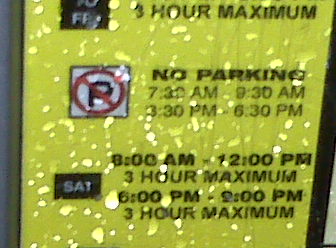
Hours for No Parking & Parking on a Meter

Parking signs drive me crazy. And, admittedly, as they say on Twitter, this is a #firstworldproblem. Still, I’m going to rant for a minute.

I’m a successful graduate of my high school, a college and two universities, and yet I gather with groups of my neighbours to study the parking signs in our neighbourhood, deciding when we should be moving our cars to the other side of the street or whether dinner guests really do have to leave within an hour.

Three signs

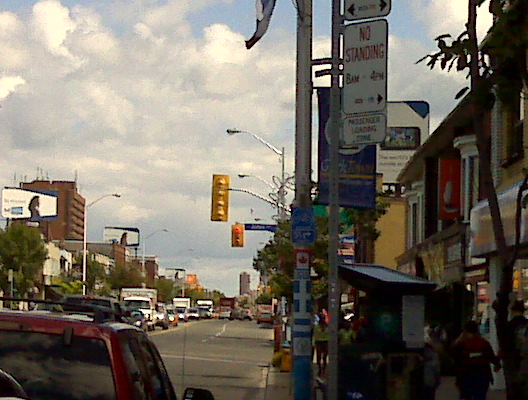
No Stopping obscured by parking sign

When I venture out into other neighbourhoods, where I may not find such friendly guidance, I run the risk of tickets, solo. Tonight, on a rainy night, I rushed down to Union Station to pick up my sister. I cooed to her that I had found a place to park, where at this late hour, I didn’t even have to pay the meter. We returned to a ticket – the area is a No Standing zone between 6 p.m. and midnight. That sign was obscured behind the larger sign commanding payment at the meter during the day. The row of us all had tickets. A quick Google search showed others had been hit the same way (and taken better pictures). Another fishing pond for tickets. Life in the big city, no?

A clump of signs

Parking meter under No Standing signs

My area in front of my workplace is particularly bad. There a parking meter sits under a set of signs that, if studied, reveal that, anywhere to the west of the meter, the exact direction in which it faces, it is a No Stopping zone every week day. However you have to read all four signs to learn that. Colleagues have stood there and debated with people as to whether park was allowed there. Close to $400 later, parking ticket in hand, they believe.

It’s rough out there. I found one travel website which gave this precaution about parking in Toronto — I should have listened:

PRECAUTIONS

If you are driving your own vehicle or a rental around Toronto, be very careful where you park. We found the parking signs on the streets to be a bit confusing, so opted to park in garages, which was much more costly.

I have full respect of the law. I just want/need to be able to understand it, if I am going to obey it.

Continue reading

October 8, 2010

If hubs are the solution, what’s the problem?

The following are comments I presented on a panel at the recent Social Planning Toronto symposium on schools as community hubs:

We know the research. Concentrated disadvantage, growing inequality, all shown in reports like Poverty by Postal Code, the Three Cities, and Social Planning’s own work, the ten year social demographic retrospective, authored by Beth Wilson, this past summer.

These are entrenched problems, ones seemingly intractable.  In his book, The Persistence of Poverty, philosopher Charles Karelis uses the metaphor of bee stings to explain how poverty cannot be cured through a singly-targeted effort. If one has many bee stings and only a little balm, it’s not worth trying to soothe just one of the stings. Each of the stings of poverty, the lack of a job, the lack of childcare, the lack of housing, the lack of a safety net, has to be treated at the same time.

This is why place-based interventions, like community hubs, make sense.

It’s startling to see what passes for common sense these days:
Hubs — Co-locating services so people don’t have to travel? Neighbourhood centres have been doing this for over 100 years.

Full-day kindergarten — Offering learning opportunities and childcare in the same space? Who knew this, but a parent?

Because funding structure and legislation have focused on populations and singular, simple problems, we have not made the traction we want on issues of poverty, things that are true to the common good and our civic values.

So, in response to the first part of this session which posits “If Hubs are the Solution….,” what problems are community hubs supposed to solve?

Using a place-based lens, hubs offer the ability to address complexity and entrenched problems. (Place-based solutions can rightly be critiqued for their own drawbacks — that many issues are beyond the scope of the local — but that’s another panel session.)

Hubs are one form of other institutions that use a place-based, wrap-around model; others are such as neighbourhood centres, settlement houses, multi-service agencies, community health centres, and even, once, community schools. (My children’s school was built in the 1960s so that the school library could be used as a public library, with a separate entrance build into the structure. That failed and now the library is down the block.)

The “system” has now adopted hubs as an answer that makes sense. Within Toronto, that means bringing community space to the inner suburbs where infrastructure supports, like meeting space and community programs, is too scarce.

The Strong Neighbourhood Taskforce and the resultant Strong Neighbourhoods strategies at the City government level and at United Way Toronto promoted hubs as one strand of the solution. The POL funds, major donor gifts, and funding through the Youth Challenge Fund helped to realize these new resources.

When the Strong Neighbourhoods Taskforce examined service levels across the city, in comparison with the needs of the local population, the one map that showed coverage, washed calm blue instead of fiery red, was the map of access to local schools. Schools are in every Toronto neighbourhood.

That’s why the concept of schools as community hubs makes such sense.

The  Toronto District School Board has grown this idea, through initiatives such as Sheila Cary-Meagher and Cassie Bell’s Model Schools for Inner City initiative. (Note these schools do not rigidly fall within the Priority Neighbourhood Areas – poor kids are more widely dispersed in the city). And, more recently, Director Spence began to open Full Use Schools. Both these programs open schools to the community and the community to schools.

The Ontario Ministry of Education has also recognized the sense of this. They have funded the Community Use of Schools program, which opens up school space to community agencies in the summer and after school, and, more recently, launched the Priority Schools Initiative, which provides support to grassroots groups to do the same.

“Schools as hubs” is on the radar.

In the midst of this municipal election, we hear candidates talking about schools as community hubs. The City has still to figure out how to work with the school board – the Community Partnership Strategy, for instance, is skirting  this boundary issue as it maps out the resources and assets in Toronto’s neighbourhoods.

So if there is all this wisdom, what’s the problem? Why are there not more hubs?

This summer I had the chance to work on a report on community hubs for the ICE committee, and that will soon be forthcoming.

But here’s a short list of some of the challenges:

Parental resistance – we still have to figure out how to work through the “stranger in the school” problem

System coordination – The multiple orders of government and even the silos within them make an integrated take, like this, challenging. Competing deadlines and funding criteria don’t make this easy.

The Funding Formula still funds school boards on a per pupil basis with targeted special grants laid on top. When school boards lost their taxing authority, they lost much of their flexibility to be innovative about local issues.

The burden of moving all this forward falls upon on two already burdened, under-funded sectors (education and community service agencies).

Listen to this semi-facetious “To Do” list for anyone developing a hub. Here’s what they have to develop:

  • Visioning
  • Partnership-building
  • Capital dollars fundraising
  • Operating dollars
  • Location identification
  • Community consultations
  • Resident engagement
  • Needs assessments
  • Zoning/permits, Design & space allocation
  • Service planning
  • Governance model
  • Administrative model
  • Feasibility studies
  • Lease agreements
  • Cost-projections
  • Cost-sharing ratio
  • Program space design and allocation
  • Operating hours
  • Outreach and communication strategy
  • Itinerant partnering protocol development
  • Staffing models
  • Job descriptions
  • Source funding
  • Emergency preparedness plan….

And we wonder why it can’t get done.

My job today was to provide evidence of why hubs are a good idea.

But we know they are. That’s why we’re all, three hundred, here.

This is less a rational debate where we need to convince each other of the merits of a good idea, but much more a discussion about our civic will and priorities and the administrative structures and resources required for this “good idea” to be realized.

Thank you.

Continue reading

September 24, 2010

Happy 2nd Blogday, Belonging Community!

Two years ago, Belonging Community began. As poet Dionne Brand has said, this is a city that is in the middle of “becoming,” and my hope was to think about Toronto from the level of a city block.

How can schools serve students better? What lives do our neighbours live? What does inequality look like at the neighbourhood level? How do local institutions affect our lives?

One hundred and two posts later, the Top Hits from the past year are:

Crime hotspots across Toronto neighbourhoods 2,992 More stats
Toronto Community Partnership Strategy: 443 More stats
About me 428 More stats
The Ontario HST: a counter-intuitive remedy 385 More stats
Ethnic enclaves in Toronto, 2001 – 2006 365 More stats
“Are there limits to gentrification? 333 More stats
The TDSB’s Learning Opportunity Index 323 More stats
Toronto swimming pools: Class in session 317 More stats
Community Partnership Strategy: NWI 265 More stats
Crime and social cohesion in Toronto 261 More stats
Defining race (and racism) in the TDSB LOI 243 More stats

Crime as you can see is big, with an average of eight hits a day. Other topics are popular because not many people are writing about them. My favourite pieces are less about these big policy pieces than the stories which emerge from living in an urban neighbourhood.

I have also appreciated the new community of bloggers, activists, and researcher that Belonging Community has introduced me to, people like Kevin Harris, Christopher Leo and Leo Romero. Sometimes too, I have even gotten a laugh. Three of the funniest (or strangest ways) people have found the blog recently are by using these search terms:

  • diane dyson emergency
  • ugliest areas of toronto
  • portland flag

Thanks all! It’s been a good year.

September 23, 2010

The "right" to choose your neighbours becomes an election issue

Just as the Annual YIMBY (Yes In My BackYard) festival is being organized for October 16 at the Drake hotel, Nimbyism is being re-visited in the Beach municipal election. Both events seem to be about having policy-makers listen to residents, but the difference lies in the inclusive lense that is used. Debates about what occur in a community often spill over into who will live in a neighbourhood, whether they be students or those living with life challenges.

A friend in the Beach tells the story of a church building which moved through three different applications to convert to affordable housing, each time being denied because those living nearby raised concerns about the proposed new mothers, or seniors or other populations who were to be sited there. The current controversy, about a new building opening on Gerrard at Woodbine, has convinced me to attend tonight’s All Candidate meeting as a case study of the tension between service-providers, policy-makers and local residents.

The HomeComing Community Choice Coalition circulated the following letter:

Thursday evening, September 23, there is an all candidates meeting in Ward 32 (Beaches) and one candidate is calling on voters to come use their voices based on their “right to be angry about the location of supportive housing at 1908 Gerrard Street East”. (at Woodbine)

In November 2007, neighbours heard that a private developer intended to build an apartment building on the site – and planned to rent the apartments to people living with mental illness under an agreement with Houselink Community Homes.  The development was zoned for the intended use, so there was no need for public consultation.  A number of area residents spoke against the development at the Affordable Housing Committee meeting dealing with the funding for the development.  As a result, City staff were directed to host a public open house with the local community in consultation with the office of the local Councillor Sandra Bussin.

At the public open house a number of concerns were voiced, many of which were related to the approval process and lack of consultation.  Other concerns were related to the people intended to live in the development:

  • that the area was overly represented with social housing
  • the impact of the housing on the community in terms of safety and security
  • whether there would be sufficient support provided to the tenants
  • the perceived lack of support services in the area

Confronted by a number of angry residents, Councillor Bussin stood her ground and defended both the process and the right of people to live in communities of their choice.  At the subsequent Council meeting to approve funding for the project, Councillor Bussin expressed her shame at the behaviour of her constituents.  Almost all of the Councillors present also rose to speak in support of funding for the project and to denounce those who would exclude people from the community based on a disability.

Now almost three years later, the building is ready for occupancy.  Graffiti calling Councillor Bussin a traitor was painted on hoardings at the building a year ago and recently similar graffiti attacking Bussin has been painted on the building itself.

Finally, within the past few days, a leaflet has appeared apparently from Martin Gladstone, a candidate for City Councillor, calling the process flawed and accusing Councillor Bussin of working against her constituents and shutting them down (attached).

While HomeComing Community Choice Coalition does not endorse any candidate for public office, we are concerned that this Councillor is being targeted for standing up for the rights of people to live in communities of their choice.  We have often affirmed that people do not have to ask the permission of their neighbours to live in a community and the neighbours do not have a right to be informed or consulted before new housing is built, if the only issue is the disability of the people who live there.

We will be at the meeting Thursday evening and hope that others will be there as well to say thank you to Councillor Sandra Bussin for standing up in the face of angry residents to say to the new Houselink tenants: “Yes in My Back Yard!”

HomeComing Community Choice Coalition

“We promote the rights of people with mental
illness to live in the neighbourhood of their choice.”

Postscript: So when the issue came to the floor tonight, Sandra Bussin’s hecklers called out, “It’s the process! Process!”  They knew, at least, it would not have looked well to be seen as picking on people living with mental illness.

September 19, 2010

The big tent of Toronto City Summit Alliance

Voluntarily, small groups have been meeting through the summer, producing backgrounders, developing position papers, and generating options, all with the aim of bettering the region of Toronto. Preparation for Toronto City Summit Alliance‘s (TCSA) 4th regional summit has begun in earnest.

ELN7

Image by Shaun Merritt via Flickr

The workgroups, roundtables and the summit, to be held in February 2011, draw people from a broad range of sectors, public, private, non-profit and citizen advocates. (The idea of working in concert, across sectors, is so engrained with TCSA’s work that I often mistakenly call TCSA the Toronto Community Summit Alliance.)

The work is like, one workgroup member explained, erecting a large tent where community conversation space is created, to discuss hard issues. Participants are looking for common ground on which to move forward together.

When the last summit was held, in 2005, one of the outcomes was the taskforce for Modernizing Income Security for Working Age Adults (MISWAA) which convened corporate heads with low-income people with community groups with economists with policy wonks. The result was the work that found how few Torontonians benefit from current income security programs, such as Employment Insurance, and the strong political pressure to improve access.

This time round, six free-standing workgroups have been convened to talk about the economy, the labour market, transit, income security, arts & culture, and neighbourhoods, social capital & housing. Each of these smaller groups leads to a larger roundtable, in the summer and fall, where ideas are tested and solutions sought. All this then rolls towards the regional summit.

ELN3

Image by Shaun Merritt via Flickr

Deliverables are already being realized. The Housing workgroup is assembling a regional data book — something wider than the data currently collected at the municipal level or CMA level, but more focused than provincial data. The transit workgroup, also early off the mark, delivered a discussion paper to its roundtable in July, looking at road tolls, among other issues.

These semi-structured and ongoing conversations participants together to address complex challenges, issues which are admittedly entwined so that the solutions also have to be integrated. Transit issues are woven to housing, labour market structures give form to income security, and cultural policies strengthen neighbourhoods. This is happening as the summit draws closer.

Unwieldy though the approach seems, everyone erecting tent poles, pulling canvas and moving chairs, to create a metaphorical tent, it is a hopeful activity, creating common space and emergent wisdom.

TCSA’s model of convening moves political activity from divisive battles, at the ramparts, to a more modern and civil version: in-person crowd-sourcing.