Posts tagged ‘Toronto’

March 30, 2011

Another challenge for non-profits

Olivia Nuamah, the new C.E.O. of Toronto’s Atkinson Foundation, was a largely unknown entity so it’s not surprising that an overflow crowd arrived to hear her speak at last month’s meeting of the Toronto Neighbourhood Centres (TNC). She had impressed community attendees at Civic Action’s Greater Toronto Summit 2011 when she was the only one to raise, from a position on the main stage,  the topic of corporate taxes.

Nuamah came for the final hour of the TNC meeting; the discussion persisted well beyond the scheduled end. Nuamah described the culture shock of returning to Toronto, a city where she was born of immigrant parents, educated in the public school system, before emigrating to England as a young adult. After 16 years, she is back with a family, having spent her adult life in European advocacy.

Nuamah remembers the strong community development ethos in the Toronto of her youth, and she explains, she is shell-shocked at the erosion of services she see now. Her recollection of a strong and vital Toronto echo the type of city that Calgary Mayor Nenshi described in his visit here last February:

I was raised in a family in east Calgary in a working class neighbourhood that didn’t have a lot of money. What I had was remarkable opportunity. I graduated from excellent public schools, I explored the city that I love on public transit, I learned to swim very badly in public pools and I spent my Saturday afternoons in the public library. I grew up in a community that gave me a chance to succeed and gave every kid growing up in the community the chance to succeed.”

Now is different. Nuamah is surprised to see how the discussion of neighbourhoods isolates Torontonians from each other, disconnecting us from a common vision. She also sees how non-profits and community agencies have been depleted by multiple layers of reporting and competitive funding structures. Her own Foundation is admittedly a part of this, she said, “funding one agency six different times to do six different things.”

In the end, funders search for the lowest “price per head,” pilot projects become a normal course for service delivery, and auditors make program decisions. The community sector is pressed towards professionalization, further distancing staff and clients from each other. The effect is that neighbourhood agencies function as a corporate arm of city services and are not recognized for the wider scope and value of their community and city-building work. Nuamah described all these dynamics.

So the Atkinson Foundation is trying to find ways to support the non-profit sector. (As it undergoes this renewal, its grants are currently on hold and are set to launch again in 2012.) The foundation’s redeveloped agenda, Nuamah said, will address sustainability and include ideas of networking, sectoral advocacy, and strengthening the capacity of volunteer boards.

The trends towards cost-cutting and others whispers of the transformations from the United Kingdom are popping up here everywhere. “First, it was garbage,” Nuamah explained, describing the growing press for efficiencies as a path to privatization. Meeting participants hooted in recognition.

Nuamah pressed on, advising, we must be ready to work together to face the hard questions. We must think collectively. We must claim the basic right to advocate. We must also get better at communicating, moving away from the polemic and away from university-level language.  If the sector doesn’t start this hard work, the ground will shift before we can act.

The Neighbourhood staff weighed in, too, explaining how non-profits have learned to use every penny, giving greater value than what funders pay for; how the stress builds among staff as the system relies on individual heroes to make it function (One Executive Director in attendance described the regular announcement at her sector’s annual conference of the E.D.’s who had died in the previous year); and, how non-governmental funders had to be ready to defend the non-profit sector since community agencies are too often dismissed as self-interested.

The later afternoon meeting finally ended, but the discussion had only started.

read more »

February 15, 2011

What’s important to you about community services in your Toronto neighbourhood?: City consultation open

The City of Toronto is looking for our help as part of the development of its Community Partnership Strategy. The Community Partnership Strategy is an  initiative that will help the City make sure that Toronto neighbourhoods have community services that work well for residents, and a strong community service sector to deliver them.

Together, with the Centre for Research on Inner City Health (CRICH) at St. Michael’s Hospital, they have gathered 50 ideas about the things that the City could pay attention to so that it knows how well community services are working for residents in Toronto neighbourhoods.

They are now asking Toronto residents, community service organizations, funders, businesses, and others to say which of these ideas are the most important. The City will use these opinions to help decide what work needs to be done to ensure Toronto has community services that work well.

Our input  is invited. There are three ways to do this:

  1. A researcher from CRICH can come to your organization and to meet with a group for about 30 minutes. They would explain the study and ask participants to fill out a short questionnaire and rate the collected ideas.
  2. Attend one of the two ‘open houses’ that being held:
  3. Participate online by sending an e-mail to smh.toronto.study@gmail.com for more information.

Participation is set to run from February 22, 2011 – March 15, 2011.

(My thanks to Sarah Rix for forwarding this to me.)

read more »

January 2, 2011

2010 in review: WordPress blog mail and more

This is the new year’s message I got from WordPress and some of my own thoughts on the year in More.

The stats helper monkeys at WordPress.com mulled over how this blog did in 2010, and here’s a high level summary of its overall blog health:

Healthy blog!

The Blog-Health-o-Meter™ reads This blog is on fire!

Crunchy numbers

Featured image

A helper monkey made this abstract painting, inspired by your stats.

The average container ship can carry about 4,500 containers. This blog was viewed about 16,000 times in 2010. If each view were a shipping container, your blog would have filled about 4 fully loaded ships.

In 2010, there were 34 new posts, growing the total archive of this blog to 107 posts. There were 5 pictures uploaded, taking up a total of 846kb.

The busiest day of the year was January 19th with 121 views. The most popular post that day was Toronto Community Partnership Strategy: Priority Neighbourhood Areas revised.

Where did they come from?

The top referring sites in 2010 were atwork.settlement.org, facebook.com, twitter.com, networkedblogs.com, and google.ca.

Some visitors came searching, mostly for high crime areas in toronto, toronto neighbourhood crime rates, diane dyson, crime in toronto neighbourhoods, and tdsb loi.

Attractions in 2010

These are the posts and pages that got the most views in 2010.

1

Toronto Community Partnership Strategy: Priority Neighbourhood Areas revised January 2010
2 comments

2

Crime hotspots across Toronto neighbourhoods September 2009
5 comments

3

About me April 2009
5 comments

4

Community Partnership Strategy: Neighbourhood Well-being Index April 2010
3 comments

5

Ethnic enclaves in Toronto, 2001 – 2006 February 2009
3 comments

Some of your most popular posts were written before 2010. Your writing has staying power! Consider writing about those topics again.

read more »

November 17, 2010

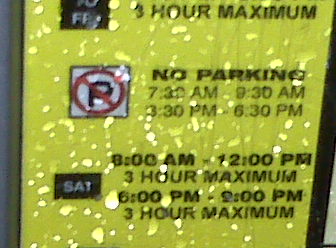
Parking signs, parking tickets, pah!

Hours for No Parking & Parking on a Meter

Parking signs drive me crazy. And, admittedly, as they say on Twitter, this is a #firstworldproblem. Still, I’m going to rant for a minute.

I’m a successful graduate of my high school, a college and two universities, and yet I gather with groups of my neighbours to study the parking signs in our neighbourhood, deciding when we should be moving our cars to the other side of the street or whether dinner guests really do have to leave within an hour.

Three signs

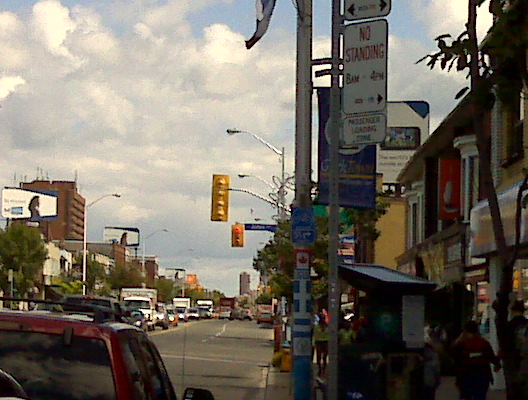
No Stopping obscured by parking sign

When I venture out into other neighbourhoods, where I may not find such friendly guidance, I run the risk of tickets, solo. Tonight, on a rainy night, I rushed down to Union Station to pick up my sister. I cooed to her that I had found a place to park, where at this late hour, I didn’t even have to pay the meter. We returned to a ticket – the area is a No Standing zone between 6 p.m. and midnight. That sign was obscured behind the larger sign commanding payment at the meter during the day. The row of us all had tickets. A quick Google search showed others had been hit the same way (and taken better pictures). Another fishing pond for tickets. Life in the big city, no?

A clump of signs

Parking meter under No Standing signs

My area in front of my workplace is particularly bad. There a parking meter sits under a set of signs that, if studied, reveal that, anywhere to the west of the meter, the exact direction in which it faces, it is a No Stopping zone every week day. However you have to read all four signs to learn that. Colleagues have stood there and debated with people as to whether park was allowed there. Close to $400 later, parking ticket in hand, they believe.

It’s rough out there. I found one travel website which gave this precaution about parking in Toronto — I should have listened:

PRECAUTIONS

If you are driving your own vehicle or a rental around Toronto, be very careful where you park. We found the parking signs on the streets to be a bit confusing, so opted to park in garages, which was much more costly.

I have full respect of the law. I just want/need to be able to understand it, if I am going to obey it.

read more »

October 8, 2010

If hubs are the solution, what’s the problem?

The following are comments I presented on a panel at the recent Social Planning Toronto symposium on schools as community hubs:

We know the research. Concentrated disadvantage, growing inequality, all shown in reports like Poverty by Postal Code, the Three Cities, and Social Planning’s own work, the ten year social demographic retrospective, authored by Beth Wilson, this past summer.

These are entrenched problems, ones seemingly intractable.  In his book, The Persistence of Poverty, philosopher Charles Karelis uses the metaphor of bee stings to explain how poverty cannot be cured through a singly-targeted effort. If one has many bee stings and only a little balm, it’s not worth trying to soothe just one of the stings. Each of the stings of poverty, the lack of a job, the lack of childcare, the lack of housing, the lack of a safety net, has to be treated at the same time.

This is why place-based interventions, like community hubs, make sense.

It’s startling to see what passes for common sense these days:
Hubs — Co-locating services so people don’t have to travel? Neighbourhood centres have been doing this for over 100 years.

Full-day kindergarten — Offering learning opportunities and childcare in the same space? Who knew this, but a parent?

Because funding structure and legislation have focused on populations and singular, simple problems, we have not made the traction we want on issues of poverty, things that are true to the common good and our civic values.

So, in response to the first part of this session which posits “If Hubs are the Solution….,” what problems are community hubs supposed to solve?

Using a place-based lens, hubs offer the ability to address complexity and entrenched problems. (Place-based solutions can rightly be critiqued for their own drawbacks — that many issues are beyond the scope of the local — but that’s another panel session.)

Hubs are one form of other institutions that use a place-based, wrap-around model; others are such as neighbourhood centres, settlement houses, multi-service agencies, community health centres, and even, once, community schools. (My children’s school was built in the 1960s so that the school library could be used as a public library, with a separate entrance build into the structure. That failed and now the library is down the block.)

The “system” has now adopted hubs as an answer that makes sense. Within Toronto, that means bringing community space to the inner suburbs where infrastructure supports, like meeting space and community programs, is too scarce.

The Strong Neighbourhood Taskforce and the resultant Strong Neighbourhoods strategies at the City government level and at United Way Toronto promoted hubs as one strand of the solution. The POL funds, major donor gifts, and funding through the Youth Challenge Fund helped to realize these new resources.

When the Strong Neighbourhoods Taskforce examined service levels across the city, in comparison with the needs of the local population, the one map that showed coverage, washed calm blue instead of fiery red, was the map of access to local schools. Schools are in every Toronto neighbourhood.

That’s why the concept of schools as community hubs makes such sense.

The  Toronto District School Board has grown this idea, through initiatives such as Sheila Cary-Meagher and Cassie Bell’s Model Schools for Inner City initiative. (Note these schools do not rigidly fall within the Priority Neighbourhood Areas – poor kids are more widely dispersed in the city). And, more recently, Director Spence began to open Full Use Schools. Both these programs open schools to the community and the community to schools.

The Ontario Ministry of Education has also recognized the sense of this. They have funded the Community Use of Schools program, which opens up school space to community agencies in the summer and after school, and, more recently, launched the Priority Schools Initiative, which provides support to grassroots groups to do the same.

“Schools as hubs” is on the radar.

In the midst of this municipal election, we hear candidates talking about schools as community hubs. The City has still to figure out how to work with the school board – the Community Partnership Strategy, for instance, is skirting  this boundary issue as it maps out the resources and assets in Toronto’s neighbourhoods.

So if there is all this wisdom, what’s the problem? Why are there not more hubs?

This summer I had the chance to work on a report on community hubs for the ICE committee, and that will soon be forthcoming.

But here’s a short list of some of the challenges:

Parental resistance – we still have to figure out how to work through the “stranger in the school” problem

System coordination – The multiple orders of government and even the silos within them make an integrated take, like this, challenging. Competing deadlines and funding criteria don’t make this easy.

The Funding Formula still funds school boards on a per pupil basis with targeted special grants laid on top. When school boards lost their taxing authority, they lost much of their flexibility to be innovative about local issues.

The burden of moving all this forward falls upon on two already burdened, under-funded sectors (education and community service agencies).

Listen to this semi-facetious “To Do” list for anyone developing a hub. Here’s what they have to develop:

  • Visioning
  • Partnership-building
  • Capital dollars fundraising
  • Operating dollars
  • Location identification
  • Community consultations
  • Resident engagement
  • Needs assessments
  • Zoning/permits, Design & space allocation
  • Service planning
  • Governance model
  • Administrative model
  • Feasibility studies
  • Lease agreements
  • Cost-projections
  • Cost-sharing ratio
  • Program space design and allocation
  • Operating hours
  • Outreach and communication strategy
  • Itinerant partnering protocol development
  • Staffing models
  • Job descriptions
  • Source funding
  • Emergency preparedness plan….

And we wonder why it can’t get done.

My job today was to provide evidence of why hubs are a good idea.

But we know they are. That’s why we’re all, three hundred, here.

This is less a rational debate where we need to convince each other of the merits of a good idea, but much more a discussion about our civic will and priorities and the administrative structures and resources required for this “good idea” to be realized.

Thank you.

read more »

September 24, 2010

Happy 2nd Blogday, Belonging Community!

Two years ago, Belonging Community began. As poet Dionne Brand has said, this is a city that is in the middle of “becoming,” and my hope was to think about Toronto from the level of a city block.

How can schools serve students better? What lives do our neighbours live? What does inequality look like at the neighbourhood level? How do local institutions affect our lives?

One hundred and two posts later, the Top Hits from the past year are:

Crime hotspots across Toronto neighbourhoods 2,992 More stats
Toronto Community Partnership Strategy: 443 More stats
About me 428 More stats
The Ontario HST: a counter-intuitive remedy 385 More stats
Ethnic enclaves in Toronto, 2001 – 2006 365 More stats
“Are there limits to gentrification? 333 More stats
The TDSB’s Learning Opportunity Index 323 More stats
Toronto swimming pools: Class in session 317 More stats
Community Partnership Strategy: NWI 265 More stats
Crime and social cohesion in Toronto 261 More stats
Defining race (and racism) in the TDSB LOI 243 More stats

Crime as you can see is big, with an average of eight hits a day. Other topics are popular because not many people are writing about them. My favourite pieces are less about these big policy pieces than the stories which emerge from living in an urban neighbourhood.

I have also appreciated the new community of bloggers, activists, and researcher that Belonging Community has introduced me to, people like Kevin Harris, Christopher Leo and Leo Romero. Sometimes too, I have even gotten a laugh. Three of the funniest (or strangest ways) people have found the blog recently are by using these search terms:

  • diane dyson emergency
  • ugliest areas of toronto
  • portland flag

Thanks all! It’s been a good year.

September 19, 2010

The big tent of Toronto City Summit Alliance

Voluntarily, small groups have been meeting through the summer, producing backgrounders, developing position papers, and generating options, all with the aim of bettering the region of Toronto. Preparation for Toronto City Summit Alliance‘s (TCSA) 4th regional summit has begun in earnest.

ELN7

Image by Shaun Merritt via Flickr

The workgroups, roundtables and the summit, to be held in February 2011, draw people from a broad range of sectors, public, private, non-profit and citizen advocates. (The idea of working in concert, across sectors, is so engrained with TCSA’s work that I often mistakenly call TCSA the Toronto Community Summit Alliance.)

The work is like, one workgroup member explained, erecting a large tent where community conversation space is created, to discuss hard issues. Participants are looking for common ground on which to move forward together.

When the last summit was held, in 2005, one of the outcomes was the taskforce for Modernizing Income Security for Working Age Adults (MISWAA) which convened corporate heads with low-income people with community groups with economists with policy wonks. The result was the work that found how few Torontonians benefit from current income security programs, such as Employment Insurance, and the strong political pressure to improve access.

This time round, six free-standing workgroups have been convened to talk about the economy, the labour market, transit, income security, arts & culture, and neighbourhoods, social capital & housing. Each of these smaller groups leads to a larger roundtable, in the summer and fall, where ideas are tested and solutions sought. All this then rolls towards the regional summit.

ELN3

Image by Shaun Merritt via Flickr

Deliverables are already being realized. The Housing workgroup is assembling a regional data book — something wider than the data currently collected at the municipal level or CMA level, but more focused than provincial data. The transit workgroup, also early off the mark, delivered a discussion paper to its roundtable in July, looking at road tolls, among other issues.

These semi-structured and ongoing conversations participants together to address complex challenges, issues which are admittedly entwined so that the solutions also have to be integrated. Transit issues are woven to housing, labour market structures give form to income security, and cultural policies strengthen neighbourhoods. This is happening as the summit draws closer.

Unwieldy though the approach seems, everyone erecting tent poles, pulling canvas and moving chairs, to create a metaphorical tent, it is a hopeful activity, creating common space and emergent wisdom.

TCSA’s model of convening moves political activity from divisive battles, at the ramparts, to a more modern and civil version: in-person crowd-sourcing.

October 17, 2009

Toronto's emotional map running hot & cold

Kevin Stolarick, Richard Florida’s “stats guy” at the Martin Prosperity Institute has been up to a bit of mischievous mapping in his spare time.

Using data from a UC Berkeley psychologist who publishes the Big Five Personality Test , Stolarick has mapped out the major emotional of characteristics of Toronto residents by neighbourhood (probably Forward Sortation Areas – the first three digits of a postal code).

The Toronto Star published the maps today: Toronto the Good – and bad and sad and mellow and … .

It’s a relief to see some maps that break the traditional “U” and “O” deprivation patterns. West-enders are extroverted, east-enders are neurotic. Suburban areas tend to be more agreeable, while those along the subway lines are less so. Most of the city is the conscientious type. Those closer to the lake tend to be more open to new experiences.

Now, because the survey is web-based, Stolarick says the sample is probably skewed towards the young (and tech-savvy), but it certainly is a bit of fun!