Posts tagged ‘Urban Affairs’

February 11, 2011

A successful city

It had been a long day at the Civic Action GTA Summit of, as Ursula Franklin calls it, “awfulizing.” Transit woes, labour market mismatches, social inequities.

Then the final speaker, Carol Colleta, the Chief Executive Officer of CEOs for Cities, arrived. Coletta is  a city builder a few times over, an advocate for the creative force of cities as described by Edward Glaeser and Richard Florida.

“With cities, there is no permanent success, and there are no permanent failures,” Coletta, in a rousing speech, told the 700 delegates who had been there since early morning.

The success of cities, she explained, is directly related to a city’s:

  • quality of talent
  • quality of place, and
  • quality of opportunity

Toronto, Coletta said, has to be a place where talent sticks, and to make talent stick, a city needs each of these.

Investments in quality of place last a very long time, and so, she reminded the crowd, it is important to get them right.

Opportunities have to be apparent and good, so that people see a future for themselves.

Getting all these things right means tapping into wider knowledge circles. This means finding creative ways to invite those who aren’t in the room to be part of city-building. She pointed to Give A Minute as an example of a new crowd-sourcing initiative already in a few American cities.

So how then to move towards success? Long-terms goals are not achieved without short-term behavioural changes. Colleta outlined three steps:

  1. Have a measurable goal. It drives behaviour;
  2. Have an achievable goal. It gets buy-in; and
  3. Have a short-term goal. That drives short-term behaviour.

All of this, Coletta explained, is propelled by a final element: quality of leadership. She left the crowd with a final question, “Does Toronto have the leadership in place to make this happen?”

read more »

December 1, 2010

How scared should we be about bed bugs?

Adult bed bug, Cimex lectularius

Image via Wikipedia

Knowing I work at WoodGreen Community Services, which has been on the forefront of the bedbug issue for a while, a friend asked me how nervous she should be about going to a movie theatre that night.

Her fear sprang from the furor causes when a tweet wrongly accused Scotiabank Theatre of harbouring bed bugs and the widespread media coverage how the bugs are sweeping Manhattan’s toniest locations.

“Or how about subways and street cars?” she asked.

“Go,” I said. “If you’re nervous, strip off when you get home, bag your clothes and then launder and dry them.”

We are not (yet) at the point you have to stop going out into public spaces.

Some activities are riskier, such as

  • moving residences (especially if it’s into an apartment building — so make sure to ask),
  • travelling (check those head boards and mattress seams), or
  • picking up second-hand furniture off the street (no more boulevard shopping).

I still trust the Toronto Transit Commission – especially safe in the winter when most of its vehicles sit outside overnight, freezing. And I think movie theatres – and other entertainment venues – were so shaken by the Twitter furor, that I expect discreet inspections are done regularly.

The good news, this week, was the attention that bed bugs generated at the municipal and provincial levels. If we manage our own surroundings cautiously and if coordinated and proactive actions are taken, bed bugs will be well-managed.

A community bed bug committee, composed of residents, tenant associations, non-profits, government reps and broader networks recently adopted a “Bedbug Mani-pest-o” outlining five key points:

  1. Build a public education campaign to raise awareness on the rising incidence of bed bug infestations, the methods of dealing with them and to de-stigmatize bed bugs
  2. Establish standard protocols for treatment of bed bugs
  3. Develop and promote a consistent community response that includes funds to support vulnerable populations to reduce financial barriers to eradicate bed bugs
  4. Conduct widespread monitoring of bed bug incidences across the Province
  5. Draft and enact legislative policies that support quick and effective responses to bed bugs

Liberal M.P.P. Mike Colle has taken almost all of these and built them into his recommendations to the province, only shying away from the legislative piece.

N.D.P. Cheri DiNovo has introduced a bill to license landlords.

The Toronto Board of Health and the City of Toronto are both lobbying for more resources, arguing that early interventions will ensure bed bugs don’t spread further.

Solutions are emerging.

For the moment, we can sleep tight. Just don’t let the bed bugs bite.

read more »

November 17, 2010

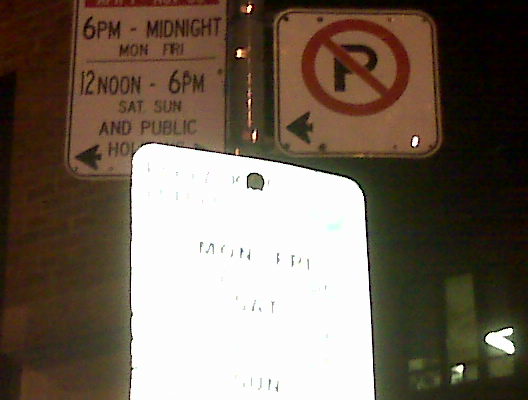
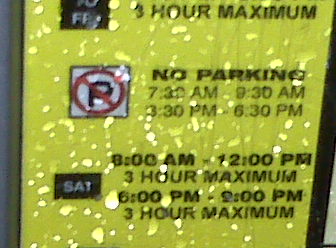
Parking signs, parking tickets, pah!

Hours for No Parking & Parking on a Meter

Parking signs drive me crazy. And, admittedly, as they say on Twitter, this is a #firstworldproblem. Still, I’m going to rant for a minute.

I’m a successful graduate of my high school, a college and two universities, and yet I gather with groups of my neighbours to study the parking signs in our neighbourhood, deciding when we should be moving our cars to the other side of the street or whether dinner guests really do have to leave within an hour.

Three signs

No Stopping obscured by parking sign

When I venture out into other neighbourhoods, where I may not find such friendly guidance, I run the risk of tickets, solo. Tonight, on a rainy night, I rushed down to Union Station to pick up my sister. I cooed to her that I had found a place to park, where at this late hour, I didn’t even have to pay the meter. We returned to a ticket – the area is a No Standing zone between 6 p.m. and midnight. That sign was obscured behind the larger sign commanding payment at the meter during the day. The row of us all had tickets. A quick Google search showed others had been hit the same way (and taken better pictures). Another fishing pond for tickets. Life in the big city, no?

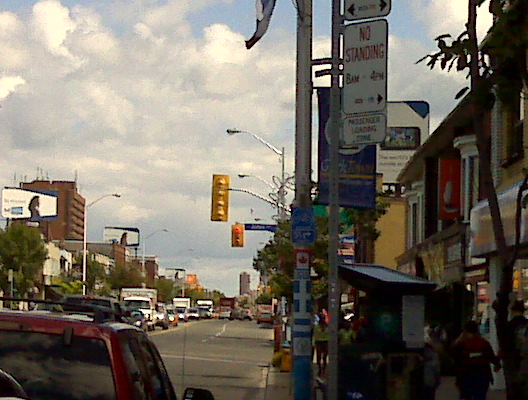
A clump of signs

Parking meter under No Standing signs

My area in front of my workplace is particularly bad. There a parking meter sits under a set of signs that, if studied, reveal that, anywhere to the west of the meter, the exact direction in which it faces, it is a No Stopping zone every week day. However you have to read all four signs to learn that. Colleagues have stood there and debated with people as to whether park was allowed there. Close to $400 later, parking ticket in hand, they believe.

It’s rough out there. I found one travel website which gave this precaution about parking in Toronto — I should have listened:

PRECAUTIONS

If you are driving your own vehicle or a rental around Toronto, be very careful where you park. We found the parking signs on the streets to be a bit confusing, so opted to park in garages, which was much more costly.

I have full respect of the law. I just want/need to be able to understand it, if I am going to obey it.

read more »

September 23, 2010

The "right" to choose your neighbours becomes an election issue

Just as the Annual YIMBY (Yes In My BackYard) festival is being organized for October 16 at the Drake hotel, Nimbyism is being re-visited in the Beach municipal election. Both events seem to be about having policy-makers listen to residents, but the difference lies in the inclusive lense that is used. Debates about what occur in a community often spill over into who will live in a neighbourhood, whether they be students or those living with life challenges.

A friend in the Beach tells the story of a church building which moved through three different applications to convert to affordable housing, each time being denied because those living nearby raised concerns about the proposed new mothers, or seniors or other populations who were to be sited there. The current controversy, about a new building opening on Gerrard at Woodbine, has convinced me to attend tonight’s All Candidate meeting as a case study of the tension between service-providers, policy-makers and local residents.

The HomeComing Community Choice Coalition circulated the following letter:

Thursday evening, September 23, there is an all candidates meeting in Ward 32 (Beaches) and one candidate is calling on voters to come use their voices based on their “right to be angry about the location of supportive housing at 1908 Gerrard Street East”. (at Woodbine)

In November 2007, neighbours heard that a private developer intended to build an apartment building on the site – and planned to rent the apartments to people living with mental illness under an agreement with Houselink Community Homes.  The development was zoned for the intended use, so there was no need for public consultation.  A number of area residents spoke against the development at the Affordable Housing Committee meeting dealing with the funding for the development.  As a result, City staff were directed to host a public open house with the local community in consultation with the office of the local Councillor Sandra Bussin.

At the public open house a number of concerns were voiced, many of which were related to the approval process and lack of consultation.  Other concerns were related to the people intended to live in the development:

  • that the area was overly represented with social housing
  • the impact of the housing on the community in terms of safety and security
  • whether there would be sufficient support provided to the tenants
  • the perceived lack of support services in the area

Confronted by a number of angry residents, Councillor Bussin stood her ground and defended both the process and the right of people to live in communities of their choice.  At the subsequent Council meeting to approve funding for the project, Councillor Bussin expressed her shame at the behaviour of her constituents.  Almost all of the Councillors present also rose to speak in support of funding for the project and to denounce those who would exclude people from the community based on a disability.

Now almost three years later, the building is ready for occupancy.  Graffiti calling Councillor Bussin a traitor was painted on hoardings at the building a year ago and recently similar graffiti attacking Bussin has been painted on the building itself.

Finally, within the past few days, a leaflet has appeared apparently from Martin Gladstone, a candidate for City Councillor, calling the process flawed and accusing Councillor Bussin of working against her constituents and shutting them down (attached).

While HomeComing Community Choice Coalition does not endorse any candidate for public office, we are concerned that this Councillor is being targeted for standing up for the rights of people to live in communities of their choice.  We have often affirmed that people do not have to ask the permission of their neighbours to live in a community and the neighbours do not have a right to be informed or consulted before new housing is built, if the only issue is the disability of the people who live there.

We will be at the meeting Thursday evening and hope that others will be there as well to say thank you to Councillor Sandra Bussin for standing up in the face of angry residents to say to the new Houselink tenants: “Yes in My Back Yard!”

HomeComing Community Choice Coalition

“We promote the rights of people with mental
illness to live in the neighbourhood of their choice.”

Postscript: So when the issue came to the floor tonight, Sandra Bussin’s hecklers called out, “It’s the process! Process!”  They knew, at least, it would not have looked well to be seen as picking on people living with mental illness.

September 19, 2010

The big tent of Toronto City Summit Alliance

Voluntarily, small groups have been meeting through the summer, producing backgrounders, developing position papers, and generating options, all with the aim of bettering the region of Toronto. Preparation for Toronto City Summit Alliance‘s (TCSA) 4th regional summit has begun in earnest.

ELN7

Image by Shaun Merritt via Flickr

The workgroups, roundtables and the summit, to be held in February 2011, draw people from a broad range of sectors, public, private, non-profit and citizen advocates. (The idea of working in concert, across sectors, is so engrained with TCSA’s work that I often mistakenly call TCSA the Toronto Community Summit Alliance.)

The work is like, one workgroup member explained, erecting a large tent where community conversation space is created, to discuss hard issues. Participants are looking for common ground on which to move forward together.

When the last summit was held, in 2005, one of the outcomes was the taskforce for Modernizing Income Security for Working Age Adults (MISWAA) which convened corporate heads with low-income people with community groups with economists with policy wonks. The result was the work that found how few Torontonians benefit from current income security programs, such as Employment Insurance, and the strong political pressure to improve access.

This time round, six free-standing workgroups have been convened to talk about the economy, the labour market, transit, income security, arts & culture, and neighbourhoods, social capital & housing. Each of these smaller groups leads to a larger roundtable, in the summer and fall, where ideas are tested and solutions sought. All this then rolls towards the regional summit.

ELN3

Image by Shaun Merritt via Flickr

Deliverables are already being realized. The Housing workgroup is assembling a regional data book — something wider than the data currently collected at the municipal level or CMA level, but more focused than provincial data. The transit workgroup, also early off the mark, delivered a discussion paper to its roundtable in July, looking at road tolls, among other issues.

These semi-structured and ongoing conversations participants together to address complex challenges, issues which are admittedly entwined so that the solutions also have to be integrated. Transit issues are woven to housing, labour market structures give form to income security, and cultural policies strengthen neighbourhoods. This is happening as the summit draws closer.

Unwieldy though the approach seems, everyone erecting tent poles, pulling canvas and moving chairs, to create a metaphorical tent, it is a hopeful activity, creating common space and emergent wisdom.

TCSA’s model of convening moves political activity from divisive battles, at the ramparts, to a more modern and civil version: in-person crowd-sourcing.

August 10, 2010

Sidewalk exchanges

When the small piano on my front porch begins to tinkle, I know a neighbourhood toddler has ventured up from the sidewalk, tired parent in tow. I keep it there just for that. In the winter, we meet out there when we are shovelling. Or we see each other early in the morning when we are running out with our smelly green bins. Clusters of us appear along the street as we return from our workday, visiting those already on their porch.

This, like any neighbourhood, is a neighbourhood where our sidewalks are important.

Our sidewalks also serve a trading function. Old bookshelves, dishes and lamps are regularly laid out well before garbage day in the neighbourhood for perusal and collection by others.  I recently met a new neighbour and realized I had her discarded lamp in my living room. (In my first house, most of the furniture “free-cycled.” My partner and I even learned the garbage collection schedule of several of the upscale areas around us—sadly, something I would be less likely to do now with the urban spread of bed bugs.)

These outdoor activities have grown out of the density of our neighbourhood where we live cheek by porch, exchanges which occur by design, by happenstance, by tradition and by local culture. They have made our neighbourhood a better place to be.

Flag of Portland, Oregon. Designed by Douglas ...

Flag of Portland, Oregon. Image via Wikipedia

Word now from Portland, Oregon, where a few neighbourhoods have formalized the opportunities for these daily communal interactions, including setting up a local outdoor tea cart and building neighbourhood “sharing posts.” Mike Lanza at Playborhood.com posted  on the this development after he took a trip to the west coast.  When Communities take over their own streets includes pictures of these great communal creations. Read it to enjoy!

Using the same creative approach, Neighbourhoods blogger Kevin Harris was one of the initiators of  a new, fun Facebook group called 50 ways to meet your neighbours (“Give a nod on the bud, Gus”). The group sprang out of a meeting Harris attended and some recent research he described that showed that Brits are shy about meeting one another.

Sounds familiar. Sidewalks are a low-risk way for us all to get to enjoy a little musical (or other form of) interchange.

April 11, 2010

Community Partnership Strategy: Neighbourhood Well-being Index

(Updates – July 1, 2011: The NWI is has been re-branded and launched as Wellbeing Toronto. July 29, 2010: This should now be referred to as the Neighbourhood Well-being Indices. Revised by the City researchers.)

Statistics and geography is about to get a whole lot more fun in the City of Toronto. City staff are working to create interactive, flash maps which allow users to explore neighbourhood-level indicators.

This fresh concept of a way to measure the vitality of a neighbourhood has now evolved into a first draft of the Neighbourhood Well-being Index (NWI). The NWI will collect neighbourhood-level information from a broad range of sources, including Statistics Canada demographic data and the City’s own administrative databases.

The NWI  is a new and separate initiative from City of Toronto staff, but it dovetails neatly with Council’s newly adopted Community Partnership Strategy, providing the broad evidence base for the strategy. The NWI also complements the move towards open data initiative, OpenTO, acting as an open data warehouse.

Some of the data to be mapped data is already available, in less friendly formats, through the City’s neighbourhood profiles, the Community Social Data Strategy and TO iMapit. The NWI will enable users to identify key populations groups or services of interest and then produce a user-friendly map of the data.

Several good examples from the U.S.A. give a preview of what the NWI might look like:

  • The New York City website Envisioning Development Toolkit is a friendly tool which compares neighbourhood rent and incomes.
  • California’s Healthy City is a more data-rich site which allows users to map local services and demographics.
  • The Reinvestment Fund’s Policy Map compares a range of data across numerous American cities.

In a sophisticated web-based interface, Toronto residents will be able to select the indicators and identify their own “priority neighbourhoods,” a shift from the current Priority Neighbourhood Areas that were selected using more universal indicators which don’t always match specific local priorities. Service-providers for youth or newcomers or seniors will able to identify the highest need neighbourhoods for each of their own populations.

Two overarching data clusters will be used as measures of a neighbourhood’s wellbeing, allowing a more granular examination of Toronto neighbourhoods. These are

  • Population Characteristics, such as Age, Gender, Language, Ethnicity, Family structure, Income.
  • Human Service Infrastructures, from and about Community Centres, Libraries, Parks, Police Stations, Schools, etc.

The NWI’s ten domains and particular indicators will likely expand as additional neighbourhood-level data becomes available. The first draft is exploring the following areas:

  • Arts, Culture and Heritage: Agency Funding & Grants; Community programs; Neighbourhood-permitted events
  • Civic Engagement and Social Inclusion: Agency Funding & Grants; City Beautification Initiatives; Community Meeting Spaces; Donations; Volunteerism; Voter Participation
  • Economic Security: 211 Calls for Service; Child Care; Community-based Services; Debt Load (excluding mortgages); Local Neighbourhood Employment; Long-term Employment; Social Assistance; Unemployment; Variety of Local Businesses; Wages & Benefits.
  • Education: Community-based Services; Early Development Instrument (EDI); High School Students applications to college/university; High School Drop-out Rates; High School Students passing Ontario Secondary School Literacy Test (OSSLT); Library Circulations
  • Environment: Open Space; Pollution/Toxic sites; Soil conditions
  • Housing: social housing waiting lists; property taxes; affordability (sales); adequacy (standards); rooming houses; Streets-to-Homes placements; Long-term Home Care Services survey; Toronto Community Housing tenant profiles; Homelessness & Hidden Homeless; 211 calls for information; and community based services.
  • Recreation and Leisure: Participants and drop-ins users of parks and recreation programs; waiting lists; facilities capacities
  • Safety: By-law inspections/Standards complaints [although these tend to rise with the income of a neighbourhood]; Calls for EMS; Community-based Services; Crime by major categories; Domestic Violence; Fire Code inspections; Firearms shootings and victims; Fires & Arsons; Grow Ops; Pedestrian & Cyclist Collisions & Injuries; Toronto Community Housing Safety and Incidents;
  • Transportation: Commuting; Public Transit Access; Wheel Trans Use; Traffic volumes. [One potential but unnoted measures is walkability]
  • Personal and Community Health: Birth Outcomes; Communicable Diseases; Community-based Services; Vulnerable Children (with data from Children’s Aids Societies)

Reviewers, both academic and from the community sector, are being asked to review the indicators, help identify priorities for the roll-out, and advise in the creation of an index for each domain.

The hope is that the NWI will be ready to launch in the next 16 – 18 months.

read more »

February 9, 2010

Toronto Community Partnership Stategy: Councillors get it

An update on a posting in January on the Toronto Community Partnership: Priority Neighbourhood Areas Revised:

On February 22, Toronto City Council will consider a recommendation to adopt a new Toronto Community Partnership Stategy (CSP). The Strategy was approved at the City Committee on Social Development and Recreation at its February 3 meeting. Councillors in attendance were supportive – although perhaps the 100 deputants waiting to speak on the issue of rink time were distracting them.

It’s a system which builds on the work the City has already done in the childcare, homeless, and arts sectors. Acting as a set of indices, the CSP’s goal is to develop “a broadly available, fact-based system for community and political discussions,” according to City staff.

Neighbourhoods which will be prioritized, in planning and resources, are those with low levels of economic security, education⁄ literacy levels and social inclusion. If the CSP’s adopted, the strategy will be piloted in 2011, focusing initially on issues of access and accessibility.

A parallel tool which will facilitate these discussions in the development of an evidence- based, publicly-available, on-line Neighbourhood Wellbeing Index (NWI). The NWI will map out the demographics, local services and “operational metrics” across Toronto neighbourhoods. City staff are pulling together a panel of expert researchers through the summer to determine a structure for the NWI. If all goes well, the NWI may be ready in the fall.

February 5, 2010

Majora Carter on "greening the ghetto" and gentrification

Majora Carter came to attention of many on TEDtalks. Explaining her connection to her community, she provided a strong voice about reclaiming the Bronx.

Last spring, she made a splash here in Toronto, making the rounds of City Hall, university circuit, and the media. People came to hear how she and her neighbours rebuilt their community so that their environments were healthier and the local economy supported the aspirations of those who lived in these low-income communities of colour.

This week, Travis Smiley interviewed Carter in a radio bit called Greening Harlem.

Like Jane Jacobs, another New Yorker before her, Carter calls for gentrification and the creation of mixed-income neighbourhoods. The riches change the neighbourhoods where she lives and works. It’s an unidealized perspective on a tough issue in urban neighbourhoods.

Explaining the importance of environmentalism and connection to the land in an urban environment, Carter explained straighforwardly, “If you drink…if you eat food, if you walk and breathe, you are an environmentalist.”

If you haven’t heard this Black woman speak, seen what’s she’s done, take a moment.

January 8, 2010

Toronto Community Partnership Strategy: Priority Neighbourhood Areas revised

What if we could measure the quality of a neighbourhood — systematically assess what’s missing and what’s in place? How could we use that information to ensure each community was strengthened?

Over the past year, City of Toronto staff and invited community members have worked to develop such a tool: that is the Community Partnership Strategy (CSP) [as described, a year ago, in one of the first posts on this blog]. The new strategy, if adopted when presented in the spring to Council, will allow all of the city’s 140 social planning neighbourhoods to be assessed across a range of domains so that priorities for supporting each neighbourhood can be set.

The City of Toronto set out to develop such a tool because, as Chris Brillinger, Director of Social Policy, explained at the end of November during cross-city consultations, “One weak neighbourhood affects us all.”

And more bluntly, he explained, the CSP will help to address when enough is enough, a question raised by Council members who push back at the seemingly continual call for additional community funding. The adoption of the CSP will allow a more systematic response to that question.

Community agencies are interested in the development of this new strategy because of the way the focus on Priority Neighbourhood Areas (PNAs) has funnelled funding into the 13 city areas since 2005. The PNAs created a rush to funding, as agencies followed the dollars and moved into these admittedly under-served areas. Brillinger reassured the crowd about the scope of this exercise, “Moving services from one part of the city to another is not on.”

As a place-based intervention, the PNAs made sense, leveraging scarce resources to address complex problems. As a long term strategy, PNAs are a recipe for starving the rest of the city — and other areas with high needs.

Under the proposed strategy, “focus neighbourhoods” would be identified according to marginalization of the neighbourhood and its residents, the [lack of] structures in place to support them, and the availability and capacity of local services.

The overall strength of the system would be assessed on the following areas:

  • Community Organizations
  • Community Space
  • Connectedness
  • Reach
  • Adaptability
  • Resources

(In future posts, I’ll look more at each of these areas in more depth.)

By looking at the strengths and weaknesses of every neighbourhood, the new CSP will allow a broader analysis of needs across the city. So, for instance, the areas with the highest unemployment rates or the poorest access to food can be identified, or the top ten neighbourhoods deserving youth programming can be threshed out from the top ten requiring additional seniors’ services. Each of these maps may be different,  but they will allow more targeted programming to be delivered where it’s needed.

read more »