Posts tagged ‘Urban’

December 17, 2009

Collective efficacy: Our trust in one another affects neighbourhood crime levels

The research crowd at the recent Toronto Neighbourhood Research Network meeting positively oohed when McMaster professor Jim Dunn described the new data capture method in a recent grant application.

“Not only will we be able to videotape the social interactions in a neighbourhood, but we’ll be able to project the data into a video-surround ‘cave’ —with sound.”

The technology would (re-)create a Canadian version of some foundational neighbourhood research, Neighborhoods and Violent Crime: A Multilevel Study of Collective Efficacy. In 1997, Robert Sampson, Stephen Raudenbush & Felton Earls drove a van slowly through the streets of Chicago, recording the social interactions they saw: adults interacting with youth and with each other. These were categorized and analyzed against the crime levels in different neighbourhoods.

Sampson, Raudenbush and Earls were trying to explain why crime levels varies among neighbourhoods which were similar in many other respects. The “broken windows” theory, popular in previous decades, hypothesized that petty crime, unchecked, leads to bigger crime. The broken windows theory had led to harsher policing responses to minor criminal activities and misdemeanors.

Their research generated the idea of collective efficacy, most easily described, as the trust neighbours have in each other to affect change. Where neighbours know each other, even by sight, and intervene when help is needed, crime levels were lower.

According to a recent presentation at CERIS, by Sara Thompson, a professor at Ryerson’s department of Criminal Justice & Criminology, strengthening the social connections within neighbourhoods is one of the most promising interventions to stop violent crime and homicides. The field of criminology has evolved from an earlier analysis that to the “kinds of places” where criminal activity occurs.

For instance, much of the debate in the 1990s, Thompson explained, focused on “kinds of people” involved in criminal activity, so that the  “purported link between violence and immigrants” resulted in calls for stricter immigration policies.

The more recent emphasis in Toronto on strengthening neighbourhoods has arisen out of the identification of “the central role of disadvantaged neighbourhoods as fertile fields for the roots of violence…” (Roots of Youth Violence, Vol 1.). This led to the pouring of resources into the Priority Neighbourhood Areas in Toronto’s “underserviced” areas.

The idea of collective efficacy moves the focus from people, to places, to finally (as novelist Barbara Kingsolver says) “the spaces between,” underscoring the importance of neighbouring and neighbourliness.

(My thanks to Sean Meagher who first introduced me to the research of Sampson, Raudenbush and Earls.)

read more »

October 23, 2009

"Are there limits to gentrification? Evidence from Vancouver"

Gentrification is fifty years old this year, UBC professor and Canada Research Chair in Geography David Ley explained to a University of Toronto audience earlier this week. Or at least the word “gentrification” is.

Although attributed to sociologist Ruth Glass first in 1964, the term can be found in an unpublished paper of hers five years earlier. Glass’ definition still holds up well, Ley explained. Gentrification is the movement of middle income households into lower income or working-class neighbourhoods.

Ley was speaking a Cities Centre hosted lecture entitled “Are there limits to gentrification? Evidence from Vancouver.” Reflecting back on the decades of work he has done on Vancouver neighbourhoods, Ley made the following points, some new, some old.

Shifts in the housing and labour markets are linked

While the labour marker and the housing market have been “commonly partitioned in academia,” they are coupled.

Citing the historical shifts in Cabbagetown, Ley read off a list of occupations from the 1960s and then a few decades afterwards. Physicians replaced Punch Press Operators. Teachers replaced transit workers. Higher income occupations replaced working class occupations. (It’s similar to the process I have described in my own neighbourhood in an earlier post.)

“Clearly a social change was going on,” said Ley.

The growth in the managerial and professional class occurred at the same time as the closure of factories were disappearing from Canada’s 5 largest metropolitan areas.  Almost as an aside, Ley pointed out the unrecognized role good quality public sector jobs has played in generating this shift. [One can’t help thinking how this links to Richard Florida’s idea of the creative classes.)

So, as the labour market shifted, the housing markets were likely to follow.

Industrial transition is the meta-narrative in the story of gentrification.

Gentrification plays out differently in different places because of the varied conditions. Urban areas with a stronger industrial base, such as Winnipeg and Windsor, will be less likely to face gentrification than post-industrial cities, such as Toronto. During the 1970s and 80s, for example, Toronto gained 60,000 of these higher status jobs while 75,000 jobs were lost in other parts of the economy.

The movement of artists predicts gentrification

The presence of artists other “pre-professionals” (with a lot of cultural capital, but little economic capital) signals a neighbourhoods in transition.

Ley described artists as modern magicians, transforming the material world of disinvested neighbourhoods, creating cachet.  Young professionals, eager to pick up such cultural capital, soon follow, driving prices up. So artists are continually shunted along out of the secure neighbourhoods into other working class, and often non-English -speaking, ones.

“So where they were in 1971, they are gone. And where they weren’t, they are in 1991,” Ley said. “Their concentration leads to their own elimination.”

The middle class then begins to move in, once terra incognito is proven. In Toronto, we saw movement along Bloor Street as this occurred. In Vancouver, the growth was along Main Street.

So what kinds of neighbourhoods has gentrification favoured?

Ley’s study of Vancouver neighbourhoods since the 1970s found these patterns:

  1. Gentrification typically occurs in areas adjacent to other high status areas.
  2. It also typically occurs close to environmental amenities, such as waterfronts and parks, where Ley remarked wryly, physiques can be admired.
  3. Gentrification occurs overwhelmingly in areas which are Anglo-Canadian (British stock).
  4. Gentrification occurs in areas where rents are above average.

This is the founding pattern. Ley said wryly that he missed the opportunity in the 970s to become a millionaire when he had the predictive model to see where gentrification would spread. Instead, Ley said, he had only the deep moral satisfaction that he had had the insight, if not the wit, to invest.

“However, once the market is ‘proven,’ a much more eclectic, experimental phase follows,” Ley explained, “and areas likely to gentrify become much harder to predict.”

Some neighbourhoods resist gentrification

People have been talking about the imminent gentrification of Vancouver’s Downtown Eastside and Grandview Woodland for 35 years, Ley explained. It has many heritage buildings, walkable, close to water and some tree-lined streets, all indicators in the earlier model of a place ripe for gentrification. And yet, they remain, some of the poorest census tracts in Canada.

Attempts at gentrification are regularly made by hopeful arrivals. Condo marketers have played off this grittiness, advertising, “Be bold or move to the suburbs.” But, as one local business owner said to Ley, “these people just wash through.”

So how have these neighbourhoods resisted persistent attempts to move them upscale?

Ley’s short answer: A complex local sense of place which is unfriendly to gentrification

Ley’s longer answer:

  • Proximate to an industrial waterfront, where one nearby resident said the rendering plant had made him a vegetarian.
  • A challenging street scene that creates unpredictable encounters in public space.
  • Local politics are highly tolerant of existing diversity and hostile to capitalism in general. For instance, when Starbucks opened on Commercial Drive, their windows were smashed repeatedly.

Neighbourhoods “in decline” are where poor people are housed, yet, Ley cautioned later, governments need to be cautious about intervening there, as improvements may lead to displacements.

Gentrifiers can triumph through persistent incrementalism

“There is clear evidence gentrifiers are trying to change their externalities,” Ley said as he flipped a transparency onto the overhead.

The graph showed the number of complaints about the smell emanating from the local rendering plant. A wave of complaints in the 1990s lead to  changes. Then, in 2005, the complaints sky-rocketed, doubling, even when additional changes were made.

Ley flipped another transparency onto the overhead: An excerpt from the Globe & Mail’s real estate section, Done Deal. A five bedroom house with a two bedroom rental unit in Grandview Woodland.

  • 1996 – Selling price, $277,000
  • 2001 – Selling price, $428,000
  • 2006 – Selling price $920,000
  • 2009 – Asked $899,000; Selling price – $1,015,000

It is one of the dichotomies of the private market, Ley explained, later in answer to a question from the audience. “The bottom line is if we have a free-market in land, than those with the most money will outbid others and hold the land.”

Recognizing the right to the city for poor people

The Downtown Eastside has held gentrification at bay, mainly, Ley says because 40% of housing in the neighbourhoods is non-market. The City has sustained affordable housing units, and neighbourhood residents and organizations have a “poor people’s turf” legitimate.

The local ethos is preservation, public investment and revitalization without displacement. It is a grudging recognition of a right to the city for poor people.

Government regulation and policy is central

In the past century, Ley explains, neo-liberal policies have encouraged the spread of gentrification and the displacement of poor people because of the lack of investments it has made in affordable housing. Escalating levels of public debt will work against the revival of a welfare state that will create new housing.

The current push for sustainable housing and improved “eco-densities” will further aggravate the problem of affordable housing and further prime the inequality that is running the poor out of Canadian cities, Ley explained.

Although newer developments purport to improve densities, building taller buildings, the units are large and use more expensive materials, leaving those with low incomes displaced form the areas being “renewed.” Indeed these taller buildings often have fewer people in them then low-rises they replaced.

Gentrification cannot be benign

Strictly speaking, if higher-end housing units are built as infill or on brownfield, displacement of the poor is not an issue.

However, Ley explained in response to an audience question, the argument shifts then to the effects beyond the building unit itself, such as whether other middle income households are then drawn to the area. Housing co-ops, for instance, have been argued to prime neighbourhoods for gentrification. One social housing service provider explained to Ley that they want their housing to be “gritty” so that it doesn’t generate these external effects.

Finally, approached afterwards on the topic of mixed neighbourhoods, Ley explained that social mixing is usually just a transitional stage, on the way to complete gentrification.

The audience would have stayed longer to flesh out the lecture further, but another class arrived, this time to face an exam.

read more »

September 30, 2009

Right to the City

This flyer came across my desk (well my computer) for an upcoming seminar. Cities Centres at the University of Toronto, The Wellesley Institute and Rooftops Canada are bringing Ana Sugranyes, the General Secretary of Habitat International Coalition to speak on the topic: Right to the City! Lessons from Chile’s social housing experience. An estimable guest, to be sure, but a bit of a dry topic — unless one is one of those dedicated souls who maintains a keen interest in diverse worldly affairs.

But one of the phrases popped out at me: Right to the city.

It’s been chortling around in leftist circles for a little while, spreading across equator and creeping north now into the United States and Vancouver. Democracy Now‘s Amy Goodman has profiled the topic. Right to the City chapters have erupted throughout U.S. cities, on three coast. Vancouverites have united under the same rallying call in their anti-Olympics advocacy.

The concept of Right to the city holds that, as inhabitants of the same urban space, we are all equal participants. The movement has become a way to capture the wide range of interests (of women, low-income people, immigrants, people of colour and all other diversities under one banner. It frames how we live together in these urban spaces.

Right to the city has been more eloquently described:

The question of what kind of city of city we want cannot be divorced from that of what kind of social ties, relationship to nature, lifestyles, technologies and aesthetic values we desire. The right to the city is far more than the individual liberty to access urban resources: it is a right to change ourselves by changing the city. It is, moreover, a common rather than an individual right since this transformation inevitably depends upon the exercise of a collective power to reshape the processes of urbanisation. The freedom to make and remake our cities and ourselves is, I want to argue, one of the most precious yet most neglected of our human rights.
David Harvey, The Right to the City

The Wellesley Institute has a notable record of identifying and acting on issues ahead of the curve, as examples their work on community-based research, social determinants of health, housing and inclusive zoning. Cities Centres and Rooftops are also no slouches.

So, if they’re bringing Right to the City to Toronto, it’s probably time to pay attention.

September 12, 2009

Defining race (and racism) in the TDSB Learning Opportunity Index

The Learning Opportunities Index (LOI) is one of the Toronto District School Board’s key tools for directing resources to the neediest students in the system. Therefore, it’s vital that the index measure deprivation accurately and reliably.

The newly modified LOI dropped less predictive measures of student performance, such as average income, housing type, and immigration status and now includes variables which are better able to measure poverty. Of the new variables, the most powerful are “families on social assistance” and families in the bottom income quartile (as measured by the LIM).

Trustees bite the bullet

So, even though some schools shifted down the ranking and would now potentially lose resources, Trustees (or most of them) bit the bullet and voted to adopt the new instrument.

Still there were some misgivings.

For instance, in terms of external challenges, critical race scholars in the U.S.A. have shown race and poverty have separate effects on student achievement. That, even when income and other demographic characteristics are controlled for, students of different racial identities perform differently within the American school system. This finding has been used, reasonably, as the basis for the creation of Africentric and other race-based schools.

When the new LOI removed the variable of immigration status — often conflated with race in the Canadian context —, the TDSB faced the problem that race, in any form, had been excised. The LOI faced the critique it had been homogenized, to the detriment of its mission of accurately measuring external challenges, and to the detriment, especially, of black students.

So the Board asked the LOI review committee (of which I am a member) to also examine how and whether race should be included in the LOI.

A question for policy wonks or for research geeks

Given the range of views on the question, perhaps the task is really better suited for politicians and policy wonks than for statisticians and research geeks.

However, the review committee has begun its review. We will look at the broader literature, and we will test the utility and strength of any new race-based variable within the Toronto context.

A problem of definition

The first problem has been trying to figure out how to approach the problem.

For instance, producing an accurate description of the term”race” is tricky because race is a social, rather than a biological construction. Its definition and boundaries are blurry and ever–changing. Statistics Canada doesn’t even use the term, but instead says “visible minority” — a bare truth in Toronto — for anyone who has a heritage other than white.

Yet, within the Toronto context, when we compare the performance of “visible minority” students against that of their white peers, there are only subtle differences, sometimes in favour of students of colour. “Visible minority” status alone is not correlated to students’ academic performance. And, that’s a relief. In fact, it’s as it should be.

However, others remind us, we know there are differences between some racial groups.

So we have to explore the term further. Some advocates have been quite clear, we need to stop skirting the issue and name the problem of academic underachievement as one of Black and Aboriginal students, and a few other historically–disadvantaged groups. If we are prepared to do that, academic interventions can be better targetted.

Reliable school–level data

So, if this is the next step, to look at particular racial groups, can we get reliable school-level data? (School–level data is needed to calculate the LOI so that each school can be accurately assessed and ranked in comparison to the others.)

The school board census is the obvious answer. Among its many questions, the TDSB’s student/parent census asked respondents to identify their racial background. However, this won’t work for the LOI.

While useful at a system– or even ward–level, the census data won’t allow reliable comparisons at the school level. For example, some schools had a high non-response rate (students wrote in “Martian” as their answer to the question of their racial background, and various classes never even did the census). The census also happened long enough ago that it no longer supplies a current picture of the Board’s students.

Ranking and weighting races

Ethnic origin might be another usable category from Statistics Canada data, and one which may give more subtlety to the analysis.

Board research has shown that groups of students born in various parts of the world perform differently. Should we parse, weight and rank the value of my children’s English⁄Celtic heritage against their Chinese heritage? (As the discussion unfolds, one can’t help but feel like the evolutionary psychologist University of Western Ontario professor, Philippe Rushton wading into the world of measuring head size to explain intelligence.)

What are we trying to measure? And where does ethnicity blend into culture or language?

And, in the end, does the Board have the stomach to rank one ethnic group against another in the allocation of scarce resources?

Fixed identities

This exercise is different from research which shows different outcomes for students who have already gone through the education system. In this exercise, we are saying that because a student comes from a specific racial background, a priori,  we will award additional resources. We are pre-judging their performance.

The awkwardness of this is that a student’s racial background is different from all the other measures currently used within the LOI because race is fixed. All the other measures, such as parental marital status, education level, and income, can be changed, even re-mediated through social policy and individual effort.

Measuring racism rather than race

Perhaps then, more accurately, this quest to measure the impact of race should be more fittingly seen as a quest to measure racism. We should be measuring the disadvantage which led to the poor environment which created the external challenge some students face. Those who argue for reparations would argue for such.

So, then, the questions becomes, how to measure this.

Use a geographic lens

There is no general “measure of racism” which we can easily access to measure how Toronto students are doing in school. So this is where geography can help. We may well be looking for a measure of concentrated disadvantage or a measure of a neighbourhood peer effect.

Racism creates the inequitable conditions whereby students of colour are more likely live in poor neighbourhoods with low levels of education, fractured families, and little access to good jobs — all variables now included in the LOI and which make it a strong measure of external challenge.

Neighbourhoods may well be the key driver in a student’s performance. And it’s a premise which has some credence.

In 2005, Robert Sampson at Harvard (one of my favourite researchers), investigated the connection between race and violence; he found that the main differences between different racial groups’ levels of violence were explained by demographics and neighbourhood conditions. He recommended that interventions which “improved neighbourhood conditions and support families” would be the most effective way to reduce violence.

Sampson also found that neighbourhood distress was inversely related to the number of workers in professional occupations and the proportion of married parents. Higher levels of recent immigrants also had a dampening effect on violence. Tom Carter, at the University of Winnipeg, has cited research supporting similar conclusions in his studies on the inner city.

In effect, what looked like racial differences were actually problems rooted in poverty and deprivation.

Furthermore, an American study found that while racial segregation has been declining, educational segregation has increased. So neighbourhoods are more divided along, arguably, class lines than racial ones. (I don’t know of a similar study in a Canadian urban centre.)

More to thresh out

In the end, what seemed like an easy question may have a complex answer.

read more »

July 18, 2009

Mapping jail and university admissions

The results are in from the stellar Toronto Star team again. This week-end, they released two sets of maps, in many ways the obverse of each other:

The latter map is the result of a court order, as described in a previous post and a strong contribution to  the argument for place-based interventions. Our thanks to them.

The maps looking at university admissions also support the work being done by the Toronto District School Board’s researchers who have mapped university applications and other academic indicators by neighbourhood.

These unsettling maps lay how applicants to one of the most prestigious universities in Canada live in different worlds than the the places where people are being jailed. Opportunities are literally mapped out.

The co-incidental (?) and simultaneous release of maps is evocative of the statistic that, in many American inner cities, there are more young men in jail than in college or university.

I’ll look at more of the details in these maps in another post.

July 16, 2009

One neighbourhood, many politics

It could have been an awkward conversation — me: a manager; my neighbour: a striking city worker; and another neighbour, who makes her living in the service industry, depending on tips.

The topic of the city workers’ strike, now ending its third week, had just popped into our front porch chitchat.

I froze, tried to shoo the topic away.

But instead, what started as a snipe about “greedy unions” turned into a wide-ranging discussion about the integrity in collective bargaining and the hard and very human realities of living through a strike. The exchange became a chance to soften hard lines which missed the complexity of our situations.

By the end, we were laughing, teasing, empathizing.

We were able to have this conversation because we had all know each other for over a dozen years. We trusted each other to have this hard conversation.

The Toronto Star profiled a similar encounter between neighbours. It is, though, a conversation that may be less and less likely in Toronto neighbourhoods, which are increasingly divided along income lines. (Why do we build homogenized houses of similar value in separated neighbourhoods?)

What happens in neighbourhoods which have less diversity, whether those differences are along political, class, or racial lines? Political science presents a useful concept to answer this: supermajorities (more than a majority, often 2/3).

In supermajorities, diverse opinions are not heard, and political positions harden. What was a conservative or a progressive belief becomes, in an unchallenged field, an ultra-conservative or a radical one.

Conversations like the one on my front porch tonight reminded me of one more reason why mixed neighbourhoods are important.

read more »

July 1, 2009

Toronto swimming pools: Class in session

One of the strongest arguments put forward to save the school pools in the TDSB has been the issue of equitable access to a public resource. Or as the headline on the Globe and Mail article by Margaret Atwood put it, without pools, “Rich kids swim. Poor kids sink.

Critics have groused because swimming pools seem a unjustified demand on the public purse for a perk which many school boards outside Toronto do not enjoy.

However, the argument goes, school pools allow students who don’t have access to summer cottages and camp to learn a basic survival skills.

It’s a debating point that has held some sway. Last week, the TDSB voted to save twenty pools, and to put 13 more on hold while the schools look for further support. Seven pools will be closed. [Declaration of potential conflict of interest: A pool will be closing at a high school which my son will be attending next year.]

Given the relentless cuts over the years, the news came as somewhat of a relief.

A closer look, though, at the pools which have been saved gives some credence to the “pools as perks for the already privileged” argument.

The list of saved pools (Forest Hill, Lawrence Park and Humberside, among others) are in some of the toniest parts of Toronto. Similarly, the list of closing pools (Bickford Centre, Central Commerce and Parkdale among others) are in poorer neighbourhoods. Such anecdotal evidence requires a closer examination.

Using these schools’ ranks on the TDSB’s Learning Opportunity Index lets us see who has won this fight. The Learning Opportunity Index uses student-level data to rank schools according to their socioeconomic bracket. The Stats Can taxfiler data measures include the percentage of students below the Low Income Measure and the percentage of families on social assistance. The higher on the Index a school is, the more rich student population is.

A rough analysis, breaking the schools into upper, middle and lower tiers shows that schools in richer neighbourhoods are the ones being saved.

Of the 20 pools which have been saved:

  • 12 [60%] of the school pools (8 high schools and 4 elementary pools) are in the top third of the LOI (i.e. the schools with the richest students)
  • 6 [30%] of the saved pools are in “middle-class” high schools, and
  • 2 [10%] of the pools which will remain open, in high schools, are in the bottom third (the neediest schools).

Comparatively, looking at the 20 pools that are still threatened or being closed, poorer schools fared worse:

  • 2 elementary school in the upper tier have a pool being put on hold.
  • 8 pools in middle tier schoolsface a threat
    • 4 closed;
    • 4 threatened (3 high schools + 1 elementary)
  • 10 pools in the poorest tier are under threat
    • 3 closed (2 high schools + Bickford Centre);
    • 7 threatened (5 high schools + 2 elementary)

Troubling, indeed.

The sample skews in favour of schools in more well-heeled neighbourhoods, but this may be a result of a “sampling error.” Perhaps more of the  pools are simply located in richer schools and so, by saving them, more “rich pools” will be saved.

So, there’s another way to examine this.

Let’s look at the number of pools saved against the number of pools threatened in each of these three income tiers. If these numbers are disproportionate then we may have evidence of a systemic problem of classism.

Sadly, these numbers tell the same biased story.

  • In the top tier, 14 pools were threatened. 12 are being saved, or six-sevenths of them (86%).
  • In the middle tier of schools, 14 pools were threatened. 7 of them are being saved (or half).
  • In the bottom tier, the poorest schools, 2 pools have been saved of the threatened 11  + the unranked Bickford Centre for Adult Students & Continuing Education. (So one in six or 17% of these pools which serve poorer students has been saved.)

Also worth noting is that the only 4 pools in elementary schools which are being saved are all in the top bracket.  However, two “top tier” elementary school have been put on hold, as have six other elementary schools, all in the middle or bottom tier.

It’s a pretty damning picture. “Higher class” pools are five times as likely to be saved as pools in the poorest schools and twice as likely to be saved as pools in the middle tier.

How can this be so?

Part of the way this has fallen out may well be because one of the key criteria used to determine whether a pool would be saved, that is whether it could “generate sufficient revenue to offset operating costs.” Pools which serve richer populations are probably more likely to be able to do so. It was a sound decision — without the further vetting needed to assure it was an equitable one.

There’s no maliciousness here, but no one asked the question, so we have created further inequalities along class lines.

If our public education system is to meet its stated ideal of leveling the playing field for all students, another look at this decision must be taken. Rich kids are swimming, and the poor ones aren’t.

For list of school pools and their status, see more.

read more »

May 31, 2009

Key factors associated with youth delinquency

A Statistics Canada analysis this spring looked at factors associated with delinquent activity among immigrant youth in Canada. Ostensibly, the report was comparing newcomer and Canadian-born youth, but what it found was more about the importance of family and friends.

The report on property-related and violent activities relied on self-reports from the 2006 International Youth Survey.

Youth were asked if they had participated in a series of risky behaviours in the previous 12 months:

  • Property delinquency was measured as youth who had damaged something on purpose (including bus shelter, window or seat), stolen a bicycle or vehicle, stolen from a store, burglary and arson
  • Violent delinquency was measured whether a youth had snatched a purse or bag, carried a weapon, threatened someone with harm, participated in a fight intentionally.

Here’s what the report found:

Rates of both property and violent delinquency vary by generational status within Canada. Native-born youth reported the highest rates of property-related delinquency, while youth who had immigrated to Canada after the age of 5 reported the lowest rates. However, factors other than generational status were found to account for differences across generational groups in rates of property-related and violent delinquency.

Having delinquent peers has the strongest effect on all youth in terms of explaining rates of self-reported delinquency. The odds of reporting property delinquency were more than three and a half times higher for youth who had delinquent peers than for those who did not. Youth who reported having peers involved in delinquent activities were almost three times more likely, as those without, to report violent delinquency.

Relationships with family also play an important role. Youth who reported a good relationship with their mother were less likely to report violent delinquency.

Youth who spent the majority of their time with friends were also more likely to report property  and/or violent delinquency. Youth who were isolated from family or friends reported higher levels of property delinquency.

If youth reporting being a victim, they also were more likely to be involved in delinquent behaviour. Those who had experienced a theft were more likely to report property-related delinquency. They were also more likely, along with those who reported having been hit violently, to report violent delinquent acts.

Finally, schools play a role as well. Youth who aspired to university were less likely to report either type of property or violent activities while youth who skipped school were more likely to do so. Youth who felt that their school was ‘unsafe’ were also more likely to report having committed acts of violent delinquency.

In sum, protective factors for youth included aspirations for university and spending time with family and/or close relationship with mothers. (Recent immigrants were most likely to enjoy these conditions, and therefore were least likely to be involved in delinquent behaviours. Stereotypes, be damned!)

read more »

May 19, 2009

An electronic front porch

Web 2.0 is re-shaping the way individuals communicate to those living near them, and, concurrently, social media needs to re-form to meet the demands of local communities.

I found an interesting article with a long name, Networking Serendipitous Social Encounters in Urban Neighbourhoods, written by Marcus Foth and published in Australia, which makes the above argument very well.

I had been considering it since another Twitter friend, Michael Cayley (@memeticbrand), challenged me last year to consider how social media supports the way we interact in our neighbourhoods. As Social Capital Value Added blogger and the founder of Riverdale Rapids ning, Cayley’s question is an honest one.

Here’s what I learned from Foth’s analysis:

  • If so designed, Web 2.0 tools can compliment community development work, allowing on-line communities of choice to merge into communities of place. Social media supplement and enhance local channels for communication. (U of T professor Barry Wellman had written extensively on this dynamic, as well.)
  • In times before electronic communications, we relied on neighbours and came to know them. “The fact that people residing in the immediate surroundings were known also established a feeling of security, community identity and a sense of belonging – a feeling that clashes with the experience of living in today’s high density, compact urban environments.” (Foth, 2009) We find community in other places now.
  • The construction of physical “town squares” and other public spaces has becomes less important in these technologically connected times. Electronic communications now facilitate personal interactions and, often, ways of meeting physically. Community connections are strengthened in different ways now.
  • Caution is required as traditional power dynamics can get played out through social media. These electronic “front porches” also have a hierarchy. Those with more social capital gather more social capital.
  • People won’t be attracted to place-focused web 2.0 tools simply because of proximity. Websites like Neighborhood Fruit or Wikimapia or the ubiquitous Craig’s List all offer some more concrete reward for interaction, whether it’s a fresh peach, esoteric knowledge, or a new job.

Foth identifies a social media project he is working on in three Australian cities to develop “urban tribes” which offer enough diversity for on-line subscribers to find others to be self-sustaining, .

In the end, it was a compelling article to find. The magic of the Web2.0 internet is that it offers serendipitous encounters, like those afforded by sitting on a front porch. (In fact, as our neighbourhoods become more homogeneous, the chances that our communities of interest and our local communities will overlap only rises. Our interconnections will only be stronger.)

Only a few days ago, I was talking to a neighbour, by phone, about how the two of us were both sick and therefore house-bound. The only interactions we had had for a few days were through things that plugged into walls. It seemed sort of sad at the time.

Now I can see we were riding the crest of the future.

May 6, 2009

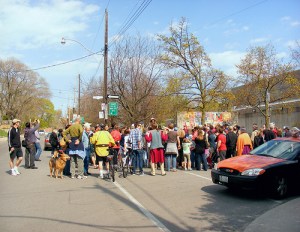
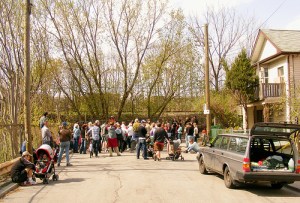
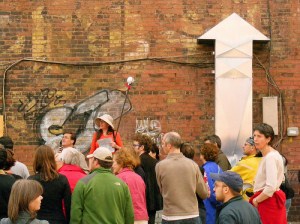
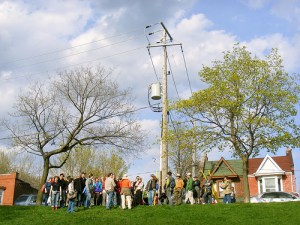
Greenwood-Coxwell Jane’s Walk

Sunday, May 3, 2009.
Photographs by Jeff Stewart (many thanks!)

To see the profile of this walk in the Globe & Mail by the Architourist, see here.

Leading a Jane's Walk, 2009

Leading a Jane

Discussing importance of community hubs and social institutions

Roden School: Discussing importance of community hubs and social institutions

Discussing community resiliency and social networks

Top of Craven Road: Discussing community resiliency and social networks

Discussing Robert Putnam's <i>Bowling Alone</i>

Gerrard Street Theatre: Discussing Robert Putnam

Discussing the buffering function of neighbourhoods

Greenwood Park: Discussing the buffering function of neighbourhoods

More photos, see reflex6002
Another Blogger’s perspective on the walk: ripple.ca
Demographic profile: Greenwood Coxwell

read more »