Posts tagged ‘Urban’

April 7, 2011

Saunders: The important functions of receiver communities (and how we get in the way)

Doug Saunders ARRIVAL CITY

Image by Jenn Farr via Flickr

Doug Saunders, author of Arrival City, spoke last week to the School of Public Policy and Governance at University of Toronto’s Munk Centre. His presentation flowed over description of the functions of communities which act as the first landing zones for urban migrants, describing the ambitions.

Arrival city neighbourhoods, or what are sometimes called receiver communities, are often found at the end of a transit line or in some other inaccessible corner of a city.  There, often a cluster of people from a similar place or the same village will have settled. In whichever urban area they are found, these are places of social mobility and change or they are places of failed dreams.

Having just returned from the Libya-Tunisian border for the lecture and book tour, Saunders began with “the Arrival City at the centre of the Arab Revolutions,” the neighbourhood of Bulaq in Cairo. It’s a place, he said, most people from Cairo would avoid. This was, though, the first neighbourhood into Tahrir Square for the rebellion against Mubarek. It had a history of such movements. Bulaq was a neighbourhood which, cut off from opportunities in the main parts of the city, had developed its own middle class, one which collided with the established Cairo middle class. It was, Saunders explained, a place of thwarted ambitions.

These receiver communities are found in the west, and the east, and the south, Saunder explained, like the French banlieux today at the edge of the capital; South Central Los Angeles, where the Hispanic residents have settled and invested in their new neighbourhoods; and Dhaka”s “place of the fallen” where the city’s “housecleaners, servants and prostitutes,” who serve the middle class, live. There are more, he said, like the “arrived overnight” neighbourhoods of Turkey, Brazilian favelas, and the neighbourhoods in Iran which fomented the 1979 rebellion. Saunders even described the historical neighbourhoods of 1789 Paris, where French villagers had settled, pushed there from the subsistence farming they had left behind, tipped quickly into early support of the French Revolution.

Receiver communities vary in their stability, but the trend of migration to urban areas is international.

Citing Professor Ronald Skeldon‘s work, Saunders explained how migration from rural to urban areas evolves from a rural family with an urban income source inevitably, although not always linearly, towards an urban family with rural roots. Education, he explained, is a key to this transformation.

It’s a mistake to see these places as static, as places which support a vital settlement function, Saunders said.

The state, Saunders explains, began to invest in these neighbourhoods after 1848 and into the 20th century. However, their role as places of transition is misunderstood, governments may interrupt or even damage their core functions.

We must think of these places as sets of functions rather than simply as locations, as places which, if they work well

  • foster networks, and act
  • as rural development support systems
  • as integration mechanisms,
  • as urban entry platforms,
  • as a social mobility channels, for the creation and distribution of social capital.

Within Toronto, Saunders has profiled Thorncliffe Park, but Parkdale, Crescent Town, Rexdale, or Scarborough Village could also all stand in. At one point, Kensington Market, or the Danforth, or Little Italy all served these functions, providing a landing place for city newcomers and now where social mobility has transformed them into desirable neighbourhoods. They are places where newcomers are able to get a foothold, and if it function correctly, connect to the rest of our city.

The drive for success is something North Americans, as the children of immigrants understand.

Saunders cited an example of how people from the same Turkish villages settled in Berlin and London and Istanbul with very different outcomes, because each of these areas offered different possibilities for integration. Understanding these complex dynamics can be challenging. Unlike the simplicity offered in a Millennial Village, it is harder to track the educational outcomes or the impact of remittances.

If an arrival city fails, isolation occurs.Rebellion bubbles up, informal economies thrive, and, as things worsen, crime, gangs and poverty emerge out of the “impediments to the natural ambitions” of these places. Protective conservatism can emerge, explaining how some immigrant communities are more conservative than the source villages from which residents emigrated. In another example, Saunders showed the audience pictures of a Dutch neighbourhood. Immigrants had settled here away from the city core, in low-rise apartments, where “it was easier to communicate with North Africa than with other Amsterdam residents.”

“It was a bottom rung, without the next two rungs,” Saunders said. So the grassy verges were converted, and the bottom floors of apartment buildings became retail and industrial working spaces. Densities were increased. It looked a lot like Spadina Avenue or New York’s Lower East Side, he explained. Regulations were pushed aside, and now they have become places where the rungs are visible, places which are succeeding. This Dutch neighbourhood has even created its own community police force, which includes a truancy patrol, unheard-of in laxer parts of the city.

Saunders warns that we are doing arrival cities wrong around the world. We need to do a few things to make sure these places work, he said:

  1. Start with the physical structures. As Jane Jacobs said, get planners and government out of the way of residents. Link these centres to other places. Transit is key to accesing the main city’s labour market, customers, and educational opportunities. Street lighting and home addresses raise property values (something residents monitor, he said, as closely as your average Torontonian obsesses over house values).
  2. Removing “bureaucratic” barriers is also key. Requirements for licensing hinder the emergence of small businesses. (The recent GTA Summit Alliance heard that 19 separate licenses and permits are required in Toronto to open a bakery.) Bureaucratic racism also hurts these communities. Black American settlements in northern states, for instance, had highways landed in the middle of their arrival cities.
  3. Citizenship barriers must also be lowered, not simply at the national level, but within the city. Postal code racism by employers is well-documented. If a large population of people sees no pathway to full citizenship, than they will see no reason to buy a house, to pay taxes, to send their children to higher education, because they see no future. Instead, newcomers will find a way to survive outside these structures, and sometimes outside the law. Countries, like Canada, have to be “very, very careful,” with reliance on temporary, foreign workers who cannot access full citizenship, Saunders warned.

Saunders concluded saying each of these have to be done in concert. No matter if it seems costly, Saunders said. Building the infrastructure to support them, including such basics as childcare, will save greater expenses later.

Arrival cities have the potential to be the next middle class or to be a continual source of problems.

His analysis and solutions, Saunders acknowledged, would be unsatisfactory to those people seeking a market solution and, also, to those looking to state actors to solve societal problems. It is, probably, why his solutions will work.

read more »

February 15, 2011

What’s important to you about community services in your Toronto neighbourhood?: City consultation open

The City of Toronto is looking for our help as part of the development of its Community Partnership Strategy. The Community Partnership Strategy is an  initiative that will help the City make sure that Toronto neighbourhoods have community services that work well for residents, and a strong community service sector to deliver them.

Together, with the Centre for Research on Inner City Health (CRICH) at St. Michael’s Hospital, they have gathered 50 ideas about the things that the City could pay attention to so that it knows how well community services are working for residents in Toronto neighbourhoods.

They are now asking Toronto residents, community service organizations, funders, businesses, and others to say which of these ideas are the most important. The City will use these opinions to help decide what work needs to be done to ensure Toronto has community services that work well.

Our input  is invited. There are three ways to do this:

  1. A researcher from CRICH can come to your organization and to meet with a group for about 30 minutes. They would explain the study and ask participants to fill out a short questionnaire and rate the collected ideas.
  2. Attend one of the two ‘open houses’ that being held:
  3. Participate online by sending an e-mail to smh.toronto.study@gmail.com for more information.

Participation is set to run from February 22, 2011 – March 15, 2011.

(My thanks to Sarah Rix for forwarding this to me.)

read more »

December 1, 2010

How scared should we be about bed bugs?

Adult bed bug, Cimex lectularius

Image via Wikipedia

Knowing I work at WoodGreen Community Services, which has been on the forefront of the bedbug issue for a while, a friend asked me how nervous she should be about going to a movie theatre that night.

Her fear sprang from the furor causes when a tweet wrongly accused Scotiabank Theatre of harbouring bed bugs and the widespread media coverage how the bugs are sweeping Manhattan’s toniest locations.

“Or how about subways and street cars?” she asked.

“Go,” I said. “If you’re nervous, strip off when you get home, bag your clothes and then launder and dry them.”

We are not (yet) at the point you have to stop going out into public spaces.

Some activities are riskier, such as

  • moving residences (especially if it’s into an apartment building — so make sure to ask),
  • travelling (check those head boards and mattress seams), or
  • picking up second-hand furniture off the street (no more boulevard shopping).

I still trust the Toronto Transit Commission – especially safe in the winter when most of its vehicles sit outside overnight, freezing. And I think movie theatres – and other entertainment venues – were so shaken by the Twitter furor, that I expect discreet inspections are done regularly.

The good news, this week, was the attention that bed bugs generated at the municipal and provincial levels. If we manage our own surroundings cautiously and if coordinated and proactive actions are taken, bed bugs will be well-managed.

A community bed bug committee, composed of residents, tenant associations, non-profits, government reps and broader networks recently adopted a “Bedbug Mani-pest-o” outlining five key points:

  1. Build a public education campaign to raise awareness on the rising incidence of bed bug infestations, the methods of dealing with them and to de-stigmatize bed bugs
  2. Establish standard protocols for treatment of bed bugs
  3. Develop and promote a consistent community response that includes funds to support vulnerable populations to reduce financial barriers to eradicate bed bugs
  4. Conduct widespread monitoring of bed bug incidences across the Province
  5. Draft and enact legislative policies that support quick and effective responses to bed bugs

Liberal M.P.P. Mike Colle has taken almost all of these and built them into his recommendations to the province, only shying away from the legislative piece.

N.D.P. Cheri DiNovo has introduced a bill to license landlords.

The Toronto Board of Health and the City of Toronto are both lobbying for more resources, arguing that early interventions will ensure bed bugs don’t spread further.

Solutions are emerging.

For the moment, we can sleep tight. Just don’t let the bed bugs bite.

read more »

November 17, 2010

Parking signs, parking tickets, pah!

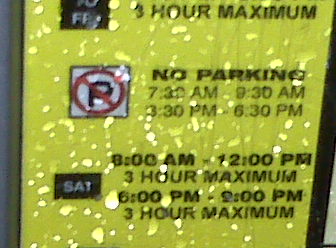
Hours for No Parking & Parking on a Meter

Parking signs drive me crazy. And, admittedly, as they say on Twitter, this is a #firstworldproblem. Still, I’m going to rant for a minute.

I’m a successful graduate of my high school, a college and two universities, and yet I gather with groups of my neighbours to study the parking signs in our neighbourhood, deciding when we should be moving our cars to the other side of the street or whether dinner guests really do have to leave within an hour.

Three signs

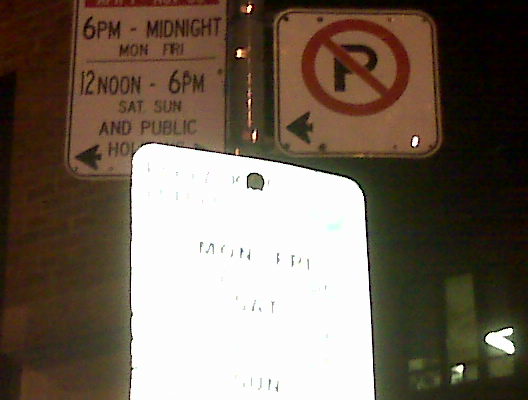
No Stopping obscured by parking sign

When I venture out into other neighbourhoods, where I may not find such friendly guidance, I run the risk of tickets, solo. Tonight, on a rainy night, I rushed down to Union Station to pick up my sister. I cooed to her that I had found a place to park, where at this late hour, I didn’t even have to pay the meter. We returned to a ticket – the area is a No Standing zone between 6 p.m. and midnight. That sign was obscured behind the larger sign commanding payment at the meter during the day. The row of us all had tickets. A quick Google search showed others had been hit the same way (and taken better pictures). Another fishing pond for tickets. Life in the big city, no?

A clump of signs

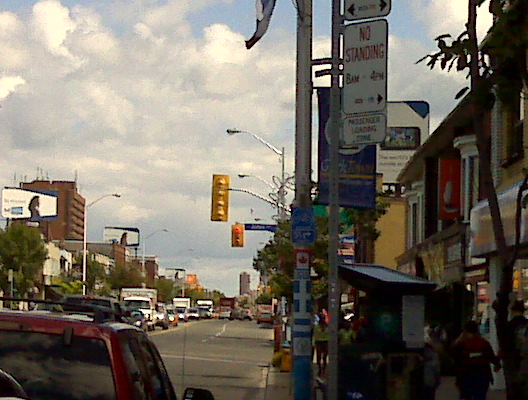
Parking meter under No Standing signs

My area in front of my workplace is particularly bad. There a parking meter sits under a set of signs that, if studied, reveal that, anywhere to the west of the meter, the exact direction in which it faces, it is a No Stopping zone every week day. However you have to read all four signs to learn that. Colleagues have stood there and debated with people as to whether park was allowed there. Close to $400 later, parking ticket in hand, they believe.

It’s rough out there. I found one travel website which gave this precaution about parking in Toronto — I should have listened:

PRECAUTIONS

If you are driving your own vehicle or a rental around Toronto, be very careful where you park. We found the parking signs on the streets to be a bit confusing, so opted to park in garages, which was much more costly.

I have full respect of the law. I just want/need to be able to understand it, if I am going to obey it.

read more »

September 24, 2010

Happy 2nd Blogday, Belonging Community!

Two years ago, Belonging Community began. As poet Dionne Brand has said, this is a city that is in the middle of “becoming,” and my hope was to think about Toronto from the level of a city block.

How can schools serve students better? What lives do our neighbours live? What does inequality look like at the neighbourhood level? How do local institutions affect our lives?

One hundred and two posts later, the Top Hits from the past year are:

Crime hotspots across Toronto neighbourhoods 2,992 More stats
Toronto Community Partnership Strategy: 443 More stats
About me 428 More stats
The Ontario HST: a counter-intuitive remedy 385 More stats
Ethnic enclaves in Toronto, 2001 – 2006 365 More stats
“Are there limits to gentrification? 333 More stats
The TDSB’s Learning Opportunity Index 323 More stats
Toronto swimming pools: Class in session 317 More stats
Community Partnership Strategy: NWI 265 More stats
Crime and social cohesion in Toronto 261 More stats
Defining race (and racism) in the TDSB LOI 243 More stats

Crime as you can see is big, with an average of eight hits a day. Other topics are popular because not many people are writing about them. My favourite pieces are less about these big policy pieces than the stories which emerge from living in an urban neighbourhood.

I have also appreciated the new community of bloggers, activists, and researcher that Belonging Community has introduced me to, people like Kevin Harris, Christopher Leo and Leo Romero. Sometimes too, I have even gotten a laugh. Three of the funniest (or strangest ways) people have found the blog recently are by using these search terms:

  • diane dyson emergency
  • ugliest areas of toronto
  • portland flag

Thanks all! It’s been a good year.

August 25, 2010

Community Partnership Strategy: Community Space

This is a long-delayed follow-up to some earlier posts on the City of Toronto’s Community Partnership Strategy which is currently under development and will measure community resources in neighbourhoods across the city.

Bonnie Green writes in the recent issue of the Agora Foundation’s The Philanthropist about the tale of two non-profit organizations in search of program space in their local communities. The article, Creating Social Space in the New Urban Landscape, captures the challenge many non-profit organizations and neighbourhoods face: a lack of community space.

Good neighbourhoods need more than services; they need the space to deliver these community programs and places where community can gather. Much of the challenge of delivering service in Toronto’s “inner suburbs” has been one of carving program space out of basements and strip malls in order to bring community services to local residents. These community spaces are the places where literacy and health programs are found, where sports leagues and seniors’ groups run, where we can access the services we need or where we organize and work with others, from and for our communities.

Good neighbourhoods also need places where neighbours can meet each other, spaces like front porches, school yards and parks, corner stores, coffee shops, places of worship, recreation centres, school yards, dog runs, and even sidewalks. These are the spaces where we can go, outside of our homes and work, where we can meet each other on neutral territory.

Academics describe both these kinds of community gathering spots as third places, and maintain that they are vital to the social fabric of a neighbourhood.

The website Cooltown Studios describes such places this way:

If you aren’t motivated to leave home or your workplace, chances are you don’t live around too many successful third places.

So, it makes great sense that the City of Toronto’s Community Partnership Strategy (CSP) proposes to use these third places as an indicator of the strength of the community support system within a city neighbourhood, combining it with two other structural components: the presence of community organizations, and funding.

The CSP’s definition of community space will measure “space for residents, informal groups, community-based organizations; meetings, programs, administration; multi-purpose [and] dedicated space.”

Two types of  measurable spaces have been identified: community meeting space, which allows informal and grassroots interactions, and community program space, which is more likely to be booked and permitted for service delivery.

Similar to the work of the Strong Neighbourhoods Taskforce, the measure could also include the percentage of the population with one kilometre of meeting space, such as in libraries, recreation centres, and community-based organizations.

However, the CSP is more than an inventory of local resources. In consultation with community, city staff are exploring the “when is enough, enough” question to answer what benchmarks would work: how much space is needed in a neighbourhood and what functions does it need to fill? How do the needs of various neighbours differ? What’s the baseline requirement for any neighbourhood?

Not enough research — or policy-wrangling — has been done to determine these answers yet, so the early stages of the CSP are more likely to provide an effective way of comparing Toronto neighbourhoods to each other. Now, thanks to the CSP, that conversation will have a good evidence base.

June 12, 2010

Cynthia’s Walks

On Cynthia’s passing: It was peaceful. She was surrounded by family. And it was too soon. “Damn, damn, damn.” Her memorial has been set for September 11th, 1 p.m. at St. John Norway.

She had a long stride, so she moved fast. It’s the way I remember Cynthia, arms swinging, backpack on one shoulder.

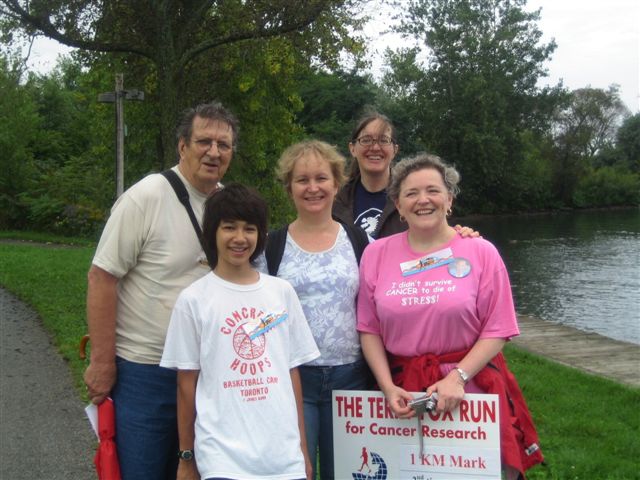
Neighbours at the 2009 Terry Fox Walk

Cynthia’s wearing her Breast Cancer T-shirt on the Terry Fox Walk. We were walking for another dear neighbour.

We walked a lot, me less eagerly, hoping instead to sit on her couch, she striding ahead, explaining that she couldn’t walk slowly. There were the shopping trips, brisk evening walks with other neighbours, and longer fundraising walks. Always walking.

When Cynthia heard about the first Jane’s Walk, she said, “We should lead one in our neighbourhood.” She had already talked to the head of a local community agency. I was working, at the time, at United Way Toronto on issues around building strong communities. But, as a researcher, stepping out in front was not my first inclination, so I demurred, offering only to speak at one of the stops. That first walk became Ashbridges to Little India. The next year, Cynthia and I led a group of forty through a torrential rain, stopping at the Mahar Restaurant for chai and samosas that Cynthia had arranged through the local BIA.

Cynthia Brouse, award-winning magazine writer, editor and my friend and neighbour for nearly fifteen years, I was proudest of a Toronto Life piece for which she hadn’t won an award: Indian Summer, the story of living in our east-end neighbourhood. (She was kind enough to omit the story of our first meeting, when, toddlers in tow, I had brushed her off and, instead, she included a quixotic story about my son and I dancing with a sparkler. And about how “dense, multiplex networks” function.)

Last year, our Greenwood Coxwell walk gained some profile, being written up by a Globe columnist, but Cynthia wasn’t well enough to lead the walk again with me. Her breast cancer had returned. Another neighbour, a historian, stepped in graciously to help, and Cynthia came to listen this time, her mother pushing her wheelchair.

However this year, within days of the annual walk, Cynthia said good-bye to her home and, for the last time, has been admitted to hospital.

Still, we talked about this thing we had joined together, this celebration of neighbourhoods, and the convergent theme of neighbourliness. I told her how this year the walk had grown again. Crazily, I had decided to do two walks, a reprise of our earlier ones and a new one I had thought up. And, crazily, two new walks had sprung up in the neighbourhood, led by others!  (The media coverage also grew with a Spacing radio podcasts of my walk and of Jane Farrow’s east end tour and also a CBC interview on Fresh Air about Jane’s Walks across the province which profiled our neighbourhood.) Our conversations had taken a life of themselves.

These ideas of local community, social networks, neighbouring, how we manage, or how we come to rely on each other, these themes were what Cynthia and I considered, continuously, until the end.

Earlier this spring, when things looked pretty gloomy, I joked with Cynthia, “I’ve had enough of sick and dying neighbours.”

Looking at me steadily, she said, “You will be happy again.”

Now, I remember that, and I imagine her offering me a cupcake to enjoy — because we can always walk it off.

read more »

April 1, 2010

Social spaces of apartment-dwelling children

Vertical Living Kids, a new report out of Melbourne, Australia, got a lot of international media play today. Researchers Dana Mizrachi and (former Montrealer) Dr. Carolyn Whitzman look at how children living in apartment buildings interact with their surrounding environment. Mizrachi and Whitzman pursued this question because, like most urban apartment buildings, these homes were not designed with children in mind.

The preliminary report focuses on forty children, aged 8-12, living in public and private market apartment buildings over three stories tall. Children’s excursions were tracked using GPS devises, travel diaries and surveys of parents. Mimicking Photovoice methodologies, the children also used cameras over the course of a week to document parts of their neighbourhoods which they liked and disliked.

The children described their sense of ownership of public space, their comfort travelling across neighbourhoods and using public transit. Children in private and public housing showed some parallels (social natures of excursions) and some differences (range and proximity of areas visited). The researchers found all the children raised “legitimate concerns about amenity and maintenance” of these spaces.

More than half of the children in public housing complained about quality of the play areas, yet none felt comfortable enough to range further. For instance, the report describes

None of the 13 children we interviewed in Carlton housing estate walk 500 metres to Carlton Gardens, with its large and new adventure playground and the Melbourne Museum, both of which are free to children. Instead, they cluster in the rather tired playground equipment on their public housing estates and play in the leftover spaces between residential buildings.

In contrast, children in private market housing were more likely to list greater access to a broader range of play spaces, including pools, tennis courts, skate parks, commercial enterprises, and public libraries. Those who live further from school were more likely to feel isolated from their immediate neighbourhood and so, perhaps, were more likely to travel.

One of the principal findings of the study was how children viewed dedicated/designated play areas: for many of them, the attraction of these spaces is the presence of other children rather than the equipment provided. Playgrounds, playing fields and such places are primarily social spaces for children, and the authors recommend, rather than being hived off from the broader community, should be designed as such.

Mizrachi and Whitzman’s study is particularly relevant to Toronto urban planning for two reasons: One-third of our city population live in such apartment buildings and, two, the critique of many newly-built condominiums that are not child-friendly.

read more »

March 1, 2010

TDSB Achievement Gap Task Force

Update June 1, 2010: The Achievement Gap Task Force has released its draft report for review and consultation. Comments will be received until Oct. 31, 2010.

Dr. Chris Spence, the Director of of the Toronto District School Board, has a vision, a Vision of Hope. It’s hit a few bumps, knocked for proposing of a boys-only school and skewered by a trustee, in the media, for doing teacher P.D. in a sports arena.

Still Spence has set some hard targets.

An important part of the Director’s vision around student achievement focuses on building effective schools, as described by Ron Edmunds 30 years ago. Edmunds, Lezotte and others laid out a framework containing the following elements:

  • Clear and Focused School Mission
  • Safe and Orderly Environment
  • High Expectations
  • Opportunity to Learn and Time on Task
  • Instructional Leadership
  • Frequent Monitoring of Student Progress
  • Positive Home-School Relations

But as the saying goes, coming up with the idea is the easy part. The hard part is the administration of it.

So, working on a tight timeline, Spence has set Lloyd McKell, the Executive Officer of Student and Community Equity, to work with an internal staff team to look specifically at the underachievement of racialized and marginalized students.

The taskforce will report to the Board, through the Director, in April. The workload is daunting, including a literature review, a survey of current school programs and public hearings. The hearings are set for March 6. (See More below, for further details.)

A cynic would wonder why they are doing it. Do we really need another study?

As a student of Edmonds, Spence must understand that the first challenge is creating the political will. In Some schools work and more can, Social Policy (1979), Edmonds wrote:

Whether or not we will ever effectively teach the children of the poor is probably far more a matter of politics than of social science, and that is as it should be. It seems to me, therefore, that what is left of this discussion are three declarative statements:

(a) We can, whenever and wherever we choose, successfully teach all children whose schooling

is of interest to us;

(b) We already know more than we need to do that; and

(c) Whether or not we do it must finally depend on how we feel about the fact that we haven’t so far.

So what remedies might we begin to consider? Our ideas must move beyond platitudes and be specific.

Speaking recently at OISE, Linda Nathan, a principal from an innovative arts school in Boston’s inner city, provided some insights into producing a strong urban education. She explains the problem is not one of an achievement gap, but of opportunity.

In her book The Hardest Questions Aren’t on the Test (Howard Gardner of Multiple Intelligences writes the jacket blurb), Nathan prescribes school administrators:

  • Develop a clear strategy, for students, parents, and teachers, of active engagement and ownership of the educational process.
  • Investigate the possibilities of incorporating, for example, an arts-based, science-based, or technology-based curriculum
  • Require a rigorous Senior Project that successfully reflects academic and non-academic learning as well as addressing a community need, recognized and documented by the student.
  • Build an assessment system that doesn’t determine student achievement and knowledge exclusively through the results of standardized tests.
  • Mandate paid time for teachers to talk about their practice and their students, and struggle with difficult questions.
  • Advocate for our public schools to equalize educational facilities, expand curricular opportunities, and reduce class size to match our best schools, this providing every child with the necessary education and skills to participate productively in our democratic. This necessarily costs more money!

Within a few months, we’ll see how the TDSB and Torontonians respond to the challenge of providing a good education to all its children.

read more »

February 5, 2010

Majora Carter on "greening the ghetto" and gentrification

Majora Carter came to attention of many on TEDtalks. Explaining her connection to her community, she provided a strong voice about reclaiming the Bronx.

Last spring, she made a splash here in Toronto, making the rounds of City Hall, university circuit, and the media. People came to hear how she and her neighbours rebuilt their community so that their environments were healthier and the local economy supported the aspirations of those who lived in these low-income communities of colour.

This week, Travis Smiley interviewed Carter in a radio bit called Greening Harlem.

Like Jane Jacobs, another New Yorker before her, Carter calls for gentrification and the creation of mixed-income neighbourhoods. The riches change the neighbourhoods where she lives and works. It’s an unidealized perspective on a tough issue in urban neighbourhoods.

Explaining the importance of environmentalism and connection to the land in an urban environment, Carter explained straighforwardly, “If you drink…if you eat food, if you walk and breathe, you are an environmentalist.”

If you haven’t heard this Black woman speak, seen what’s she’s done, take a moment.