Posts tagged ‘City of Toronto’

January 8, 2010

Toronto Community Partnership Strategy: Priority Neighbourhood Areas revised

What if we could measure the quality of a neighbourhood — systematically assess what’s missing and what’s in place? How could we use that information to ensure each community was strengthened?

Over the past year, City of Toronto staff and invited community members have worked to develop such a tool: that is the Community Partnership Strategy (CSP) [as described, a year ago, in one of the first posts on this blog]. The new strategy, if adopted when presented in the spring to Council, will allow all of the city’s 140 social planning neighbourhoods to be assessed across a range of domains so that priorities for supporting each neighbourhood can be set.

The City of Toronto set out to develop such a tool because, as Chris Brillinger, Director of Social Policy, explained at the end of November during cross-city consultations, “One weak neighbourhood affects us all.”

And more bluntly, he explained, the CSP will help to address when enough is enough, a question raised by Council members who push back at the seemingly continual call for additional community funding. The adoption of the CSP will allow a more systematic response to that question.

Community agencies are interested in the development of this new strategy because of the way the focus on Priority Neighbourhood Areas (PNAs) has funnelled funding into the 13 city areas since 2005. The PNAs created a rush to funding, as agencies followed the dollars and moved into these admittedly under-served areas. Brillinger reassured the crowd about the scope of this exercise, “Moving services from one part of the city to another is not on.”

As a place-based intervention, the PNAs made sense, leveraging scarce resources to address complex problems. As a long term strategy, PNAs are a recipe for starving the rest of the city — and other areas with high needs.

Under the proposed strategy, “focus neighbourhoods” would be identified according to marginalization of the neighbourhood and its residents, the [lack of] structures in place to support them, and the availability and capacity of local services.

The overall strength of the system would be assessed on the following areas:

  • Community Organizations
  • Community Space
  • Connectedness
  • Reach
  • Adaptability
  • Resources

(In future posts, I’ll look more at each of these areas in more depth.)

By looking at the strengths and weaknesses of every neighbourhood, the new CSP will allow a broader analysis of needs across the city. So, for instance, the areas with the highest unemployment rates or the poorest access to food can be identified, or the top ten neighbourhoods deserving youth programming can be threshed out from the top ten requiring additional seniors’ services. Each of these maps may be different,  but they will allow more targeted programming to be delivered where it’s needed.

read more »

November 29, 2009

Bed Bugs: A call for action in Toronto

The reports are in: bed bugs aren’t just found in nursery rhymes.

In case you missed the media hyperbole a few weeks ago, it was stunning. The National Post led with the story of the spread of bed bugs on transit vehicles and other public spaces. CBC’s The National covered the release of the two reports, released simultaneously, at Toronto City Hall. A section of the print story on the CBC website was subtitled “psychologically terrorized.”

The stories reflected the panicky mood of the 100+ crowd who attended the launch of the reports, commissioned by Habitat Services and WoodGreen Community Services.  Many of those in attendance felt compelled to speak from the floor after the presentation, and boxes of reports disappeared by the armload.

The two bed bug reports focus on the policy responses required to combat the spread of bed bugs and, also, on what to do if you are battling the pests.

The message was clear: bed bugs are back. Toronto Public Health has already agreed to direct some of its scarce resources to low income residents faced with the high costs of extermination.

Both reports are available on the WoodGreen website in the What’s New section. [Full disclosure: this is the agency where I work.]

November 1, 2009

Mixed picture on mixed income: Moving in on poor neighbourhoods

Early one morning this week, I drove a neighbour (and, of course, friend) to a downtown hospital for a medical test.

We were distracted from the quiet between us by the car radio. CBC’s Metro Morning was broadcasting from Regent Park, the downtown neighbourhood with a scope of need that is almost double any other part of the city. We zoomed right through it, along Shuter Street.

Metro Morning was exploring the community’s revitalization. The first stage was underway, and 1 Cole Place, the new condominiums, were opening. The morning’s interviews demonstrated the deep history and vitality of the neighbourhood and, also, the new interest that has been sparked in the community.

As I drove back home alone, I decided to stop the car and go watch the broadcast from Nelson Mandela Park school.

Host Andy Barrie was the efforts to create a mixed income neighbourhood in Regent Park. He was interviewing a young University of Toronto doctoral student and Trudeau scholarship winner, Martine August, and long-time resident and community organizer, Sandra Costain, about the impact of the looming arrival of higher income residents (and their homes).

It was a sobering interview, one which just whet my appetite. August cited studies from her literature review, and Costain concurred from experience, but they both painted a gloomy picture:

  • People segregate themselves according to their separate identities. In 14 studies August looked at, interactions between higher-income newcomers and lower-income residents show that interactions don’t occur.
  • Very often when people of higher incomes do move into a poorer neighbourhood and exercise their political muscle, it’s to push social services, which low income people need, out.
  • Community programs which were universal, free to local (low-income) residents begin to require documentation of need, fees introduced, and stigma grows.

What was left unsaid in the short interview is what might mitigate these colonizing forces.

For instance, in his work in school, Clyde Hertzman found that children from poor families did better when in a mixed income school. He attributed that to the “sharp elbows of the middle class,” which act to protect a full range of services.  By extension then, those who buy homes in a poor area need to see further than their property values, but to a common good.

Discussing this electronically with Brian Eng at the Wellesley Institute afterwards, he said that this tendency of mixed income neighbourhoods to push out poor people further underscores the importance of community development.

Eng gave the example of the co-ops around the St. Lawrence Market as a good example of a mixed income community that works. In fact, commentators on CBC’s website, gave the example of the Woodsworth Coop, in the same area, that has monthly business meetings to discuss community business, shared common task (such as cleaning) and regular celebrations with food.

Where opportunities for interactions are created and fostered, stronger communities emerge, a place with, as one American social justice organization called for Better Neighbourhoods, Same Neighbours.

read more »

October 17, 2009

Toronto's emotional map running hot & cold

Kevin Stolarick, Richard Florida’s “stats guy” at the Martin Prosperity Institute has been up to a bit of mischievous mapping in his spare time.

Using data from a UC Berkeley psychologist who publishes the Big Five Personality Test , Stolarick has mapped out the major emotional of characteristics of Toronto residents by neighbourhood (probably Forward Sortation Areas – the first three digits of a postal code).

The Toronto Star published the maps today: Toronto the Good – and bad and sad and mellow and … .

It’s a relief to see some maps that break the traditional “U” and “O” deprivation patterns. West-enders are extroverted, east-enders are neurotic. Suburban areas tend to be more agreeable, while those along the subway lines are less so. Most of the city is the conscientious type. Those closer to the lake tend to be more open to new experiences.

Now, because the survey is web-based, Stolarick says the sample is probably skewed towards the young (and tech-savvy), but it certainly is a bit of fun!

October 4, 2009

Overheard at the SPT Symposium

Late arrivers had to sit along the steps in the auditorium at New College/U of T. Ed Broadbent led off Social Planning Toronto‘s Building the Future We Want symposium. Chief economist at the TD Bank Don Drummond sat in the second row, his session and chance to answer was up next. Potential candidate for mayor of Toronto Glen Murray was scheduled to finish at the end of the day.

It was the place to be. Registration had had to be cut off. Organizers were also wise enough to schedule long breaks so that registrants could network. {Shameless ad inserted here: If you haven’t become a member of the newly re-branded SPT, you should.}

I couldn’t stay for long, but even the few morning hours I attended yielded some great quotable quotes. Here’s two:

  • “Everybody’s talking about community hubs within their own silos.”
  • “David Frum is my favourite Canadian export.” (okay, Broadbent said this in his speech.)

What did you hear?

October 1, 2009

David Crombie on neighbourhoods and belonging

Quick notes from David Crombie, the former mayor of Toronto, speaking at the WoodGreen Community Services’ annual general meeting tonight:

Someone wise once said there are three questions everyone has to answer:

    1. Who am I?
    2. Where do I belong?
    3. How do I behave?

Neighbourhoods are where we do that.

Crombie also took a moment to reflect that he is the same age as the agency itself, 73 years old. Evoking the issues the agency faced at its start, Crombie reminded the crowd of  its founder Ray McCleary’s rallying call in the 1930s, “We need to reduce the power of poverty.”

Ever so. The work goes on.

September 24, 2009

Crime hotspots across Toronto neighbourhoods

(October 29, 2012 Update: CBC release of police crime data by type and neighbourhood)

Today, Stats Can released a hot product: a report on crime in Toronto.  Even though we are one of the safer metropolitan areas on the continent, Neighbourhood Characteristics and the Distribution of Police-reported Crime in the City of Toronto is sure to draw some attention.

Produced by Mathieu Charron at the Canadian Centre for Crime Statistics, the report looks at the location of reported crimes and the characteristics of the neighbourhoods in which they occurred.

The data, drawn from Statistic Canada’s Uniform Crime Reporting Survey (UCR)  “reflect reported crime that has been substantiated by police.” 106,175 incidents were clustered and mapped across the city.

The reports differentiates between violent crime and property crime, finding different correlations. The pattern shows that low-income and nearby neighbourhoods are more likely to suffer spillover effects.

Dividing crimes into violent and property ones, the report found:

  • Neighbourhoods with higher violent crime rates tend to have less access to resources. Education level of residents was one of the best predictors of such access.These neighbourhoods also tended to be “densely populated and have a higher percentage of residents living in multi-unit dwellings” (the tall towers which are the focus of the Mayor’s renewal efforts.) These neighbourhoods are also more likely to have more children, more single-parent families, more renters, and more people of colour.
  • Property crime (theft, break & enter) is concentrated around shopping centres, both large and small, in commercial districts, and in neighbourhoods around these places. Areas with high levels of education or a high portion of manufacturing and office jobs were less likely to report property crime.

Criminologists recognize the spatial patterns of crime. Crime comes in hot spots around the city. Mapping out various criminal activities, the report’s spatial crime patterns follow the same deprivation “U” which marks less privileged areas of the city. Densely populated cores, transportation and shopping hubs, which all draw large numbers of people, tended to report higher crime rates.

The report does not rank or rate specific neighbourhoods, however it did describe “some hot spots…Danforth, downtown east side, and the intersections of Lawrence and Morningside, Jane and Finch, and Jane and Eglinton.”

Here, for those who like the gory details, is what I could see on the maps. The highest levels of crime clustered in the following places:

  • Breaking & Entering: Downsview, Bridle Path, Lawrence Park,Don Mills
  • Drug offense: Jane-Finch, York, Dufferin Grove, Parkdale, New Toronto/Mimico, Trinity-Bellwoods, Regent Park, Greenwood- Woodbine, Crescent Town, Birchcliff, Cliffcrest, Scarborough Village, Kingston-Gallow, Woburn.
  • Major Assault: Jane-Finch, Jane-401, York, Downtown west & east, Lawrence-Kingston Road.
  • Minor Assault: Rexdale, Jane-FinchDownsview, Jane-401, Dufferin-Bloor, Parkdale, Don River-Gerrard, Danforth, Kingston Road, Woburn, Malvern
  • Mischief:  Riverdale, Cabbage Town, York, Morningside/Highland Creek.
  • Motor Vehicle Theft: Etobicoke, Scarborough (where car ownership rates are higher)
  • Robbery: Rexdale, Jane-Finch, Jane-Sheperd, York, Danforth, Woburn
  • Sexual Assault: Rexdale, Jane-Finch, Jane-401, High Park, Bloor-Danforth, Kingston Road
  • Theft: Dispersed along waterfront and main roads
  • Theft from Motor Vehicle: Pearson Airport, Willowdale, High Park, Downtown (west & east), Riverdale, University of Toronto, Scarborough

In contrast, the city’s financial district and the north end of Yonge Street were identified as areas with lower rates of violence. In essence, the central neighbourhoods of the city are higher-income and safer areas, while neighbourhoods with poor physical infrastructure and social resources were more likely to have higher levels of police involvement.

So, the final word probably best belongs to Canadian housing activist Michael Shapcott who wryly noted in his Twitter feed about the study, “Plenty of crime in rich, white neighbourhoods (fraud, tax cheating, ‘white collar’), it just doesn’t get policed/reported.”

read more »

July 18, 2009

Mapping jail and university admissions

The results are in from the stellar Toronto Star team again. This week-end, they released two sets of maps, in many ways the obverse of each other:

The latter map is the result of a court order, as described in a previous post and a strong contribution to  the argument for place-based interventions. Our thanks to them.

The maps looking at university admissions also support the work being done by the Toronto District School Board’s researchers who have mapped university applications and other academic indicators by neighbourhood.

These unsettling maps lay how applicants to one of the most prestigious universities in Canada live in different worlds than the the places where people are being jailed. Opportunities are literally mapped out.

The co-incidental (?) and simultaneous release of maps is evocative of the statistic that, in many American inner cities, there are more young men in jail than in college or university.

I’ll look at more of the details in these maps in another post.

June 1, 2009

2006 Toronto demographics

Map of Toronto

Image via Wikipedia

If you are feeling like a real demographic data geek, you’ll enjoy this presentation titled, Demographics of Toronto: A visual presentation of population sub-groups. It was assembled for a Toronto consortium meeting of the Canadian Social Data Strategy by Harvey Low, the City’s planning analyst who convenes the group of community agencies and city divisions.

Topics include 2006 census variables on population and age variables, immigration, and income. There is also a draft of a “mosaic indicator” to measure diversity and the degree to which Toronto neighbourhoods are ethnic enclaves.

If you are looking for more specific data, take a look at the links on the side of this blog. They include links to a range of sites. Particularly interesting is the City of Toronto’s Toronto-wide and neighbourhood level data across a range of domains.

read more »

May 6, 2009

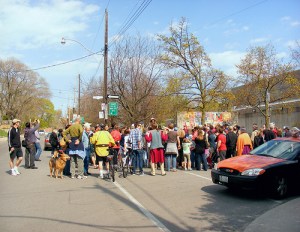
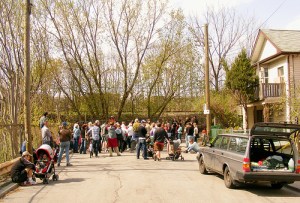
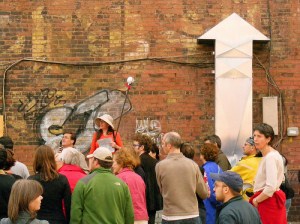
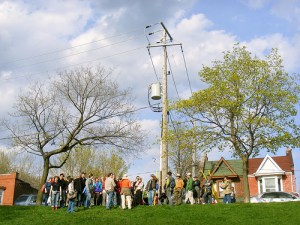
Greenwood-Coxwell Jane’s Walk

Sunday, May 3, 2009.
Photographs by Jeff Stewart (many thanks!)

To see the profile of this walk in the Globe & Mail by the Architourist, see here.

Leading a Jane's Walk, 2009

Leading a Jane

Discussing importance of community hubs and social institutions

Roden School: Discussing importance of community hubs and social institutions

Discussing community resiliency and social networks

Top of Craven Road: Discussing community resiliency and social networks

Discussing Robert Putnam's <i>Bowling Alone</i>

Gerrard Street Theatre: Discussing Robert Putnam

Discussing the buffering function of neighbourhoods

Greenwood Park: Discussing the buffering function of neighbourhoods

More photos, see reflex6002
Another Blogger’s perspective on the walk: ripple.ca
Demographic profile: Greenwood Coxwell

read more »